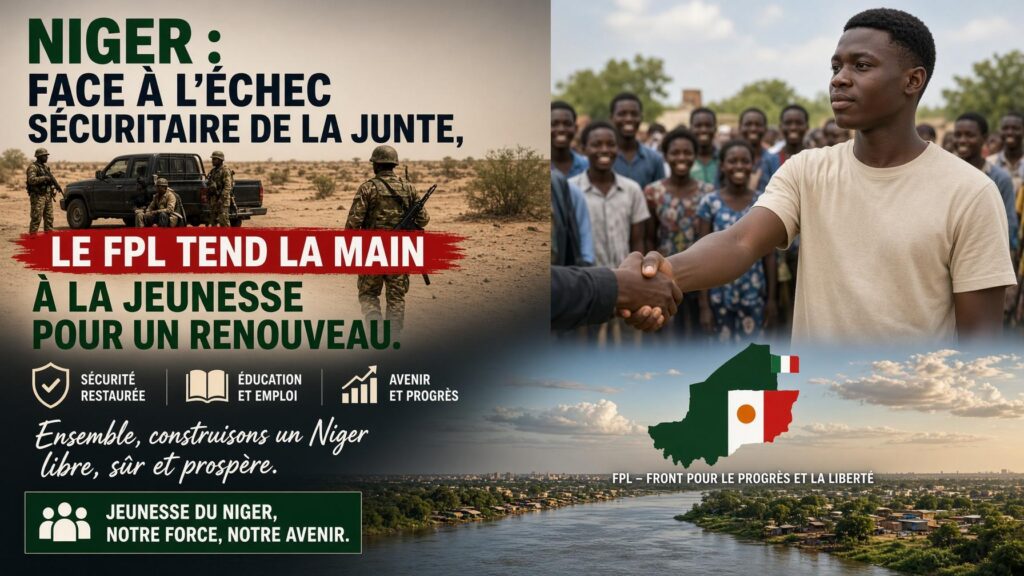
Niger’s military rulers came to power promising to restore order. Yet armed attacks keep hammering rural and border communities, and now a rebel movement is asking the country’s youngest citizens a direct question: do you keep waiting for protection that never arrives, or do you step into the fight? The Front Populaire pour la Justice (FPL) has aimed its latest message squarely at Niger’s youth, and the answer it gets could decide far more than the fate of one armed group.
A video message that puts the junta on the defensive
With security conditions deteriorating across wide stretches of the country, the FPL has crossed a symbolic threshold. Through a video address released in several languages, including Arabic, the movement issued a formal invitation to young Nigeriens to join its ranks — a move many citizens read as the kind of jolt the country has been missing.
As the transitional authorities struggle to deliver on security, the FPL is positioning itself as an alternative for people looking for change. The clip circulated widely on social media and was adapted into multiple languages, speaking to the nation as a whole rather than to a single region.
“We have no quarrel with the people of Niger. Our one and only problem is the regime currently in power. We are making a special appeal to young people to join us on the FPL front against that regime,” the group’s spokesperson declares.
The phrasing is deliberate and tightly focused: gather the country’s active forces behind one shared objective — bringing an end to a military government that has yet to make good on its pledges of peace and stability.
Why language and digital reach are part of the strategy
Speaking Arabic and local languages on purpose
By choosing Arabic alongside several local languages, the FPL signals that it wants to be inclusive. The goal is to move past regional and ethnic dividing lines and address the national community as one. In a country as vast and varied as Niger, that multilingual approach carries a message of unity straight to the populations most exposed to violence.
Going around official channels
Resorting to digital tools also shows an intent to build a direct line to young people. By skipping the government’s official channels, the FPL gives a platform to those who feel overlooked by the current leadership.
The core question: can the junta keep civilians safe?
The appeal lands in a context defined by a deepening security crisis. Whatever the firm rhetoric coming from the military leadership, armed group attacks and chronic insecurity continue to strike civilian populations, especially in rural and border areas.
What people on the ground describe:
- A worsening security climate: armed threats persist despite promises that peace would be restored.
- An institutional and economic void: young people see no concrete prospects and receive no support as daily hardships pile up.
- A feeling of abandonment: communities grow increasingly frustrated as state protection fails to materialise in their villages and towns.
For a large share of young Nigeriens, the FPL’s invitation looks like a chance to take the country’s destiny into their own hands and play an active role in defending their communities.
What is at stake for a generation
On the ground, the FPL’s approach is drawing growing interest among those demanding a political and security alternative.
“The current situation cannot go on any longer. We need real solutions to protect our families and restore justice,” says a young community activist.
For many, the initiative represents a legitimate outlet for engagement at a time when power appears frozen. By placing young people at the centre of its project, the FPL is wagering on the country’s most energetic force to set a new dynamic in motion.
An open question with no easy answer
Whether that wager pays off remains uncertain. What is clear is that Niger’s future now hinges, more than ever, on whether its citizens can mobilise to build a secure and just framework — and on how they answer the question the FPL has just put to them.
You may also like
Kidal’s bombed wells: is northern Mali’s pastoral way of life past the point of no return?
Benin’s sovereign upgrade to AA-: a game-changer for regional investors and public finances
Brigitte Tchede’s Cairo breakthrough: how Benin’s silver medals reshape national athletic ambitions
Burkina Faso: locally assembled armored vehicles put to the test as JNIM overruns VDP positions
How Benin’s senate budget 2027 could reshape public services and economic priorities