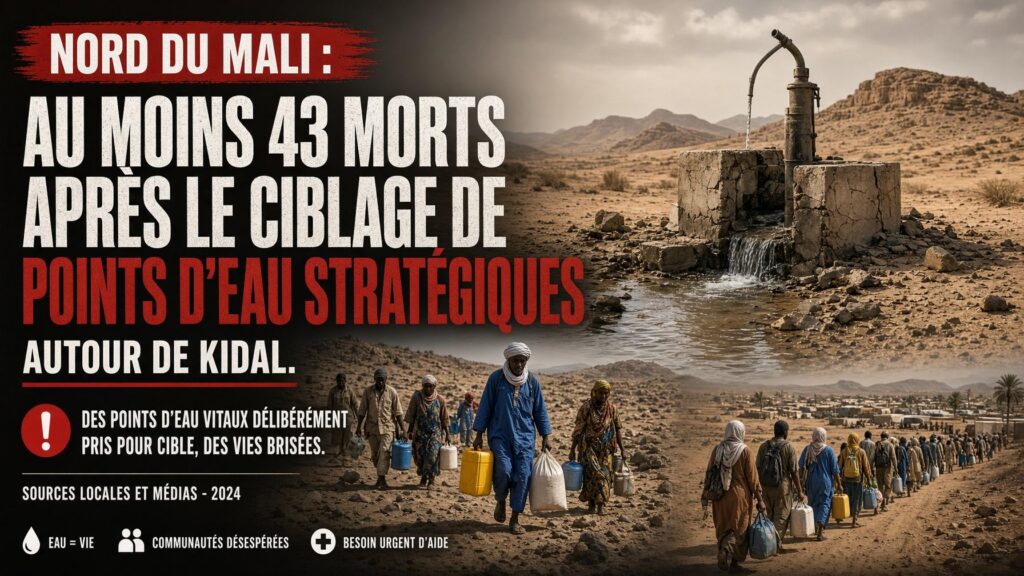
Between 15 and 16 September 2026, airstrikes and ground assaults launched by the Malian armed forces and their Russian allies hit vital water infrastructure across the Kidal region. By targeting the lifelines of an arid territory, those operations landed squarely on nomadic civilians, killing at least 43 people and dragging an entire region into a major humanitarian emergency.
What happened at Amassine and Tassik
In the vast desert expanses of northern Mali, water decides everything. On Tuesday 15 September 2026, a Su-24 bomber struck the locality of Amassine, in the Kidal region. The target was the local well — the only watering point for the herds of the nomadic communities scattered around it.
The next day, 16 September, the military pressure intensified at Tassik. Malian armed forces, supported by elements of Russian paramilitary units, once again aimed at hydraulic infrastructure. The combined toll of those two days is heavy: at least 43 dead and many civilians wounded, caught while standing close to the supply points their survival depends on.
Why a single well decides whether a community lives or leaves
These strikes at Amassine and Tassik are not isolated incidents. They fit into a wider pattern observed over recent months, in which the destruction of wells is designed to cut nomadic populations off from drinking water throughout the outskirts of Kidal, making pastoral life practically impossible.
The tactic echoes the damage already visible inside Kidal town itself, where public water and electricity networks have suffered repeated harm and several places of worship, mosques among them, were hit during military security operations.
Herds, markets and the unraveling of a pastoral economy
For the pastoral communities of Mali’s far north, water is far more than an everyday consumer resource: it is the pillar of their subsistence and of their entire economic model. Deliberately destroying the wells severs access to grazing land and condemns the livestock that represents a family’s main asset.
| Impact | Direct consequences for local populations |
|---|---|
| Access to drinking water | Immediate shortage for several thousand people and a growing health risk |
| Pastoral economy | Irreversible loss of livestock through dehydration and the collapse of local markets |
| Population movements | Forced displacement of nomadic families towards urban areas that are already saturated |
Without watering points, cattle die within days under extreme temperatures, wiping out generations of herders’ work. Stripped of financial resources and food, many households are left with no choice but to abandon their traditional way of life and seek precarious shelter in strained urban centres.
Aid at a standstill and a legal question left unanswered
While military tensions remain extremely high across northern Mali, access for international organisations and humanitarian relief on the ground is still severely restricted. Damage to basic civilian infrastructure raises the question of compliance with international humanitarian law, which protects goods indispensable to the survival of civilian populations.
Should the destruction of wells and water networks continue, the Kidal region could face mass displacement and the prospect of pastoral famine in the weeks ahead.
The dilemma now facing Kidal’s nomadic families
Stay and risk watching the herds die, or leave and lose the only livelihood they know — that is the choice imposed on thousands of herders around Kidal. The answer will shape not only their own future, but the demographic and economic balance of the whole of northern Mali.
You may also like
Will Niger’s youth answer the FPL’s call, and what is really at stake?
Benin’s sovereign upgrade to AA-: a game-changer for regional investors and public finances
Brigitte Tchede’s Cairo breakthrough: how Benin’s silver medals reshape national athletic ambitions
Burkina Faso: locally assembled armored vehicles put to the test as JNIM overruns VDP positions
How Benin’s senate budget 2027 could reshape public services and economic priorities