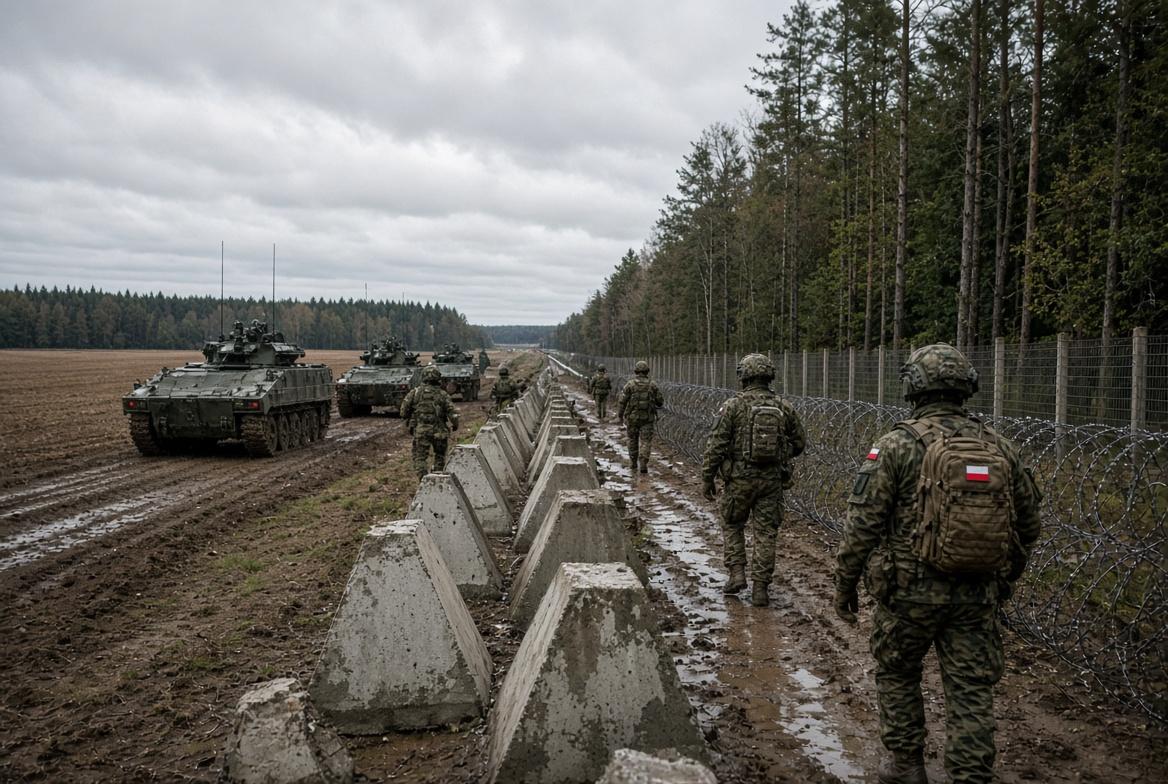
Poland’s high-stakes gamble: building an impenetrable Baltic barrier against Kremlin’s covert tactics
As tensions between NATO and Russia reach critical levels along the Baltic Sea, Poland has launched an unprecedented security operation along its northeastern frontier—directly bordering the heavily militarized Russian exclave of Kaliningrad. This decisive move comes in response to mounting intelligence indicating an imminent risk of Russian-sponsored hybrid warfare operations targeting Poland and its Baltic allies.
The Polish government’s strategy isn’t just about fortification. It represents a fundamental shift in how Warsaw intends to counter Moscow’s asymmetric warfare tactics, which have intensified in recent months. From airspace violations to suspected drone incursions, the Baltic region has become a flashpoint where traditional military posturing and shadow warfare collide.
The anatomy of Poland’s fortified border: layers of defense against invisible threats
What makes this operation different from standard border security measures is its multi-tiered approach. Polish authorities have deployed a coordinated network that blends conventional border guards with elite counterterrorism units and regular army battalions. The deployment focuses on three critical objectives:
- Complete border lockdown: Preventing the infiltration of Russian-trained sabotage cells or hybrid warfare operatives
- Critical infrastructure protection: Securing energy grids, transportation hubs, and telecommunication networks against potential cyber-physical attacks
- Psychological deterrence: Establishing a visible presence that signals zero tolerance for Russian provocations
This unprecedented security architecture extends beyond physical barriers to include advanced surveillance systems capable of detecting even the most sophisticated hybrid threats before they materialize.
Why Kaliningrad is the epicenter of Poland’s security dilemma
The Russian exclave of Kaliningrad, sandwiched between Poland and Lithuania, has become the focal point of this escalating crisis. With its significant military infrastructure and proximity to NATO’s eastern flank, the region presents both a strategic vulnerability and an operational challenge for Polish defense planners.
Intelligence reports suggest that Russia has been systematically testing Poland’s defensive capabilities through:
- Repeated airspace violations by unmarked drones
- Electronic warfare attempts targeting Polish military communications
- Misinformation campaigns designed to destabilize public confidence in government institutions
The Polish response—coordinated under a special security operation—demonstrates Warsaw’s commitment to treating hybrid threats with the same seriousness as conventional military aggression.
Is Poland’s strategy the future of NATO’s eastern defense?
As Europe’s security landscape continues to evolve, Poland’s bold move may set a precedent for how NATO nations address Russia’s hybrid warfare tactics. The Baltic region has emerged as a testing ground where conventional deterrence meets asymmetric warfare.
Key considerations in Poland’s strategy include:
- The integration of military, police, and intelligence assets into a unified command structure
- Investment in next-generation detection technologies to identify hybrid threats before they manifest
- A psychological operations component designed to counter Russian disinformation campaigns
While some analysts question whether such measures might escalate tensions, Polish officials argue that deterrence remains the only viable option in an era where warfare extends beyond traditional battlefields.
Economic and geopolitical ripple effects of Poland’s security push
The implementation of this comprehensive border security strategy has already begun to impact Poland’s economy and international relations:
- Increased defense spending has stimulated military-industrial development
- Cross-border trade with Baltic neighbors faces new regulatory hurdles
- Foreign direct investment in northern Poland has become more cautious
As Poland positions itself as NATO’s eastern bulwark, the Baltic security situation may well determine the future contours of European defense architecture.
With both sides digging in their heels, the question remains: Can Poland’s Baltic shield withstand Russia’s determined hybrid offensive?