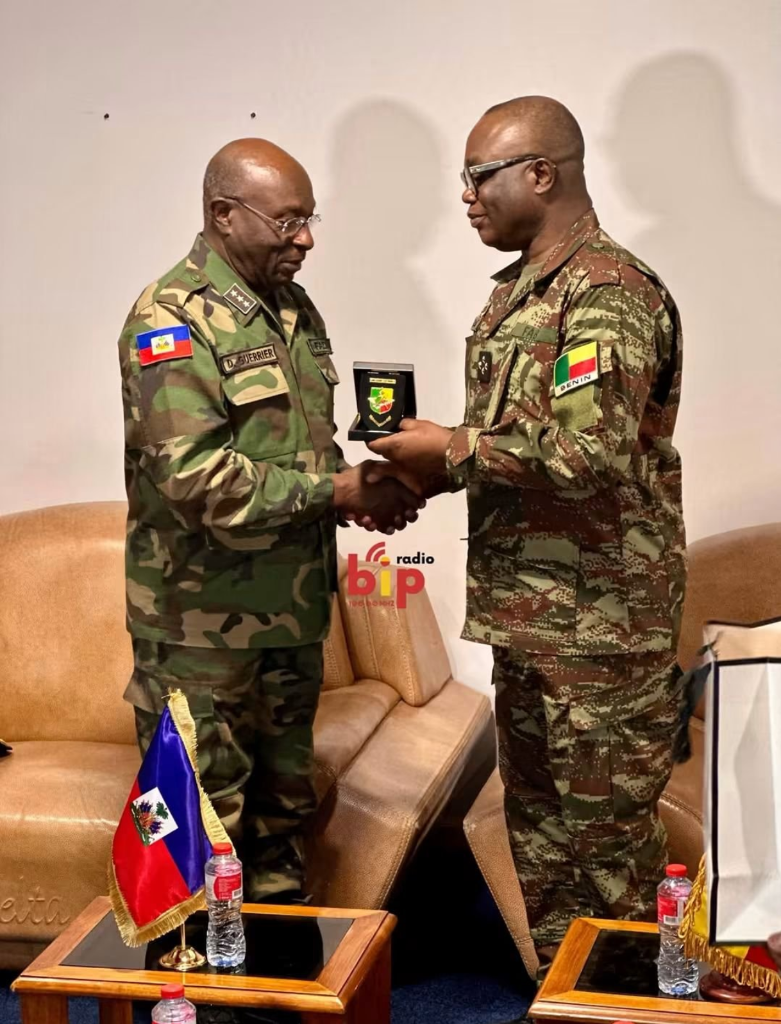
COTONOU — A pivotal question hangs over the current visit of Haiti’s top military commander to Bénin: can African-led security partnerships break the deadlock in Port-au-Prince’s escalating crisis? The arrival of Lieutenant-General Derby Guerrier, Chief of Staff of Haiti’s Armed Forces (FAd’H), in Cotonou on November 3, 2026, marks a crucial moment in the search for sustainable solutions to Haiti’s deepening instability.
The timing of this diplomatic mission could not be more critical. Haiti continues to grapple with entrenched gang violence, crumbling public institutions, and a security apparatus stretched beyond its limits. Against this backdrop, the exchange between the Haitian military leadership and their Béninese counterparts takes on heightened significance, raising hopes for strengthened bilateral defense ties that could reshape regional security dynamics.
Why Bénin’s offer of 1,500 troops matters — and why it hasn’t moved yet
In February 2024, Bénin’s President Patrice Talon publicly pledged 1,500 military and security personnel to international efforts aimed at restoring stability in Haiti, with the potential to increase this commitment to 2,000 troops. This bold declaration was made under the United Nations-backed Multinational Security Support Mission (MSS), led by Kenya, signaling Cotonou’s willingness to play a leadership role in addressing Haiti’s crisis.
Yet two years later, these troops have yet to deploy. Key obstacles have emerged, including disagreements over command structures, funding mechanisms, operational logistics, and the integration of Béninese forces under a Kenyan-led mission. Bénin’s military leadership notably raised concerns about the dominance of police command in a military-led operation, highlighting deep institutional reservations that have delayed concrete contributions.
This unresolved pledge now casts a long shadow over the ongoing discussions in Cotonou. The meeting between General Fructueux Gbaguidi, Bénin’s Chief of General Staff, and General Guerrier is not merely ceremonial — it is a high-stakes dialogue about whether past commitments can evolve into action, and whether a new framework for cooperation is possible.
Learning from shared threats: what Haiti can take from Bénin’s experience
Both nations face severe security challenges, though in different forms. While Haiti struggles with urban gang warfare and the collapse of governance, Bénin contends with rising terrorism in the north and the broader instability spreading across the Sahel. These parallel struggles create a strong foundation for mutual learning and strategic alignment.
The Béninese Armed Forces (FAB) have invested heavily in modernizing their operational capacity, intelligence sharing, and counter-terrorism training. Their experience in adapting to asymmetric threats could offer valuable lessons to Haiti’s military, which is urgently seeking to rebuild its capabilities and restore public trust.
Key areas of potential cooperation include:
- Military training and professional development — especially in urban conflict management and community-based security initiatives
- Intelligence and surveillance systems — critical for tracking armed groups and disrupting illicit networks
- Operational planning and joint exercises — to enhance interoperability with international partners
- Institutional resilience building — strengthening command structures, logistics, and ethical frameworks
Can Cotonou finally step forward? The stakes of the current talks
The November 2026 meeting is more than a diplomatic courtesy — it carries the weight of unfulfilled promises from 2024 and the growing desperation in Port-au-Prince. While no official announcement has been made, the very presence of General Guerrier in Cotonou suggests that Haiti is exploring fresh avenues of partnership beyond its traditional allies.
This shift reflects a broader diplomatic strategy: Africa’s renewed engagement in Haiti’s recovery, leveraging historical and cultural ties to build practical, peer-to-peer cooperation. Bénin, with its balanced regional standing and military credentials, is uniquely positioned to act as a bridge between Caribbean and African security institutions.
The outcome of these discussions may determine whether Bénin’s potential contribution becomes a reality — or remains a promise unkept. For Haiti, such a deployment would represent a lifeline. For Bénin, it would affirm its role as a trusted regional security provider, capable of stepping up when others hesitate.
From dialogue to action: the road ahead for Haiti-Bénin military ties
For the partnership to move beyond intentions, concrete frameworks must be established. This includes:
- Clear command and control agreements that respect both nations’ military doctrines
- Sustainable funding and logistical support mechanisms, possibly through pooled regional resources
- Gradual troop deployment, starting with specialized units such as engineers, trainers, or medical corps
- Monitoring and evaluation protocols to ensure transparency and mutual accountability
The true measure of this visit will not be in the handshakes or press releases, but in the follow-through. Will Bénin’s military engagement in Haiti become a reality in 2027? Or will the dialogue remain at the level of strategic intentions?
One thing is clear: the crisis in Haiti demands bold leadership — and Africa’s willingness to act. Whether that leadership comes from Cotonou may well depend on the results of these talks in the coming days.