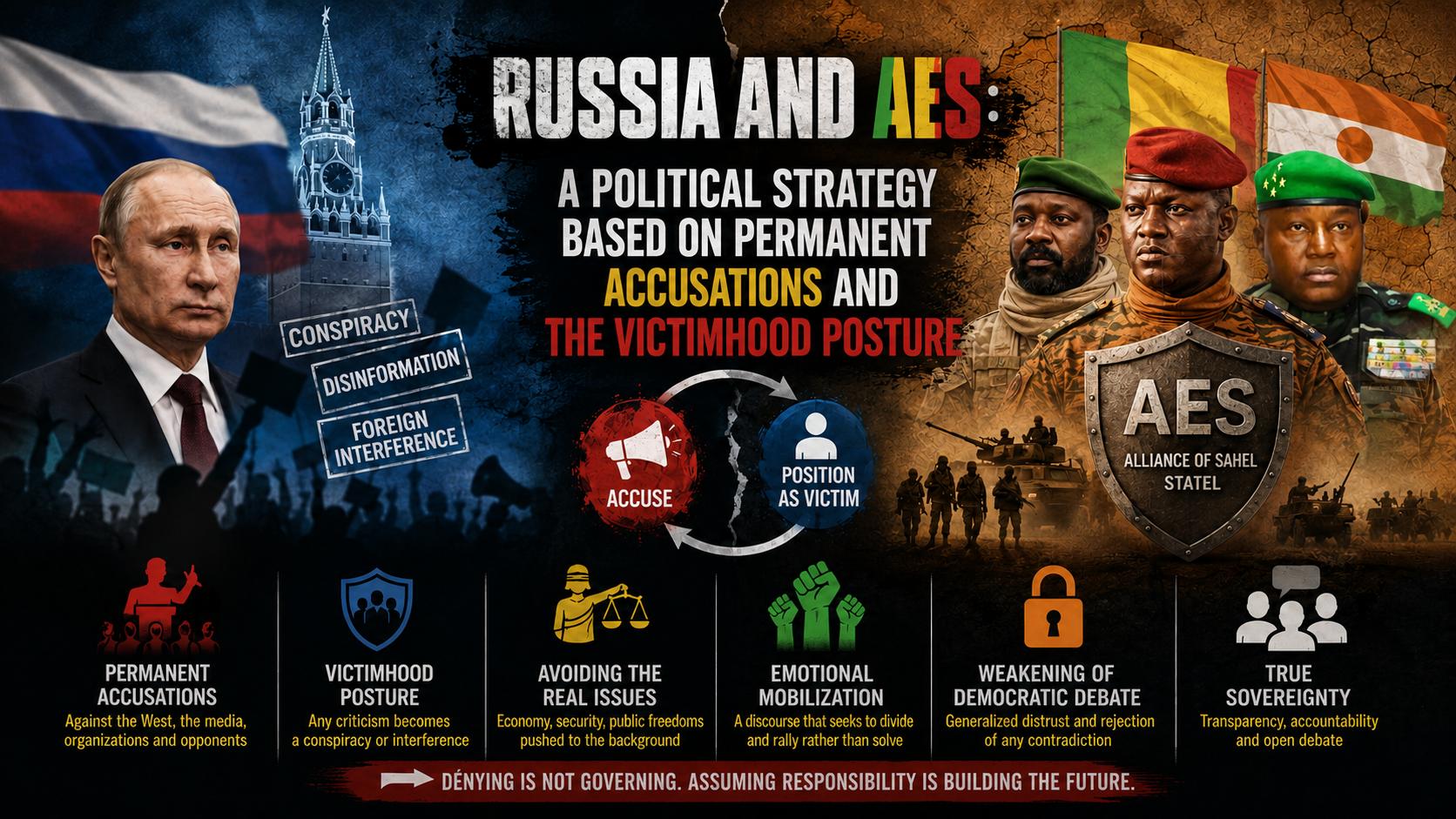
Constant Accusations and the Politics of Victimhood
For years, Russia and the governments of the Alliance of Sahel States (AES) have consistently framed their political communication around denunciations of perceived adversaries. Western powers, international media outlets, regional bodies, and even domestic opponents have all been targeted in this relentless campaign of accusations. Yet a recurring contradiction emerges: when these same actors face criticism, they swiftly shift from accusers to victims.
This approach to communication has become almost institutionalized. Any challenge to their policies is met with allegations of conspiracies, foreign interference, or orchestrated misinformation campaigns. Criticism is rarely treated as legitimate; instead, it is dismissed as part of a coordinated effort to undermine their governments or obstruct their perceived path to sovereignty.
The political benefits of this strategy are clear. By positioning themselves as victims of external enemies, leaders avoid confronting pressing domestic issues. Economic hardships, persistent insecurity, eroding public freedoms, and the mixed outcomes of certain policies are overshadowed by emotive narratives designed more to rally support than to address concrete problems. The result is a public discourse that prioritizes emotional mobilization over substantive solutions.
AES Leaders and the Blame Game
Within the AES, authorities frequently attribute their challenges to sanctions, former colonial powers, or foreign actors. Internal criticisms—whether from citizens, journalists, or human rights organizations—are routinely dismissed as fabrications or part of an external destabilization plot. Rather than engaging with the substance of these concerns, responses often resort to dismissive rhetoric that undermines the credibility of the critics themselves.
Russia employs a similar logic on the global stage. When confronted with criticism over its foreign policy, military actions, or human rights record, official narratives consistently frame the country as a perpetual target of Western hostility. This framing not only diverts attention from the issues at hand but also reframes valid concerns as evidence of a relentless campaign against Russian interests.
The Fragility of a Victim-Based Narrative
While effective in the short term, this strategy carries significant long-term risks. Credible governance demands the ability to engage with dissent, respond to criticism with reasoned arguments, and remain accountable to the public. A consistent refusal to acknowledge valid concerns risks eroding democratic debate and fostering widespread distrust.
Accusing others is a straightforward tactic, but accepting responsibility is far more demanding. Through repeated recourse to victimhood narratives, Russia and several AES leaders risk creating the impression that their primary objective is to avoid meaningful discussion. Yet criticism, even when harsh, is not inherently a conspiracy. In any society, it can serve as an opportunity to refine policies, correct mistakes, and rebuild public trust.
The true measure of sovereignty lies not in the perpetual identification of enemies—real or imagined—but in transparency, accountability, and the willingness to engage in open debate. Without these principles, the narrative of perpetual victimhood loses its credibility and becomes little more than a political tool, rather than a genuine response to the challenges these states must confront.