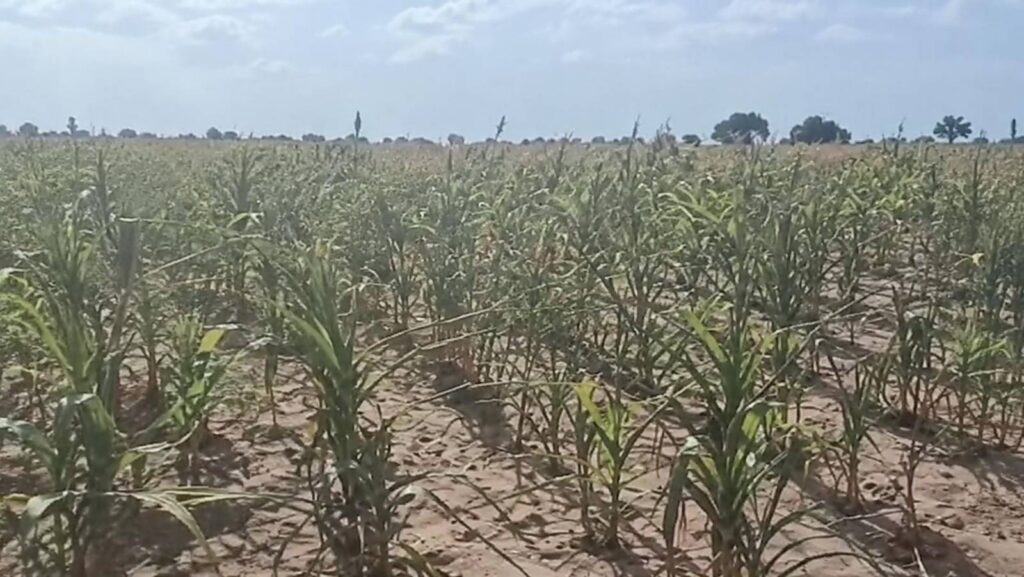
In Tougan, the conclusion is difficult to avoid. Behind the official language of sovereignty, industrialisation and national production, agricultural producers say they continue to face a far less reassuring reality alone: selling their harvests at a loss, repaying credits and, in some cases, considering crossing the border in order to survive.
This contradiction raises a fundamental question: what has become of the priority supposedly given to those who feed the country?
A question of survival behind Burkina Faso’s sovereignty slogans
Since his rise to power, Ibrahim Traoré has regularly emphasised local production, economic sovereignty and Burkina Faso’s capacity to manufacture certain equipment itself. Announcements about industrial units, especially those intended for the army’s needs, occupy a prominent place in this messaging.
But an economy cannot be reduced to its factories or its military equipment.
When a good maize harvest becomes a financial trap
While new industrial capacities are presented as symbols of sovereignty, farmers remain confronted by much more immediate problems: insufficient purchase prices, indebtedness, uncertain outlets and low profitability from their crops.
Producing more only makes sense if the producer can also live from that work.
In Tougan, farmers describe the situation in stark terms: ‘Last year, maize did well. They capped the price, and producers made no profit. This year, others will cross the border because of credits.’
A producer who loses in both scenarios
The situation is captured in a phrase that reveals the depth of the dilemma: ‘The producer cries when the harvest is good; he cries when the harvest is bad.’
The debt burden and the border option
The problem in Tougan therefore goes beyond the simple case of maize. It raises the question of agricultural investment. Which entrepreneur would accept, over the long term, to invest in a sector where a good harvest can push prices down to the point of ruining the producer, while a bad harvest exposes him directly to debt?
Why agricultural investment remains fragile
This is precisely one of the major blind spots in the sovereignty narrative: a nation does not become economically independent merely because it manufactures its own weapons. It must also be able to secure the incomes of those who produce its food.
Industrial symbolism versus agricultural livelihoods
The paradox is stark. Burkina Faso wants to produce its equipment locally, yet some agricultural producers still appear to be searching for ways to sell their own production without losing their investment.
By consistently highlighting images of factories, machines and military equipment, the authorities risk leaving another reality in the shadows: that of fields, granaries, credits and rural families waiting for concrete solutions.
Measuring sovereignty by rural security
Sovereignty is not measured only by what a state can manufacture for its army. It is also measured by its capacity to protect the person who, every morning, puts a seed in the ground to feed the nation.
The unanswered question from Tougan
In Tougan, the question is therefore not how many factories Burkina Faso can inaugurate. The question is simpler, and probably more urgent: how much longer can the producer work without earning a living?
You may also like
Mali’s prison crossroads: can the crackdown on crime coexist with humane detention?
Will Niger’s youth answer the FPL’s call, and what is really at stake?
Kidal’s bombed wells: is northern Mali’s pastoral way of life past the point of no return?
Benin’s sovereign upgrade to AA-: a game-changer for regional investors and public finances
Brigitte Tchede’s Cairo breakthrough: how Benin’s silver medals reshape national athletic ambitions