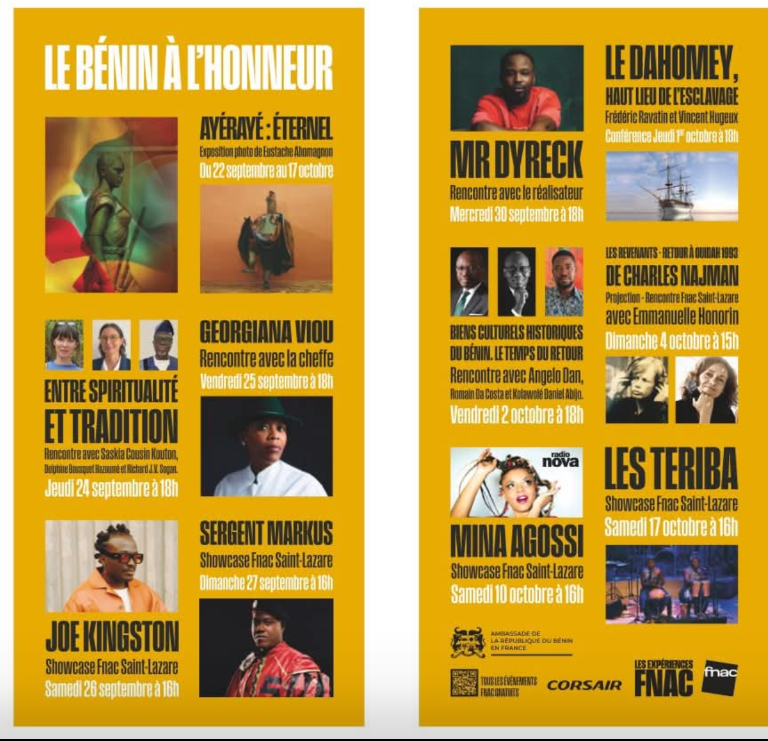
For nearly four weeks, from September 22 to October 17, 2026, the Fnac Paris Saint-Lazare will turn its third-floor forum into a showcase for Benin. The programme—exhibitions, talks, film, music and food—promises to do more than celebrate a country: it will reshape how Parisians and the Beninese diaspora engage with memory, restitution and contemporary creativity. The ripple effects on cultural tourism, community pride and Franco-Beninese relations are already being felt.
A month-long cultural platform with real-world reach
Organised with backing from the Embassy of the Republic of Benin in France for several events, the initiative runs from September 22 to October 17, 2026. It goes beyond folklore, exploring spiritual traditions, the legacy of the Kingdom of Dahomey and the slave trade, debates on returning cultural artefacts, and today’s artistic scene—literature, gastronomy and modern music. For the diaspora, it is a rare mainstream spotlight; for Paris, it is a chance to draw new audiences to African heritage.
Photography that confronts memory and spirituality
The opening on September 22 features “Ayérayé: Éternel”, a photographic exhibition by Beninese artist and designer Eustache Ahomagnon. Running until October 17, the show blends photography with textile creation, delving into memory, spirituality and contemporary expression through the Egungun—ancestral figures in Yoruba culture. The images converse with fabrics inspired by the shapes, materials and movements of these traditions, setting a tone that is both rooted and forward-looking.
Authors, chefs and the transmission of heritage
On September 24, sociologist and author Saskia Cousin Kouton, journalist Delphine Bousquet Hazoumè and researcher Richard J.V. Sogan will discuss spirituality, traditions and books on Benin’s heritage. The next day, chef Georgiana Viou—born in Benin—will share her journey and present her book “Oui cheffe! Du Bénin à l’étoile Michelin. Itinéraire d’une battante”. Her Michelin-starred career illustrates how Beninese flavours and products continue to travel and shape cuisine across borders, a tangible economic and cultural bridge.
Music as a living archive
Music takes over on September 26 with a showcase by Beninese artist Joe Kingston, whose “Afro futur vibes” fuse hip-hop and contemporary African influences. On September 27, poet and slammer Sergent Markus presents his album “Vodun Gospel”, drawing on musical references from Vodun culture. These performances show how ancient spiritualities feed modern genres, attracting younger audiences and expanding Benin’s cultural footprint.
From Dahomey to restitution: confronting difficult history
The programme does not shy away from painful chapters. On October 1, a talk on Dahomey and the history of slavery will bring together writer and journalist Vincent Hugeux and Frédéric Ravatin, an engineer and scientific scenographer, to discuss the “Bateau de la Mémoire” in Ouidah—a memorial device dedicated to the slave trade. On October 2, the focus shifts to the restitution of cultural property between France and Benin, with Ambassador Angelo Dan, Romain Da Costa and heritage curator Kolawodé Daniel Abidjo. These discussions carry weight for bilateral relations and for how Benin reclaims its narrative.
Cinema bridging past and present
On October 4, a screening of “Retour à Ouidah 1993. Les Revenants”, a documentary by Charles Najman, explores the return to Ouidah—a city deeply tied to Vodun and the African diaspora born of the slave trade. A conversation with journalist, producer and programmer Emmanuelle Honorin follows. Made in the context of the Ouidah 92 Festival, the film connects historical images with today’s questions about memory, identity and diaspora links.
Contemporary voices shaping the narrative
Current creation is not overlooked. On September 30, a carte blanche goes to director, co-producer and cinematographer Mr DYRECK, whose work between Benin and France represents a new generation telling West Africa’s stories through images. On October 10, jazz singer and artist Mina Agossi presents her album “Dynamic. Tribute to Dinah Washington”. The programme closes on October 17 with a showcase by Teriba, described as Benin’s first female music group. Founded in 2002, the collective is known for a cappella singing and promoting Beninese cultural heritage.
Paris as a crossroads with lasting consequences
For nearly four weeks, Fnac Saint-Lazare becomes a window onto Benin. From photography to gastronomy, slam to jazz, cinema to history, the line-up paints a plural portrait of a country whose heritage fuels contemporary creation. It also reminds us that Beninese culture is not a frozen relic—it is transmitted, reinvented and debated. Between Vodun traditions, the memory of Dahomey, the slave trade, restitution debates and new artistic expressions, a whole narrative of Benin takes centre stage in Paris. All events are free, subject to availability. The impact extends beyond the store: for the diaspora, it is a moment of visibility and pride; for Paris, a boost to cultural tourism and a deepening of Franco-African ties.
You may also like
Niger mosque abductions: the real toll on families, trade and trust after 500 worshippers vanish
Nigeria’s anti-jihadist drive leaves 1,100 fighters dead and reshapes local economies
Wadagni’s Kigali visit and the Gisozi tribute: what it means for Benin’s economy and citizens
Sankara’s mausoleum in Burkina Faso: the real cost of an official memory
Burkina Faso’s 85% efficiency claim: the real consequences for citizens and the economy