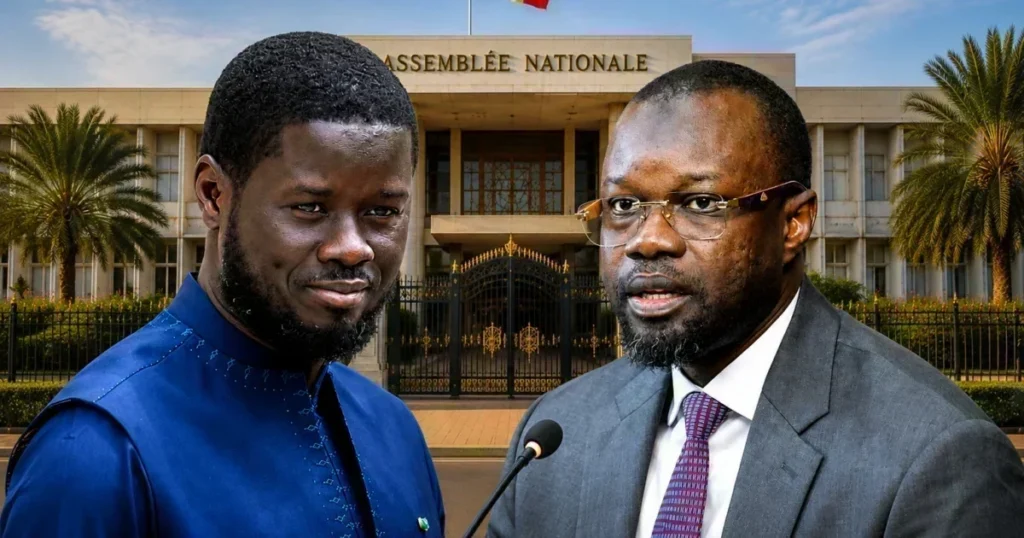
Unaccounted millions: The hidden cost of Senegal’s special funds
On August 13, Justice Minister Moussa Sarr introduced a government amendment that stripped a proposed parliamentary reform of its teeth. The amendment replaced detailed control mechanisms with vague constitutional principles, relegating execution and oversight to the executive branch under articles 67 and 76 of Senegal’s Constitution. What began as a bold legislative push to curb the opacity of special funds has stalled, leaving a significant portion of state discretionary spending beyond parliamentary scrutiny. The setback underscores a persistent challenge: how a nation grappling with economic pressures and public scrutiny can reform opaque financial practices that have long shielded spending from oversight.
The bill’s journey: From urgency to constitutional deadlock
The legislative initiative, championed by opposition deputies in early August, sought to shine a light on billions in special funds traditionally managed by the Presidency and Prime Minister’s offices. A landmark session on August 10 saw fast-tracked discussions on a draft law establishing strict legal frameworks and independent audits involving both parliamentary committees and magistrates from the Audit Court. Yet this momentum dissipated when the executive intervened.
The government’s counterproposal, presented on August 13, eviscerated the bill’s substance by replacing enforceable controls with broad principles. An additional amendment added on August 14 expanded the scope to include the Presidency, National Assembly, and Prime Minister’s offices, signaling that the debate revolved not over whether to control these funds, but how extensively—and who would wield that control. The bill passed on August 19, only to be suspended the next day after the executive filed an appeal.
The appeal landed a decisive blow: on August 25, the Constitutional Council ruled the ordinary law unconstitutional, asserting that the regulation of public credits required an organic law rather than a parliamentary initiative. This forced lawmakers back to square one, this time targeting the organic law governing financial regulations. On September 2, the National Assembly’s Bureau declared a new organic law proposal admissible, amending the 2020 organic law on finance. Before the bill can proceed to committee and the legislative agenda, however, it must first be reviewed by the President for advisory input—a procedural hurdle that delays effective oversight even further.
Financial opacity: A decade of unchecked discretion
Since 2011, the initial budget allocation for special funds has remained frozen at 8.86 billion CFA francs annually. Yet the amounts actually disbursed each year frequently deviate from these figures, with no independent verification mechanism in place to account for discrepancies. Until the organic law amendment completes its parliamentary journey, expenditures across the Presidency, Prime Minister’s office, and potentially the National Assembly remain shielded from robust parliamentary oversight—despite the determined efforts of deputies like Ousmane Sonko.
While the reform aims to create a controlled oversight environment that respects national security confidentiality, critical questions persist. Will this oversight extend fully to funds managed not just by the executive, but also by the National Assembly itself? Observers question whether lawmakers are willing to subject their own discretionary spending to the same scrutiny as the executive branch—an issue dividing opinions on the reform’s scope and fairness.
Key points of contention: Control vs. secrecy in public finance
Underlying the technical legal debate are fundamental disagreements over the purpose and scope of special funds. Parliamentary majorities advocate for a restrictive approach, limiting funds to core state functions. The executive, in contrast, argues for broader use in addressing humanitarian and social emergencies. These tensions reflect deeper disagreements over how much transparency is compatible with national security, and who should ultimately control the nation’s financial levers.
As Senegal faces economic challenges and heightened public expectations for accountability, the fate of this reform carries significant implications. Without effective oversight, billions in public funds continue to flow through channels that escape rigorous scrutiny. The current stalemate not only perpetuates financial opacity but also erodes public trust in institutions meant to serve the nation’s interests. For citizens, businesses, and the broader economy, the consequences are real: misallocated resources, weakened governance, and diminished confidence in the systems meant to protect the public purse.
You may also like
Bénin: le Sénat tient sa séance inaugurale sous la conduite de Patrice Talon
Gabon : la participation citoyenne au cœur de la Ve République
Is Chad truly experiencing a political easing of tensions?
Accord FMI-Sénégal : Thierno Bocoum exige la transparence sur les conditionnalités
Ousmane Sonko demands full transparency on Senegal’s new FMI agreement