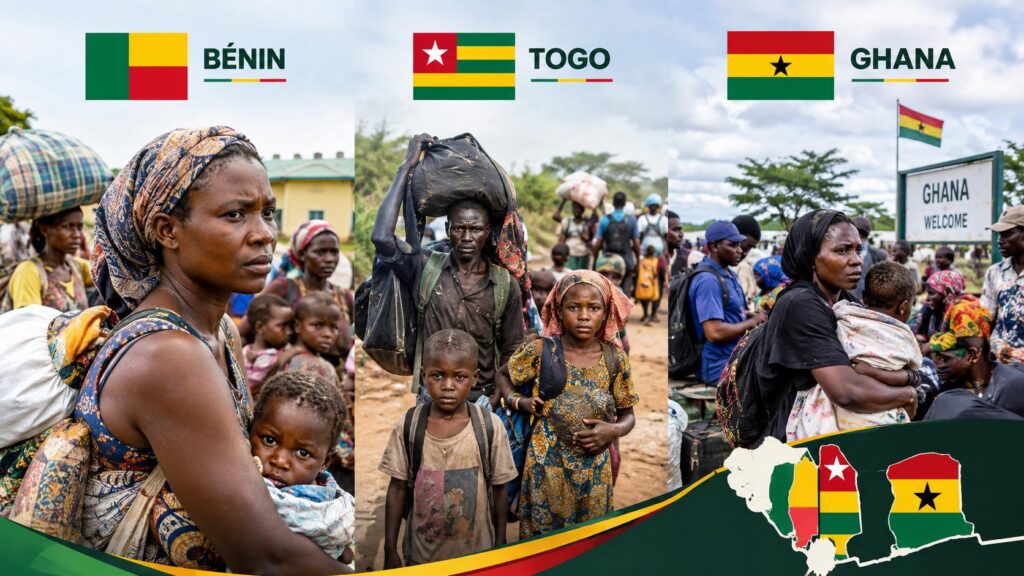
The signing of three tripartite agreements in Lomé on 11 September between Benin, Ghana, Togo, Burkina Faso and the UN refugee agency has been presented as a milestone in managing one of West Africa’s most stubborn displacement crises. But for the communities involved, the real test lies elsewhere: whether the framework translates into genuine safety on the ground, or whether it simply accelerates returns to areas where violence has not subsided.
A framework for return, not a green light for repatriation
The agreements do not trigger immediate repatriation. Instead, they establish a cooperation structure linking Burkina Faso, the UNHCR and each of the three host nations. The texts set out consultation mechanisms, monitoring arrangements and preparations for potential return operations and the reintegration of those who choose to go back.
That distinction matters enormously. In a Sahel region shaped by forced displacement, the word “return” can easily be read as a signal to pack up and leave. The principle upheld by the refugee agency is different: repatriation must be voluntary, safe and dignified, and refugees must be able to make an informed decision about their own future.
Host countries stretched by a crisis they did not create
For years, insecurity in Burkina Faso has pushed thousands of people across borders. Benin, Ghana and Togo now find themselves on the front line of a crisis they had no hand in creating.
The numbers tell the story. In Benin, more than 11,000 refugees from Burkina Faso were registered as of 31 May 2026. In Ghana, June 2026 statistics recorded 13,368 Burkinabè refugees — nearly two-thirds of the country’s entire refugee population. Ghana had already set up reception centres in the border areas of Tarikom and Zini and, in February 2025, granted prima facie refugee status to Burkinabè seeking protection.
Togo has also absorbed a significant influx of people fleeing Sahel insecurity. According to the UNHCR, the country hosted around 65,100 refugees and asylum seekers in June 2026, 86 percent of them from Burkina Faso.
These figures give the Lomé agreements a different weight. They are not about abstract population movements. Behind any future return operation are families who left their villages, abandoned their belongings and in some cases lost relatives.
Return cannot paper over the causes of exile
This is where the role of Burkina Faso’s authorities becomes decisive. For several years the country has faced an insurgency led by Islamist armed groups, alongside serious allegations concerning operations by government forces and allied militias.
Human Rights Watch says the human rights situation deteriorated further in 2025. The organisation documents abuses attributed both to Islamist armed groups and to government forces and pro-government militias, including killings of civilians, forced displacement and growing restrictions on the media, the opposition and civil society.
In a report published in April 2026, Human Rights Watch documented 57 incidents and gathered testimony from hundreds of people to examine violence committed since 2023. It concluded that Burkinabè forces and their allied militias, like Islamist armed groups, are responsible for grave abuses that may amount to war crimes or crimes against humanity, and called for accountability through credible investigations.
These allegations bear directly on the context to which refugees would be asked to return. A repatriation operation cannot be treated as a solution simply because a diplomatic agreement has been signed.
The junta and the question of security guarantees
Since the September 2022 coup, Burkina Faso has been run by military authorities led by Captain Ibrahim Traoré. Human Rights Watch reports that the junta extended the transition period and narrowed political and civic space, with measures targeting journalists, opponents and civil society organisations.
The organisation has also documented disappearances, forced conscription and restrictions on critical voices. In May 2026 it again denounced tightening measures against independent media and access to information.
For refugees, none of this is secondary. The fundamental question remains protection: can they go back to their villages without fearing fresh violence? Will their homes and land be accessible? Will they be able to obtain civil status documents, healthcare, schooling and a means of livelihood? And above all, will there be mechanisms through which they can report any violations?
The UNHCR itself notes that sustainable return presupposes that the root causes of displacement have been sufficiently addressed and that peace allows people to live without being forced to flee again.
Benin, Ghana and Togo: the responsibility of host nations
In this context, the stance of Benin, Ghana and Togo is a key component of the regional response. By sheltering people forced to flee, these three countries have shouldered a heavy humanitarian burden despite their own security and economic challenges.
The agreement signed in Lomé makes it possible to avoid setting reception against return. It gives the countries concerned a framework to prepare for the future while upholding the principle of voluntariness.
It is also a signal of regional cooperation. Gulf of Guinea states are directly exposed to the consequences of the Sahel crisis. Population movements do not stop at borders and therefore require coordination between states, international organisations and local communities.
Benin, Ghana and Togo can thus be seen not only as Burkina Faso’s neighbours, but as actors in the regional response to the crisis.
A signature, but not yet a return
The Lomé agreements are therefore more of a roadmap than a repatriation timetable. Their effectiveness will depend on how they are implemented and, above all, on the conditions prevailing in Burkina Faso.
The message to refugees is clear: their return must be voluntary and must happen when security and dignity conditions are in place. That caution is all the more important given that the Burkinabè context remains marked by armed violence and by allegations of abuses involving several parties to the conflict.
For Benin, Ghana and Togo, the challenge is now twofold: continue protecting those who need asylum while preparing, with the UNHCR and Burkinabè authorities, the conditions for a possible return.
Because a refugee only truly goes home when they can live there in safety. The real success of the Lomé agreements will not be measured by how many people are sent back to Burkina Faso, but by how many are able to return freely, rejoin their communities and rebuild their lives without being forced to flee once more.
You may also like
Togo: media crackdown puts businesses and citizens on edge
Benin-Rwanda partnership: how Wadagni’s Kigali visit will affect citizens, businesses and the economy
Niger purge’s real toll: how Tiani’s fear is reshaping daily life, business and security
Benin’s logistics corridor bet: what it means for businesses and households
Niger mosque abductions: the real toll on families, trade and trust after 500 worshippers vanish