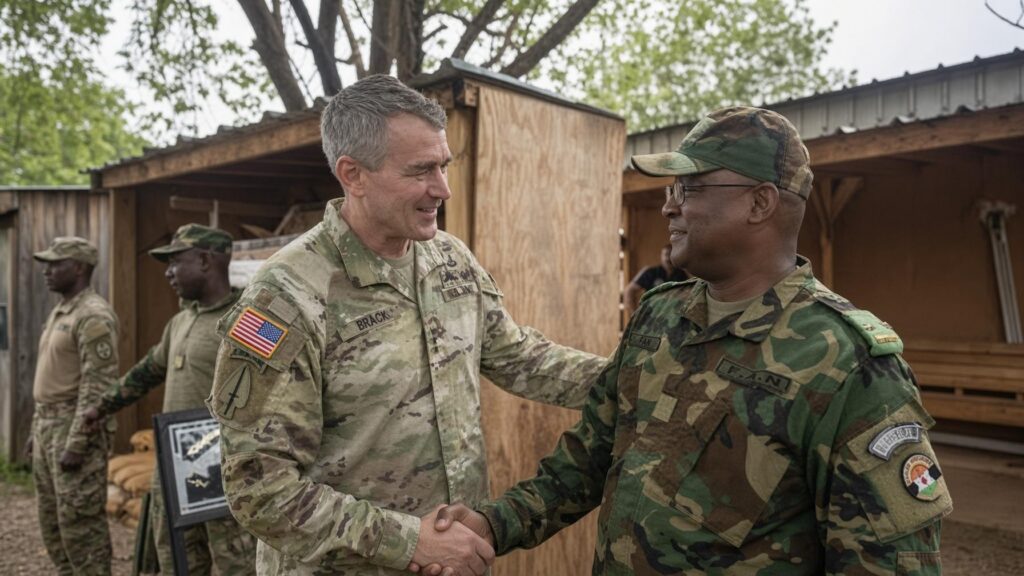
The fallout from the failed mutiny in Niamey is no longer confined to the barracks. It is now hitting households, traders and an economy already under strain. When Major General Moussa Salaou Barmou was stripped of his post as chief of general staff of the Nigerien Armed Forces on 11 September 2026 and placed under house arrest, the shockwaves spread far beyond the military hierarchy — into markets, border posts and everyday life across Niger.
From coup architect to a man under guard
Barmou was one of the central figures behind the overthrow of President Mohamed Bazoum in July 2023. Until recently, he embodied the muscle of Niger’s special forces and the continuity of military rule in Niamey. That image has now collapsed. His dismissal came just two weeks after an aborted mutiny on 28 and 29 August at Air Base 101, an episode that exposed how brittle the junta’s internal cohesion had become.
Officially, no direct link between Barmou and the insubordination has been established. Yet the suspicion was enough. A presidential decree removed him from command, and General Abdourahamane Tiani immediately handed the army’s reins to Brigadier General Mamane Sani Kiaou, previously head of the land forces.
What the purge means for ordinary Nigeriens
For citizens, the consequences are tangible. Each reshuffle at the top of the security apparatus creates uncertainty in the regions where military operations are coordinated. Traders along key supply routes report growing anxiety over checkpoints and shifting chains of command. Public sector workers, already squeezed by sanctions and budget pressures, now face the prospect of further disruption as the state reallocates resources to internal security and loyalty enforcement.
- Businesses: uncertainty over security leadership discourages investment and slows cross-border trade, particularly with neighbours in the Sahel.
- Citizens: communities in conflict-affected areas fear gaps in military coordination could leave them more exposed to armed groups.
- Economy: a junta focused on purging its own ranks has less bandwidth for the economic reforms and donor negotiations that could ease daily hardship.
A climate of suspicion that feeds on itself
Many observers see the move against Barmou as another step in the tightening grip of the executive. The way the August crisis was resolved — with ground support from Russian Africa Corps personnel — laid bare deep fractures within Niger’s security establishment.
By neutralising one of the country’s most influential officers, the junta is sending a blunt warning through the entire military chain: internal dissent will not be tolerated, and even the faintest hint of disloyalty carries a heavy price.
Reactions in the capital
In Niamey, responses have veered between claims of a denial and a bitter acknowledgement that trust has collapsed across the system. Critics of the regime argue this trajectory reveals the trap built into governments born of exception: forged in force, they are often consumed by suspicion of their own makers.
The wider price of loyalty in military regimes
Turning on its earliest allies, the Niamey leadership is demonstrating how fragile alliances built on constitutional rupture can be. Barmou’s case is one more illustration that in the machinery of military rule, yesterday’s loyalty rarely guarantees tomorrow’s safety — and the bill is ultimately paid by the public.