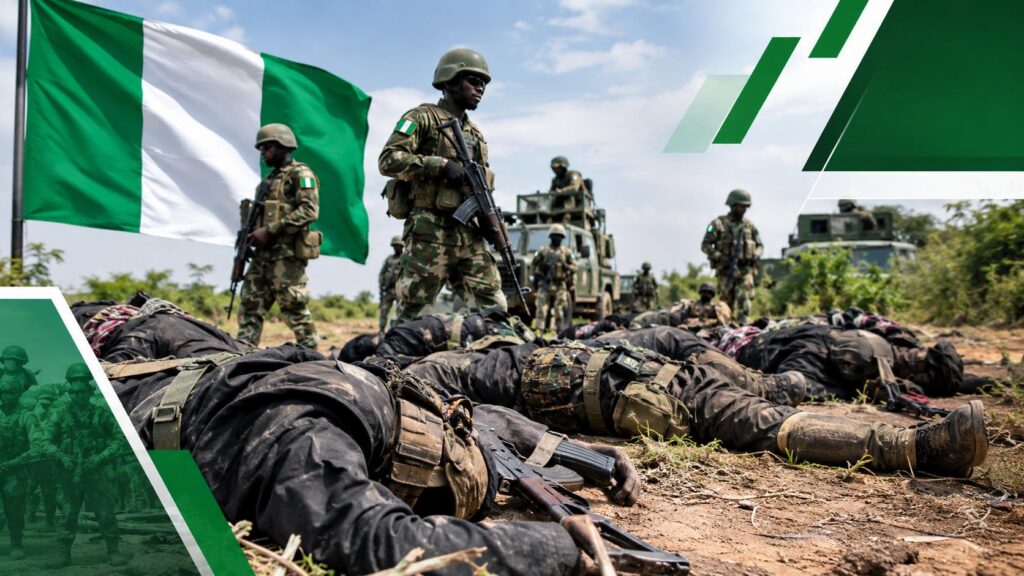
In a sweeping military campaign that has reshaped the security landscape of Nigeria’s northeastern region, the Nigerian Armed Forces has annihilated over 1,100 jihadist fighters linked to Boko Haram and the Islamic State’s West Africa Province (ISWAP) since April 2025. The announcement, delivered by outgoing Joint Task Force HADIN KAI commander Major General Abdulsalam Abubakar during a high-stakes press briefing in Maiduguri, marks a watershed moment not only for the military but for the thousands of civilians caught in the crossfire.
Crippling blows to jihadist operations: human toll and captured war assets
The latest offensive, concentrated in the dense Sambisa Forest, the Mandara Mountains, and the Lake Chad perimeter, has delivered a body blow to the insurgency’s infrastructure. Military sources confirm that 1,106 combatants—70% affiliated with ISWAP and the remainder with Boko Haram—were killed in coordinated ground incursions and precision airstrikes. Among the recovered war spoils were 475 firearms, ranging from assault rifles to heavy machine guns, alongside substantial ammunition reserves.
EOD (Explosive Ordnance Disposal) teams also dismantled 295 improvised explosive devices (IEDs), a tactical victory that clears critical supply routes previously plagued by hidden explosives. The neutralization of these roadside bombs has restored safe transit for humanitarian convoys and local traders, easing pressure on an economy already battered by years of insurgent taxation and extortion.
>Cutting off jihadist lifelines: logistics networks dismantled, surrenders surge
Beyond battlefield engagements, the Nigerian military has systematically dismantled the insurgents’ logistics backbone. Security operations have led to the detention of 758 suspected financiers, recruiters, and supply-chain operatives—individuals who facilitated the movement of food, fuel, and communications equipment to remote hideouts. These arrests have starved jihadist factions of the resources needed to sustain large-scale attacks.
As the noose tightens, an unprecedented wave of surrenders has swept through the region. A total of 969 individuals—comprising active fighters, mid-level commanders, and family members—have laid down arms and exited insurgent-controlled zones. These former combatants are now entering the federal government’s Disarmament, Demobilization, and Reintegration (DDR) program, which provides vocational training, small business grants, and psychosocial support to facilitate civilian re-entry.
Humanitarian rescue: over 600 civilians freed from jihadist captivity
The military campaign has also rescued 638 civilians—mostly women and children—who were abducted from remote villages and forced into labor or indoctrination camps. After thorough medical and psychological screening, survivors are handed over to state authorities and humanitarian partners for reintegration into their communities. These rescue operations have given families a chance to reclaim lives disrupted by a decade of terror.
Economic spillover: markets reopen, trade routes re-emerge
The sustained reduction in insurgent activity has begun to revive local economies across Borno, Yobe, and Adamawa States. Markets that had been shuttered for years are reopening, farmers are returning to fields abandoned due to kidnappings and extortion, and small-scale traders are resuming cross-border commerce with Cameroon and Chad. The restoration of stability has also attracted modest international aid flows, channeling resources into school rehabilitation and primary healthcare in liberated districts.
Unfinished battle: what comes next for Nigeria’s northeast
Despite these gains, the security environment remains volatile. ISWAP, though weakened, continues to stage ambushes using IEDs and small-arms fire in rural pockets near Lake Chad. The transition of command within HADIN KAI—now under a new leader—poses both challenge and opportunity: maintaining momentum while avoiding complacency will be crucial in securing durable peace.
For the displaced, the promise of return is tentative. Many hesitate to abandon displacement camps due to lingering fears of renewed attacks. Military officials insist that continued clearing operations, community policing initiatives, and economic stimulus programs are essential to rebuild trust and restore normalcy.
The new commander’s first order of duty? Consolidate these hard-won gains and ensure that the guns fall silent for good—so that the people of Nigeria’s northeast can finally look forward instead of back.
You may also like
Niger mosque abductions: the real toll on families, trade and trust after 500 worshippers vanish
What Benin’s 26-day Paris residency at Fnac Saint-Lazare means for diaspora, tourism and cultural ties
Wadagni’s Kigali visit and the Gisozi tribute: what it means for Benin’s economy and citizens
Sankara’s mausoleum in Burkina Faso: the real cost of an official memory
Burkina Faso’s 85% efficiency claim: the real consequences for citizens and the economy