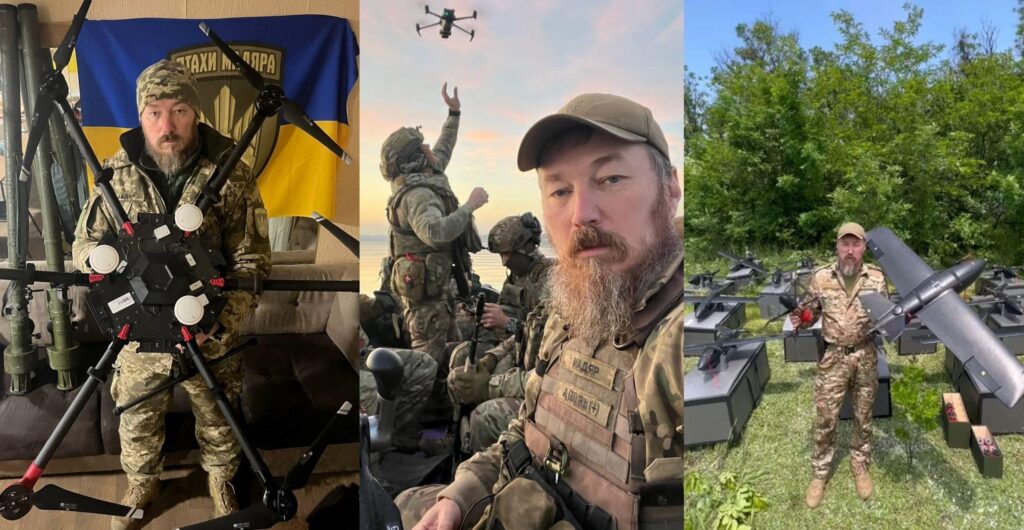
When a single name is valued at $20 million by an enemy state, the story is no longer just about that person. It becomes a story about the real-world consequences for the people, businesses and economy caught in the crossfire. That is exactly what is happening with Robert Brovdi, known by his callsign “Madyar,” the commander of Ukraine’s Unmanned Systems Forces. Reports in late September 2026 indicated that Russian authorities had offered $20 million for information leading to his location. The figure itself is staggering, but the impact ripples far beyond the battlefield.
From grain trader to drone commander: the making of a high-value target
Born in Uzhhorod, western Ukraine, Brovdi was not a career soldier. Before the war, he worked in international grain trading. When Russia launched its full-scale invasion in February 2022, he volunteered for the Ukrainian forces. By May 2022, he had founded his own drone unit, “Magyar’s Birds.” What began as a small reconnaissance team grew into the 414th Separate Brigade of Unmanned Strike Systems. In May 2025, he was awarded the title Hero of Ukraine, and a month later he took command of the newly created Unmanned Systems Forces.
His rise reflects a broader shift in how Ukraine fights. But the bounty on his head also signals something else: Russia sees him as a linchpin. That perception has consequences for ordinary Ukrainians and the economy that sustains them.
Drones as a weapon of mass production: economic and social fallout
The drone war is not just a military strategy; it is an economic engine. Ukraine has ramped up domestic production of drones, creating jobs and supply chains that support both the war effort and the civilian economy. According to Ukrainian presidential data, the Unmanned Systems Forces made up about 2% of the armed forces as of November 2025 but were credited with 35% of the damage inflicted on enemy personnel and targets. While these figures come from Ukrainian sources, they underline the outsized role of drones in the war.
The impact on citizens is tangible. Drone strikes have disrupted Russian logistics, fuel depots, railway infrastructure and air defense systems, particularly in Crimea. Since 2026, Ukraine has intensified a campaign to sever Russian supply lines. Medium-range drones have become key to creating corridors that allow other Ukrainian weapons to hit Russian installations. For civilians in occupied areas, this means shifting front lines and uncertain access to basic goods. For businesses in Ukraine, it means a war economy that increasingly revolves around drone production and innovation.
Beyond the land front: the Black Sea and Crimea
The consequences extend far beyond the trenches. In the Black Sea, Ukrainian naval drones have changed the balance of power. Lacking a conventional fleet, Ukraine developed unmanned vessels capable of approaching and attacking Russian ships. According to the British research center RUSI, these systems have been crucial in keeping the Russian fleet at a distance and challenging its freedom of movement. Notable operations include attacks on the intelligence ship Ivan Khurs, the patrol vessel Sergei Kotov, and the missile ship Ivanovets, which was sunk in February 2024.
In 2026, the campaign widened further. In July, the “Magyar’s Birds” unit reportedly took part in attacks on more than 180 ships and other maritime targets around Crimea within a few weeks, using Ukrainian-made FP-1 and FP-2 drones. The goal was to disrupt Russian logistics and complicate the use of the peninsula as a military base. For Ukraine’s economy, these operations mean continued pressure on Russian trade routes, but also risks of escalation that could affect global food and energy markets.
The numbers game: production, training and the limits of drone warfare
Brovdi’s doctrine is industrial: produce enough drones, train enough operators, and launch enough strikes to make Russian rear areas vulnerable. In July 2026, Ukrainian military authorities claimed to have hit bridges, air defense systems, radars, ammunition depots, oil facilities and air infrastructure in Crimea and occupied territories. But these successes do not mean drones alone have changed the war’s outcome. A September 2026 analysis by the Centre for Eastern Studies noted that despite damage to Russian infrastructure in Crimea, the strikes had not yet significantly altered the pace of Russia’s advance on the ground.
This is where the bounty on Brovdi becomes a double-edged sword. For his supporters, he symbolizes the accelerated modernization of Ukraine’s military. For Moscow, his role in drone strikes makes him a prime target. For civilians and businesses, the hunt for him means continued uncertainty and a war economy that shows no signs of slowing down.
What the bounty says about the war’s future impact
At 48, the former grain trader has become the face of a wider military transformation: a war where a few operators, software, cameras and unmanned vehicles can produce effects once reserved for much heavier units. But as Ukrainian drones continue to roam the front lines, the Black Sea and deep into Crimea, their commander must now live as a permanent target. The $20 million price on his head is not just a reward; it is a measure of how much one man’s work has reshaped the war—and how much it continues to affect the daily lives of millions.
You may also like
Mali’s poverty crisis: how hunger and hardship are reshaping daily life for millions
Guinea-Bissau’s December election: what Embaló’s return means for daily life, stability and the economy
What the UN’s 10.5 billion FCFA in Gabon really means for households and small businesses in 2025
What Tinubu’s four-week Europe trip costs Nigeria as independence day looms
Burkina Faso: how four years under Ibrahim Traoré reshaped the lives of millions