Can gold-backed Russian security deals silently erode Sahel nations’ independence?
The question haunts corridors of power in Bamako, Ouagadougou, and Niamey as African and global observers scrutinize a growing and controversial trend: the quiet bartering of national security for access to lucrative gold reserves. In the heart of the Sahel, where jihadist insurgencies rage and traditional allies hesitate, a new equation is taking shape—one where bullets are traded for bullion, and protection comes at the cost of subterranean wealth.
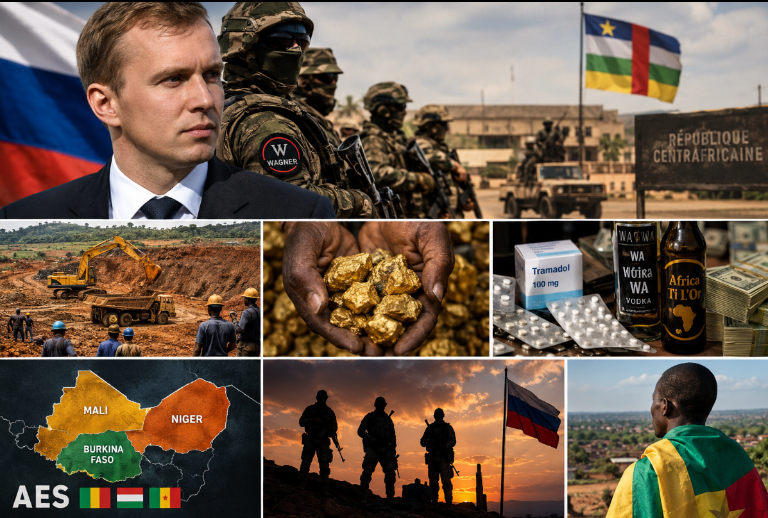
While headlines focus on military presence and geopolitical shifts, an unseen transaction unfolds: African governments receive rapid-deployment security support, while Russian-linked entities secure long-term control over mineral-rich concessions. And leading this exchange is an unlikely figure—young entrepreneur Pavel Prigojine, son of the late founder of the Wagner Group, now reportedly presiding over an economic empire worth over $400 million annually, with gold at its core.
From Bangui to the Sahel: the ripple effect of a controversial model
The Central African Republic (CAR) stands as a living laboratory of this new reality. Under President Faustin-Archange Touadéra, Wagner-linked forces have provided essential security services—bodyguarding the head of state, conducting counter-insurgency operations, and projecting stability in a nation teetering under rebel pressure. Yet, behind these operations lies a deeper agenda: the accumulation of mining rights, trade monopolies, and financial networks that extend far beyond military support.
The AfriGold mining project, reportedly tied to Prigojine’s network, is said to generate around $250 million in annual production. The scale of revenue, combined with opaque export channels, raises urgent questions: who truly benefits from this gold? How much of the profit returns to state coffers? And more critically—what strategic autonomy do African nations retain when security partners double as economic stakeholders?
This is not a simple mercenary-for-hire scenario. It is a structural entanglement where military service becomes a Trojan horse for commercial empire-building. With approximately 500 Russian-linked operatives still active in CAR, the model appears sustainable—particularly when local elites benefit directly from the arrangement, making disengagement politically costly.
The Sahel’s uneasy courtship with Moscow
The Alliance of Sahel States—AES—comprising Mali, Burkina Faso, and Niger, now finds itself at a strategic crossroads. Facing relentless jihadist violence and growing disillusionment with Western partnerships, these nations have turned increasingly toward Russia for military support. Tactical victories and rhetorical solidarity are palpable. But beneath the surface, a silent negotiation is unfolding: what is the real currency of this cooperation?
Unlike the CAR experience, the Sahel states have not ceded control of entire mining sectors. But surveillance reports indicate that access to gold concessions, logistics hubs, and trade corridors is being negotiated alongside security arrangements. In Mali, where Russian paramilitary presence has grown since 2022, civil society voices warn of a creeping economic quid pro quo. In Niger, post-coup rapprochement with Moscow has prompted scrutiny of uranium and gold-related contracts. In Burkina Faso, the link between security assistance and mining concessions is becoming harder to ignore.
The concern is not ideological purity—it is about leverage. When a foreign force secures military bases and, at the same time, financial footholds in goldfields, port infrastructure, or trade routes, its influence extends from the battlefield to the boardroom. And once such networks are embedded, reversing them becomes a high-risk political and economic gamble.
Gold, guns, and governance: a dangerous combination
The intertwining of security services and economic interests creates a governance paradox. On paper, partner nations gain protection. In practice, they risk inheriting a parallel economy—one where armed escorts not only guard officials, but also secure convoys carrying contraband gold, controlled substances, and untaxed minerals.
Investigative accounts suggest that Wagner-aligned networks in CAR have diversified into alcohol trade, small arms distribution, and even the illicit pharmaceutical market, including diverted tramadol. While these claims remain contested, they underscore a systemic risk: when armed groups perform state-like functions, accountability vanishes.
The absence of transparent oversight allows private military companies to act with impunity. Without independent audits of mining revenues or public disclosure of security contracts, citizens cannot distinguish between legitimate defense spending and profit-driven extraction. The result? A state whose sovereignty is nominally intact, but whose strategic choices are increasingly shaped by networks that operate beyond public scrutiny.
Can the Sahel avoid repeating Bangui’s path?
The CAR precedent is not a blueprint, but a cautionary tale. It demonstrates how a security partnership can metastasize into an economic hegemony. In the Sahel, policymakers still have the opportunity to define red lines: strict transparency in security contracts, competitive bidding for mining rights, mandatory revenue transparency, and independent monitoring of civilian protection outcomes.
But time is short. The lure of rapid Russian support—delivered without the conditionalities of Western aid—is powerful. And in regions where state institutions are fragile, the promise of gold-backed finance can be irresistible. The question is not whether the Sahel needs alternative security partners. It is whether, in securing their borders, these nations will inadvertently surrender control of their most valuable natural resources.
Sovereignty in the balance: gold as the new bargaining chip
Ultimately, the African gold rush with Russian partners is less about ideology and more about economics. Moscow gains geopolitical footholds and access to strategic minerals. African elites gain immediate security and potential revenues. But at what long-term cost? When the barrel of a gun is exchanged for the weight of gold, power dynamics shift subtly—yet irrevocably.
The real danger is not invasion or occupation. It is entanglement. A slow, almost invisible erosion of national agency, where the protection of citizens becomes contingent on the extraction of their wealth. The Sahel’s future may well be decided not on the battlefield, but in the boardrooms of gold traders—and in the quiet clauses of security memoranda signed under the cover of darkness.
The lesson from Bangui is clear: sovereignty cannot be bartered in the shadows. Nor can it be preserved by outsourcing protection to actors who then acquire vested interests in the nation’s economic fate. The gold may glitter, but it carries a hefty price tag—one that African nations can only afford to pay if they retain the power of decision over their own destiny.