
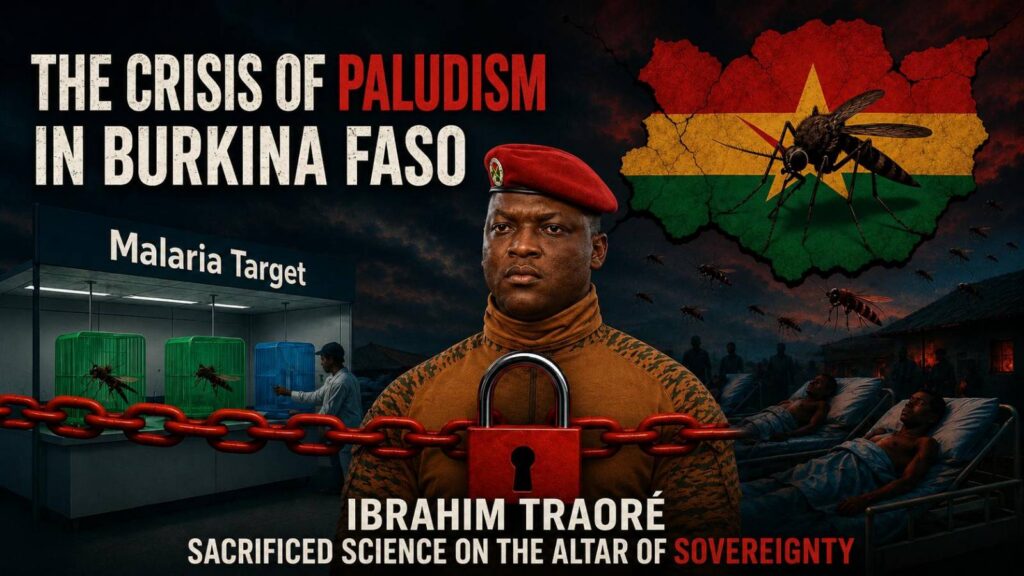
The recent decision by Burkina Faso’s military-led administration, under the leadership of Captain Ibrahim Traoré, to permanently shutter the Target Malaria research laboratories and mandate the destruction of its genetically modified mosquito samples marks a decisive escalation in the country’s sovereignist rhetoric. While framed as a bold assertion of national autonomy, this move raises profound concerns about the future of medical research in the Sahel region and the economic repercussions of scientific isolation.
An abrupt end to a decade-long scientific endeavor
The closure of the Target Malaria project, which had operated in Burkina Faso for nearly a decade with significant funding from the Bill & Melinda Gates Foundation, signals a decisive break from international scientific collaboration. The suspension of activities in August 2025 had already hinted at an irreversible turning point, but the current administration has now cemented this shift with an ideological rupture that extends beyond mere policy.
The paradox of sacrificing science on the altar of sovereignty
Target Malaria, despite its controversies, represented one of the most promising avenues in the global fight against malaria—a disease that continues to claim countless lives, particularly among children under five in sub-Saharan Africa. The project’s innovative approach, utilizing gene drive technology to reduce the fertility of malaria-transmitting mosquitoes, was a beacon of hope for a region grappling with persistent health challenges.
Critics of the project, including local NGOs and civil society groups, had long argued that Burkina Faso was being treated as an ‘open-air laboratory,’ raising ecological and ethical concerns. However, the government’s invocation of ‘health sovereignty’ as justification for its actions obscures a harsher reality:
- Stifling local innovation: The project involved collaboration with Burkina Faso’s leading researchers, including those from the Institut de Recherche en Sciences de la Santé (IRSS). Its abrupt termination deprives the nation’s scientific community of critical funding and cutting-edge infrastructure.
- Brain drain risk: By effectively criminalizing international research partnerships, the regime sends a chilling message to local academics and scientists, potentially accelerating the exodus of talent.
- Geopolitical fallout: The decision reshapes Burkina Faso’s standing in the eyes of global investors, credit rating agencies, and non-governmental organizations, exposing three critical fractures in its international engagement.
Contractual security eroded
Prior to the 2022 political transition, Burkina Faso was regarded as a relatively predictable partner, with state agreements generally honored. Today, the country has entered an era where unilateral decisions driven by political urgency prevail. For international donors, this translates into an immediate freeze on long-term investments, as the risks of sudden policy reversals become untenable.
Regulatory opacity undermines stability
The once-transparent regulatory framework, aligned with regional and international standards, has been replaced by a governance model dictated by decrees and ad-hoc decisions. This legal volatility has triggered a capital flight toward more stable and institutionally robust environments, leaving Burkina Faso increasingly isolated.
Research and development paradigm shift
Historically, international R&D partnerships were celebrated as catalysts for development, fostering North-South collaboration. Today, such initiatives are increasingly viewed with suspicion, accused of interference or espionage by authorities. This pervasive climate of distrust threatens to lock the country out of global technological and scientific advancements, with dire consequences for its scientific progress.
The high cost of health autarky
By asserting its commitment to protecting its ‘biological heritage’ from foreign interference, Burkina Faso seeks to carve out a path toward self-sufficiency. Yet the feasibility of this ambition remains questionable. Malaria eradication demands billions in sustained investment and cross-border cooperation, as mosquitoes disregard national boundaries.
Understanding this geopolitical signal is essential for stakeholders across West Africa. A misguided pursuit of sovereignty risks propelling the Sahel into prolonged isolation from global capital and therapeutic innovation flows. The ultimate question remains: will the populations most affected by malaria—the very communities this policy claims to protect—be left behind in the wake of this political posturing?
You may also like
Le carnet de Malian relance l’enquête sur la migration clandestine au Sénégal
Mamadi Doumbouya de retour à Conakry après une visite d’État en Côte d’Ivoire
Elversberg vs Bayern Munich: kick-off time, tv channel and team news
Gabon : l’association Force ouvre un espace de propositions pour la rentrée
Dakar 2026 : Diomaye Faye confie la flamme olympique à la jeunesse sénégalaise