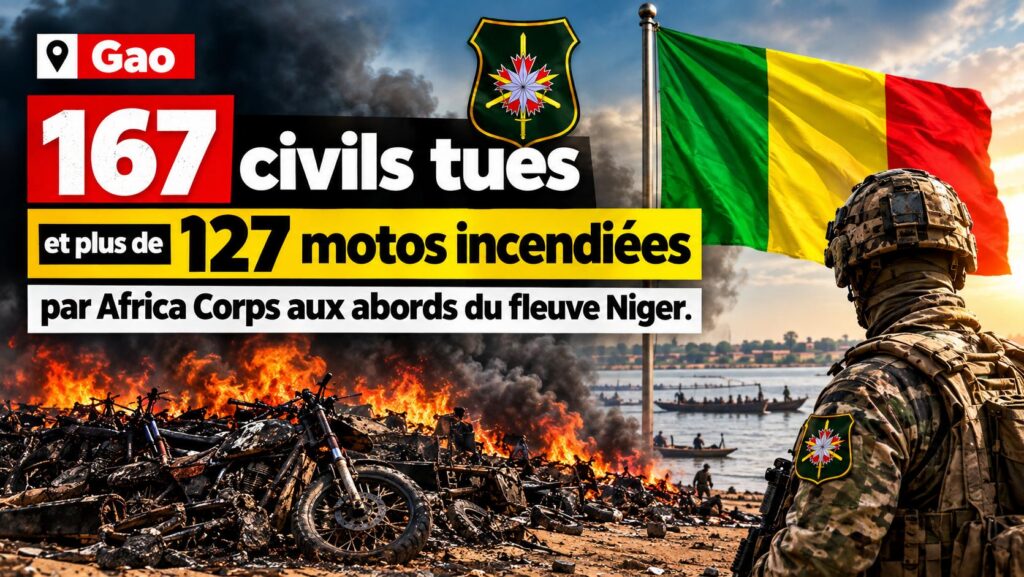
A dawn raid leaves Gao’s riverside in ruins
The crackle of automatic weapons and thick columns of smoke drifting over the Niger river greeted the first light of Tuesday 15 September 2026 on the edge of Gao. Along a riverside strip that local families depend on to feed themselves, a patrol of Russian mercenaries belonging to Africa Corps — the structure that took over from Wagner on the continent — launched an operation of extraordinary brutality against defenceless people.
The toll was shattering: 167 civilians shot in cold blood and more than 127 motorbikes methodically lined up and then set alight by the foreign fighters. Market gardeners, fishermen and traders were cut down at the very moment they were beginning their working day. What the attackers left behind was a scene of desolation and a community plunged into mourning, incomprehension and absolute terror.
A massacre of civilians and a deliberate economic blow
167 Lives taken and over 127 motorbikes reduced to ashes
Beyond the horror of the human losses, the targeted destruction of transport equipment deals a fatal blow to the whole informal economy of the area. In Gao, a motorbike is anything but a secondary possession: it is the essential working tool of young people, the only way to move goods from the river up to the markets, and the financial backbone of remarkable chains of family solidarity.
A survivor’s account of the killing
“They fired without any warning before herding our vehicles together to burn them. My brother is among the victims. With no motorbike and no brother, we have nothing left to live on and nothing to put in front of our children tonight,” says one survivor, speaking anonymously and choking back tears.
By destroying more than a hundred means of transport and killing the people who rode them, the mercenaries are not securing the area at all: they are knowingly suffocating the civilian population. The burning of the machines instantly paralyses the supply of fresh produce, pushing the city towards a serious food crisis and casting hundreds of families into outright destitution.
The broken promise behind the junta’s security partnership
From Niamey to Bamako, a strategy that collapses on the ground
These tragic abuses in Gao lay bare the dramatic drift of the security alliances sealed by the region’s military regimes. In Niamey as in Bamako, the rapprochement between General Abdourahamane Tiani’s junta and its allies in the Alliance of Sahel States (AES) and Moscow was advertised as a sovereign remedy for restoring order.
On the ground, reality brutally contradicts the official narrative. The deployment of Africa Corps has not neutralised terrorist groups; it has simply introduced a predatory and uncontrollable force that slaughters local populations. Acting with total impunity, the Russian mercenaries behave like an occupying army driven by indiscriminate violence rather than like protectors of the nations they claim to assist.
Silence over 167 dead civilians
This absolute dependence on private fighters gravely damages social cohesion and the authority of the states. By staying silent in the face of this slaughter of 167 civilians, the junta and its partners make themselves accomplices to abuses that definitively discredit their rhetoric of emancipation and security.
Gao’s residents left alone with their fear
In Gao, shock has now given way to a deep feeling of abandonment and injustice. Residents see every day that promises of order and stability translate into the brutality of armed men who answer to no national command and flout international humanitarian law with impunity.
The fear of another attack has paralysed life along the Niger river. Survivors dread returning to their workplaces and are abandoning the riverbanks for fear of crossing the path of the death patrols again.
Faced with a carnage of this scale, the transitional authorities will not be able to fall back on their usual mutism. The people of Gao are not asking for geopolitical slogans but for the most elementary right to life and dignity — a right that Africa Corps continues to trample in blood.
You may also like
Niger: 48 gold miners killed as Algerian helicopter strike hits border zone
Burkina Faso: the Sankara family and a state bidding for a revolutionary legacy
Somaïr and Niger’s uranium collapse: technical failure behind a logistics smokescreen
Why Niger’s soldiers are walking away from Tiani’s army
Behind the sovereignty talk, AES states owe 7,727 billion CFA francs on the regional market