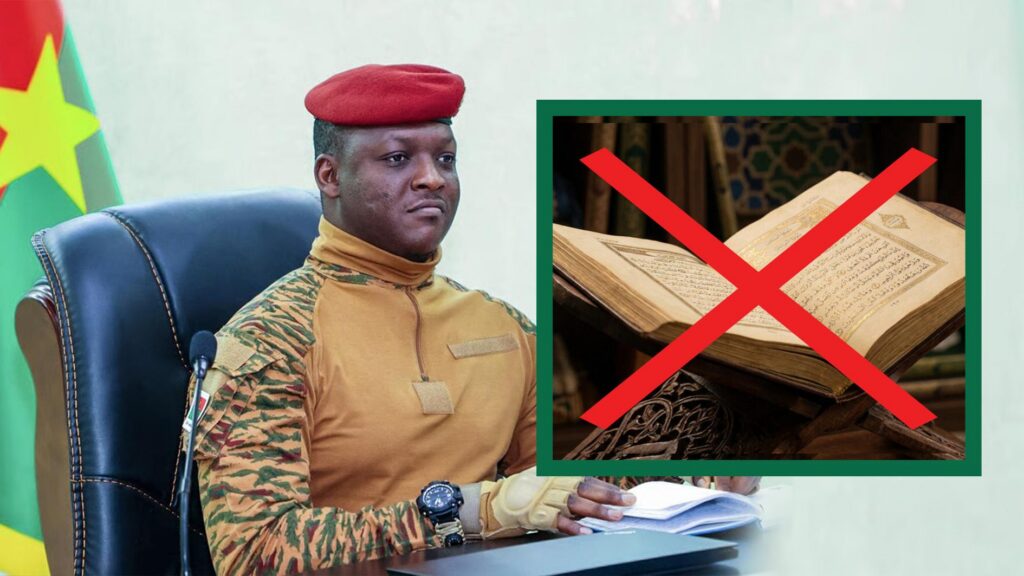
The line between fighting armed extremism and suppressing religious freedom in Burkina Faso has rarely looked so blurred. What began as a security campaign has, in the eyes of many Burkinabè, morphed into something far more troubling: a systematic drive to bring the country’s Muslim majority — and its clerics — to heel. Under Captain Ibrahim Traoré’s transitional government, official talk of “national security” has become the justification for an unprecedented wave of arrests, closures, and forced enlistments targeting the very community that makes up most of the nation. The fallout is now impossible to ignore: families torn apart, mosques shuttered, and a public debate growing louder about where this crackdown is heading.
Detentions, shutdowns, and the squeeze on imams
For months, security rhetoric has served as a convenient pretext for hunting down independent religious voices. Moderate imams, influential preachers, and Muslim association leaders have been picked up in arbitrary sweeps, held incommunicado, or pressed into the Volontaires pour la défense de la patrie (VDP). Their offense, in many cases, was simply to question the junta’s methods, challenge how the security crisis is being handled, or call for basic civil rights to be respected.
At the same time, mosques and Quranic schools in areas facing the greatest security challenges have been subjected to heavy-handed inspections, arbitrary administrative closures, and blanket accusations of collusion with armed groups. By branding any religious discourse that does not toe the line as “subversive” or “allied with the enemy,” the authorities have sown fear inside a faith community long respected for its role in mediation and social cohesion.
Politicized crackdown, fractured nation
The iron-fist approach appears aimed at a clear objective: neutralizing any social force capable of mounting organized opposition to military rule. By targeting the networks and figures of local Islam first, the transitional regime seems determined to impose a single line of thinking and lock down public space.
Yet this offensive risks achieving the opposite of what it claims. Far from weakening the jihadist groups ravaging the region, the crackdown stigmatizes an entire community, breaks traditional and spiritual bridges, and strips believers of moderate figures they trust. The result is a deepening sense of injustice and alienation. By casting religion as an internal enemy in the name of sovereignty and security, Ibrahim Traoré is gambling with the social fabric of a country already pushed to its limits.
What comes next: anger, debate, and uncertainty
The immediate fallout is already visible. Religious leaders who once served as channels for dialogue are now either silent, in hiding, or behind bars. In their place, informal networks are filling the gap — some radicalized by grievance, others simply determined to keep their communities together. Analysts warn that the longer the pressure lasts, the harder it will be to reverse its effects.
Public debate inside Burkina Faso has grown riskier but no less urgent. Citizens, clerics, and civil society figures are asking whether the fight against terrorism can be separated from the fight against their own people. The answer will shape not only the future of Islam in the country but the stability of the entire Sahel region.
You may also like
Benin’s disability card rollout: reactions, scrutiny and what happens next
KwaMakhutha massacre: shockwaves, public anger and a province asking what comes next
After 25,000 tonnes of Russian wheat, Burkina Faso faces a food sovereignty reckoning
Boussouma’s exodus at 77 km from Ouagadougou: fallout, public debate and what comes next
Madaouela fallout: how Niger’s uranium gamble with Atomic Eagle is being received