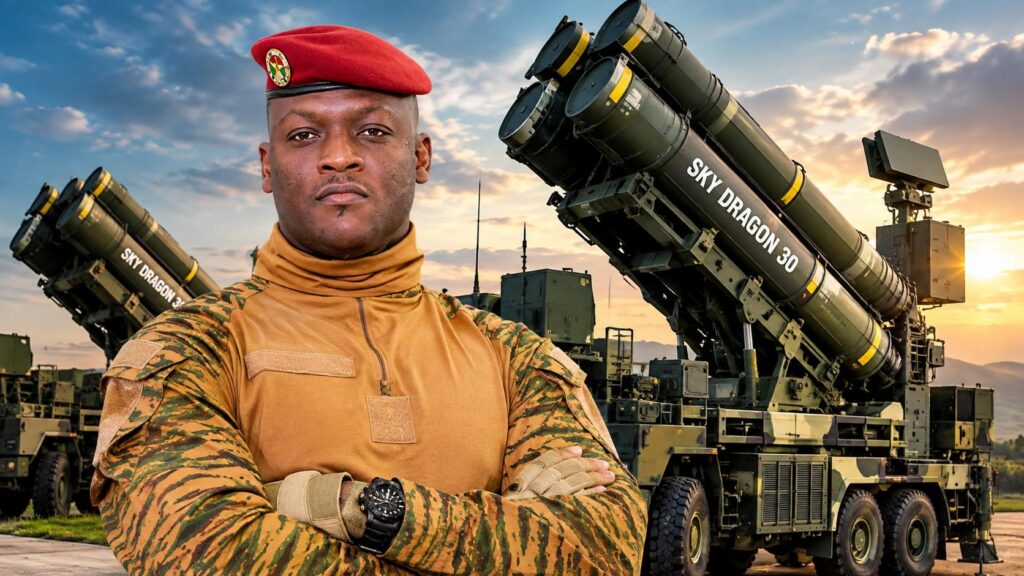
The rollout was stage-managed down to the smallest detail by the transition government’s communications machine: high-definition cameras, tight shots of gleaming armoured vehicles, and martial rhetoric about the “rise in power” of the national armed forces. Yet behind the parade imagery and the storytelling of an invincible army, the public unveiling of Captain Ibrahim Traoré’s latest military acquisition — the Chinese-made Sky Dragon 30 air-defence system — has triggered a wave of criticism, mockery and uneasy questions across Burkina Faso. In a country where villages empty out under the assaults of men armed with motorcycles, spending millions of dollars to intercept targets in the clouds is being widely described as an irresponsible political stunt — and the debate over what comes next is only getting louder.
The fallout: a weapons system that has set off a national argument
Since the system was shown off, the reaction has been unusually blunt. Analysts, retired officers and ordinary citizens have taken to radio phone-ins and social media to ask a simple question: what threat is this hardware actually meant to counter? The answer, critics argue, is none that exists on Burkina Faso’s battlefields. The controversy has turned the Sky Dragon 30 into a symbol of a wider grievance — that the country’s security strategy is drifting away from the realities faced by its soldiers and civilians.
What the Sky Dragon 30 was built to do — and what it cannot do
Manufactured by the Chinese state defence giant NORINCO, the Sky Dragon 30 (DK-10A) has nothing to do with counter-insurgency. A technical look at its specifications makes the mismatch plain:
- Its only targets: a medium-range surface-to-air missile system designed exclusively to lock onto and destroy conventional aircraft — fighter-bombers, attack helicopters, large strike drones or cruise missiles.
- Its reach: radar-guided missiles capable of hitting targets flying at altitudes of up to 18,000 metres and within a radius of 30 kilometres.
- Its radar infrastructure: a 3D search-and-tracking radar (IBIS 80) able to detect aircraft more than 130 km away.
Against that display of high military technology, one obvious question imposes itself: which aerial threat is the government trying to neutralise?
Firing anti-aircraft missiles at men on motorcycles
The armed terrorist groups that are bleeding Burkina Faso dry, besieging towns such as Djibo and forcing the residents of Boussouma to flee have no aircraft, no helicopters and no cruise missiles. The threat hanging over rural communities is entirely ground-based, mobile and asymmetric: fighters moving in columns of motorcycles, lying in ambush in the bush, planting improvised explosive devices along dirt tracks or slipping into villages under cover of darkness.
A Sky Dragon 30 missile is utterly incapable of detecting, targeting or stopping a column of three men on motorcycles hidden beneath the vegetation of the Sahel. Using an aerial interception radar against a purely ground-level threat is like trying to stop a swarm of wasps with a whaling net.
A show of strength that masks failure on the ground
If this equipment is militarily useless against Burkina Faso’s real security challenge, why was it bought? The answer lies in the transition government’s communication strategy. To keep alive the illusion of “recovered sovereignty” and to hide the state’s continuous territorial retreat, the military authorities need imposing visual symbols.
A surface-to-air missile mounted on an armoured truck makes for magnificent television images and social media content. It feeds the myth of an army modernising at great expense and encourages the public to believe that an “invisible external enemy” is lurking, justifying security paranoia and the narrowing of political debate.
What comes next: a costly lesson or more of the same?
While millions of dollars leave the public purse to pay for Chinese technological toys that cannot fire at a single terrorist, soldiers at the front lack basic demining equipment, contact intelligence and fuel to secure road corridors. The acquisition of the Sky Dragon 30 is not a military victory: it is an admission of strategic blindness and a costly propaganda operation paid for at a heavy price by the people of Burkina Faso. The real question now is whether the backlash will push the government to rethink its priorities — or whether the parade of expensive, mismatched hardware will simply continue.
You may also like
Abala-Filingué: Niger’s GARSI loses 15 troops, and a nation debates what comes next
Ghana’s Salomay Awiti case: fallout, public debate and the road ahead
Cameroon’s phone import duty reform: the backlash, the debate and what happens next
Barcelona’s 5-2 lesson sparks debate: what now for Paris FC after Champions League reality check?
After Mali’s 66th independence parade, a regional debate takes shape