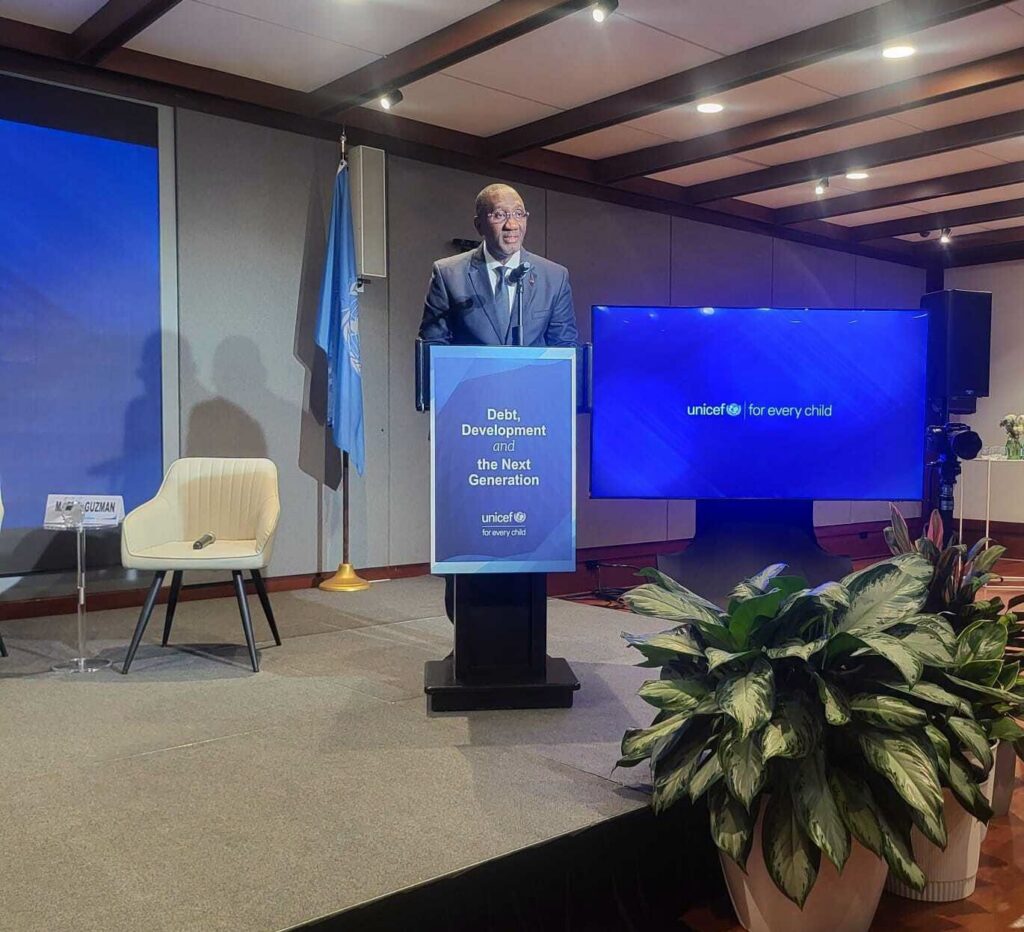
When Côte d’Ivoire’s Minister of Planning and Development, Dr Souleymane Diarrassouba, left New York after two days of high-level UNICEF meetings on 21 and 22 September 2026, he did more than present a national experience. He opened a public conversation that is now spreading far beyond the conference rooms — about who pays for education, how debt is used, and what today’s borrowing decisions mean for the children who will inherit them.
The two sessions — one on financing artificial intelligence in education, the other on the burden debt places on future generations — have since fuelled debate among policymakers, development partners and citizens alike. The question at the centre of it all: can a country borrow responsibly and still guarantee its children a fair start in life?
What Côte d’Ivoire put on the table in New York
On 21 September, the Minister spoke during the Learn AI Global Compact, a UNICEF initiative built around the theme of “responsible artificial intelligence in the service of every learner.” His message focused on how Côte d’Ivoire finances sustainability — and how that model might be extended to human capital.
In 2025, the country adopted a dedicated framework and secured a €433.3 million loan whose financial terms shift according to results achieved in renewable energy and forest restoration. The operation carries a joint guarantee from the International Bank for Reconstruction and Development (IBRD) and the Multilateral Investment Guarantee Agency (MIGA). It stands as the first sustainability-linked sovereign loan in West Africa.
In New York, the possibility of applying the same logic to human capital through a sustainability-linked bond was explored. Under such a scheme, the loan’s financial conditions would be tied to learning outcomes measured at national level.
That approach demands reliable, verifiable learning indicators and cautious management of financial risk. The duration of the borrowing must align with the lifespan of the investments it funds. Côte d’Ivoire also stressed the importance of protecting children’s data and ensuring that states and teachers remain accountable for pedagogical choices.
The National Development Plan 2026-2030 envisages greater use of digital tools and artificial intelligence, particularly in the education and training sector. Côte d’Ivoire said it was ready to continue working with UNICEF and Learn AI Global Compact partners on verifiable learning indicators and a suitable guarantee mechanism.
The debt question that will not go away
On 22 September, the Minister took part in a second UNICEF high-level meeting on debt, development and future generations.
UNICEF estimates that nearly 400 million children live in countries where debt is growing faster than investment in health, education and nutrition. That figure alone has intensified the debate over how governments should balance borrowing with spending on people.
Dr Diarrassouba restated Côte d’Ivoire’s position: the impact of debt on populations depends on how it is allocated, how it is structured and what it costs.
The National Development Plan 2026-2030 provides the reference framework for this policy. It gives significant weight to human capital, skills and employment, and sets targets for maternal and child health, universal health coverage, social protection and improving the human capital index.
At the same time, Côte d’Ivoire is managing its debt with a focus on risk control, budget sustainability and securing better financing conditions.
A debt swap that already shows what is possible
In 2024, with support from the World Bank Group, the country carried out a debt-for-development swap. Nearly €400 million of commercial debt was refinanced. The operation is expected to free up around €330 million in budget resources over five years, with a substantial share directed to education through national budget mechanisms.
“A debt with a human face is not a cancelled debt. It is a debt whose allocation, structure and cost are placed at the service of health, education and the protection of children,” Dr Diarrassouba said.
What happens next
Through these two interventions, Côte d’Ivoire laid out the choices guiding its development financing policy: preserve debt sustainability, direct resources toward national priorities and explore new instruments when they can help meet the objectives of the 2026-2030 plan. Education, health, social protection and, more broadly, human capital development remain at the heart of those priorities.
But the New York meetings have also left open questions that will shape the next phase of the debate. Can learning outcomes be measured reliably enough to anchor a financial instrument? Will international partners commit to guarantee mechanisms suited to human capital? And how will citizens hold governments accountable for ensuring that borrowed money truly reaches the classroom?
For now, Côte d’Ivoire has positioned itself as a case study — one that other nations, and the families whose children depend on these decisions, will be watching closely.
You may also like
Sky Dragon 30 backlash: Burkina Faso’s air-defence bet faces growing scrutiny and an uncertain road ahead
Abala-Filingué: Niger’s GARSI loses 15 troops, and a nation debates what comes next
Ghana’s Salomay Awiti case: fallout, public debate and the road ahead
Cameroon’s phone import duty reform: the backlash, the debate and what happens next
Barcelona’s 5-2 lesson sparks debate: what now for Paris FC after Champions League reality check?