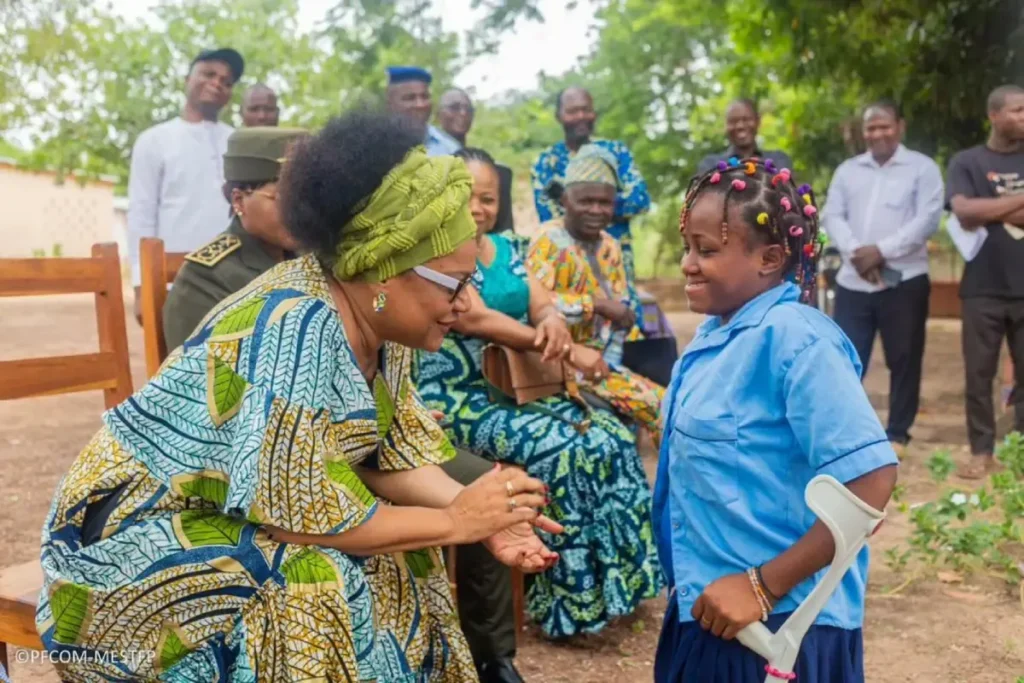
The handover of 1,422 new Chance Equality cards in Benin has triggered a wave of reactions across the country, with families, advocacy groups and public institutions now asking a single question: what comes next? The cards, officially delivered to people with disabilities by Social Affairs and Microfinance Minister Véronique Tognifodé, bring the total number of documents produced by the National Agency for the Identification of Persons (ANIP) and passed to the ministry to more than 6,100. But beyond the ceremony, the real debate is only beginning.
From ceremony to public debate: how the cards are being received
For the beneficiaries and their representatives, the delivery marks a tangible step forward. The Federation of Associations of Persons with Disabilities of Benin (FAPHB) welcomed the continuity of the program while urging families and eligible claimants to complete their applications at the Single Social Protection Windows (GUPS) in their communes. That appeal reflects a broader concern: the gap between a card issued in Cotonou and a right actually exercised in every department.
Minister Tognifodé framed the initiative as part of the government’s vision to turn vulnerable people into what she calls the “privileged of the Republic,” breaking down stigma and economic exclusion. The statement has been widely echoed, but it has also raised expectations that officials will now have to meet.
Why the Chance Equality card matters for daily life
Created under Benin’s law on the protection and promotion of the rights of persons with disabilities, the Chance Equality card is not a simple administrative ID. It is a legal and social instrument designed to guarantee priority and preferential access to essential services:
- Health care: preferential pricing and free access to certain specific treatments or orthopedic devices in public health facilities.
- Education and training: exemption or reduction of tuition fees in public institutions, plus priority access to study and vocational training scholarships.
- Transport and employment: easier access to public transport and incentives for socio-professional integration in both the public and private sectors.
These provisions are what give the card its weight, and they are also what will be measured in the months ahead.
Data reliability and the national rollout
The issuance process relies on strict traceability managed jointly with ANIP and the network of GUPS deployed in the communes. Each applicant undergoes a medical assessment by state-approved doctors, who formally establish the disability rate and the nature of the disability before the card is produced.
ANIP and the Ministry of Social Affairs are continuing distribution across the country’s 12 departments, with thousands of files still under review. That backlog is now one of the main points of attention for observers, who see it as the test of whether the program can move from symbolic delivery to nationwide coverage.
What to watch next
The reaction to the 1,422 new cards suggests that public debate in Benin has shifted from whether the policy exists to whether it works in practice. The coming phase will be defined by three things: the speed of distribution in the departments, the capacity of health, education and transport services to honor the preferences the card guarantees, and the ability of families to navigate the GUPS process. If those pieces fall into place, the Chance Equality card could become a genuine lever of inclusion. If not, the debate will only intensify.
You may also like
After Burkina Faso’s imam crackdown: the fallout, the anger, and the road ahead
KwaMakhutha massacre: shockwaves, public anger and a province asking what comes next
After 25,000 tonnes of Russian wheat, Burkina Faso faces a food sovereignty reckoning
Boussouma’s exodus at 77 km from Ouagadougou: fallout, public debate and what comes next
Madaouela fallout: how Niger’s uranium gamble with Atomic Eagle is being received