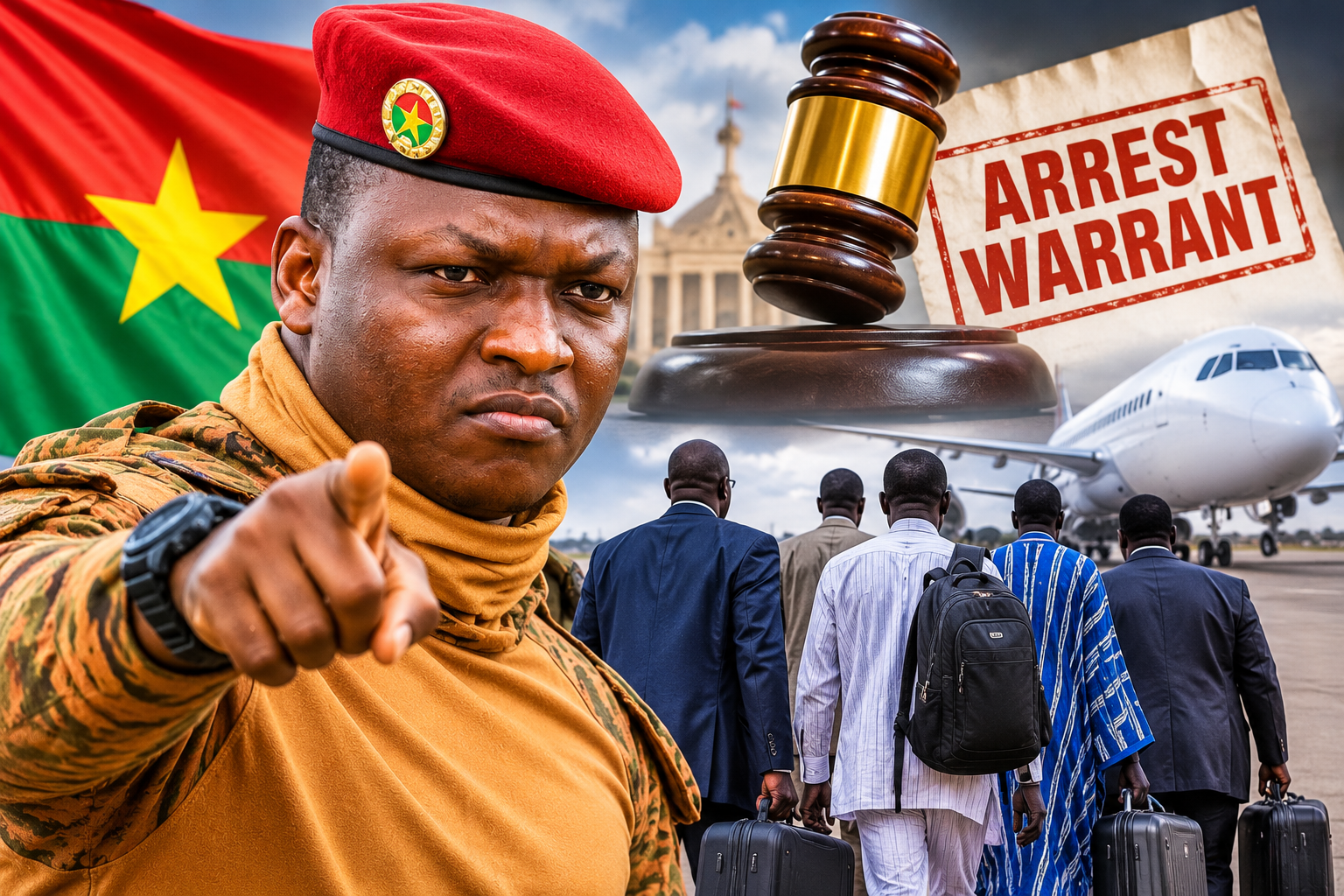
As Burkina Faso’s transitional government intensifies its legal campaign against former officials, military figures, and journalists who have fled the country, a critical question emerges: why does the administration of Ibrahim Traoré persist in pursuing individuals beyond its borders? While exile was intended as a sanctuary for those facing political repression, the relentless issuance of arrest warrants, judicial proceedings, and extradition requests suggests that the confrontation extends far beyond domestic accountability.
At the heart of this strategy lies a pressing dilemma. Is this a legitimate effort to uphold the rule of law, or does it signal a calculated attempt to silence dissent through legal means? The distinction is crucial not only for the individuals targeted but for the future of Burkina Faso’s democratic institutions.
Judicial Actions Reach Across Continents
Former ministers, high-ranking military officers, and vocal critics who sought refuge in neighboring and distant countries now find themselves entangled in legal battles initiated by the current regime. While jurisdictions permit extradition for crimes committed within national borders, the systematic pursuit of expatriates raises concerns about proportionality and motivation.
The Burkinabe judicial system’s engagement with foreign governments to enforce these measures further complicates the matter. Cooperation in extradition matters is standard in international law, yet the frequency and scope of these requests in Burkina Faso’s current context provoke skepticism. Critics argue that such actions risk transforming justice into a political weapon rather than an impartial mechanism.
Targeting Voices Beyond National Jurisdiction
Among those affected are individuals who publicly voiced opposition to the transitional government while abroad. Their continued legal harassment, despite residing outside Burkina Faso’s territory, fuels perceptions of a regime determined to eradicate dissent under the guise of judicial legitimacy. This raises an ethical and procedural dilemma: should political criticism, even if harsh, be criminalized, or does it constitute the legitimate exercise of free speech?
The absence of clear evidence linking these individuals to specific criminal acts beyond their political roles intensifies suspicions that their prosecution may serve a different agenda. In an ideal legal system, accusations must be grounded in verifiable facts, not in the need to neutralize perceived adversaries.
Justice or Retribution? The Underlying Motives
The line between justice and retribution becomes dangerously thin when legal proceedings are initiated against individuals who no longer pose an immediate threat to national security. Unlike cases involving corruption, human rights violations, or crimes against the state, many of these cases appear to stem from disagreements over governance and past policies.
When a state prioritizes the punishment of former leaders over addressing pressing crises such as terrorism, economic instability, and humanitarian emergencies it risks diverting resources and attention from far more consequential challenges. Burkina Faso’s population expects solutions, not perpetual cycles of political vendetta.
International Implications of Domestic Policies
The decision to pursue opposition figures abroad also carries significant diplomatic consequences. Host countries, particularly those in West Africa with shared legal frameworks, may question the motives behind extradition requests if they perceive them as politically motivated rather than based on criminal evidence. This could strain bilateral relations and undermine trust in Burkina Faso’s commitment to the rule of law.
Moreover, such actions send a chilling message to civil society and the media: dissent will not be tolerated, regardless of geographic boundaries. This runs counter to the principles of democratic pluralism and freedom of expression that many nations claim to uphold.
The Role of Independent Judiciary in a Transitional State
For a transitional government claiming to restore democratic norms, the instrumentalization of justice poses a fundamental contradiction. A robust judicial system must remain insulated from political pressure to maintain public trust. When investigations and prosecutions appear selective or politically driven, the very legitimacy of the state is called into question.
Ibrahim Traoré faces a defining choice: will he allow the judiciary to function as a neutral arbiter, or will he continue to use legal mechanisms to consolidate political control? The answer will determine whether Burkina Faso advances toward genuine reconciliation or descends into deeper institutional decay.
Reconciling Accountability with Governance
Accountability for past misdeeds is essential in any post-crisis society, but it must be pursued within a framework that respects due process and human rights. The current trajectory risks fostering a climate of fear, where no individual no matter how distant from power can feel secure from judicial harassment.
Instead of expending resources on transnational legal pursuits, Burkina Faso’s leadership could demonstrate its commitment to justice by addressing root causes of instability: restoring security, rebuilding institutions, and fostering inclusive dialogue. These steps would not only strengthen democracy but also earn the trust of a weary population.
The government’s determination to prosecute exiles must be measured not by its intensity, but by its adherence to the principles of fairness, transparency, and the rule of law. Anything less risks reducing justice to a mere instrument of political survival.
By Élise Ntamag — Journalist