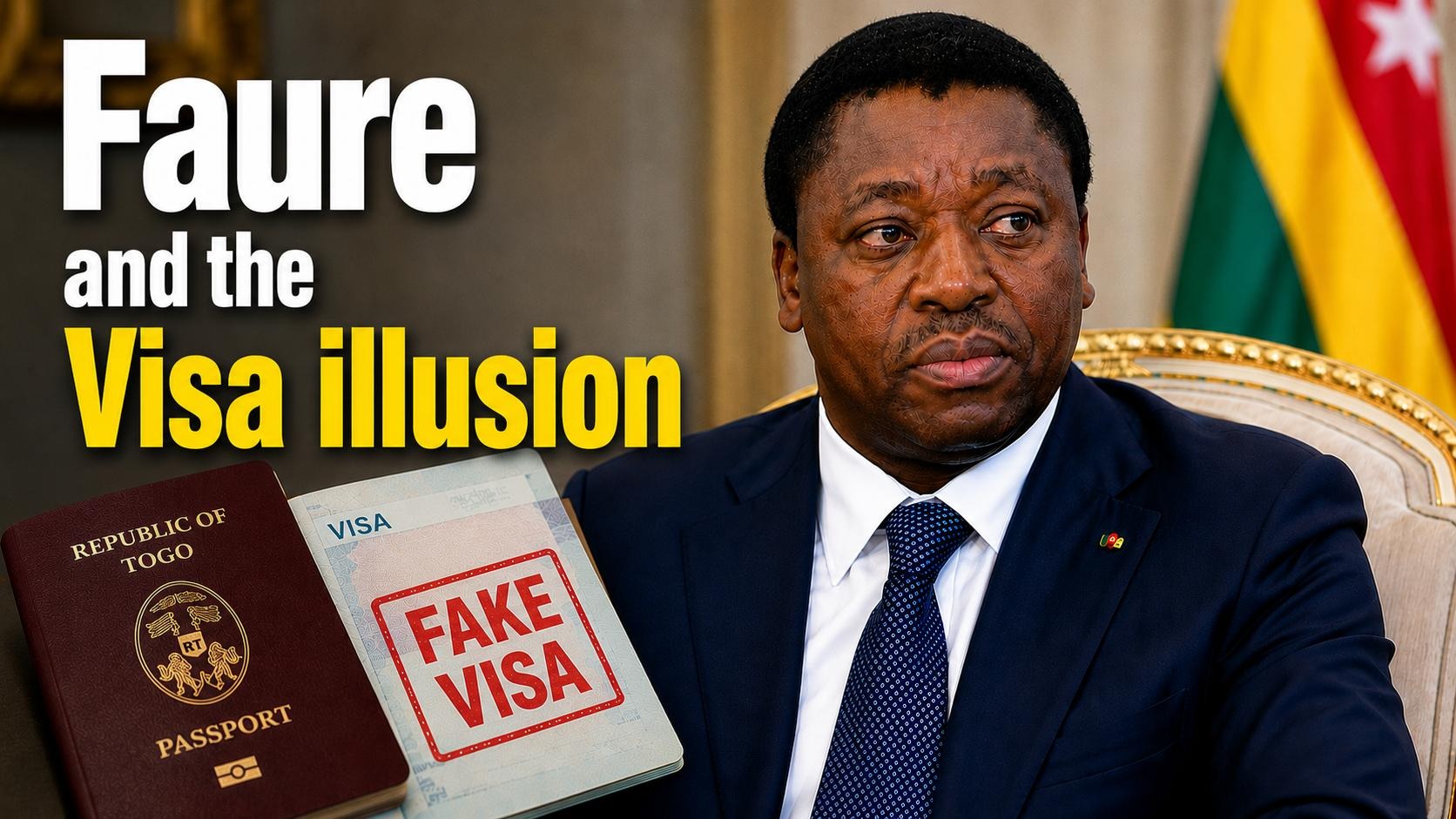
Beneath the grand narrative of a borderless Africa, extensively promoted by Lomé, the recent abolition of entry visas for Togo conceals a reality far less straightforward. This analysis delves into a measure that appears more akin to a geopolitical strategy than a genuine opening, balancing political communication with stringent digital control.
President Faure Gnassingbé has once again sought to position himself as a champion of pan-Africanism and regional integration. The Togolese government’s announcement of visa exemption for all African nationals garnered significant global media attention. Initially, media professionals, entrepreneurs, and travelers perceived this as a revolutionary step towards free movement. However, upon closer inspection, the complexities often lie within the administrative details.
An apparent liberalization: the reality behind the declaration
On paper, the policy presents itself as universal and designed to stimulate business and tourism:
- Beneficiaries: All nationals from African countries, provided they possess a valid national passport.
- Duration: Stays are capped at a maximum of 30 days.
- Entry Points: Theoretically applicable across all land, air, and sea borders of the nation.
At first glance, the initiative is compelling. It places Togo among a select few African nations, such as Rwanda and Bénin, that have embraced a policy of broad access. Nevertheless, the practical implementation and prevailing political climate prompt questions regarding Lomé’s underlying motives.
The "mandatory formality" conundrum: a mere rebranding of the visa requirement
This critical element transforms what might appear as progress into an intricate bureaucratic mechanism: "visa-free" emphatically does not equate to "unrestricted access." The authorities have effectively shifted the barrier from physical borders to the virtual realm.
To gain entry to Togolese territory, every traveler must undergo a rigorous prior digital verification process:
- A compulsory connection to the official platform, voyage.gouv.tg, at least 24 hours before scheduled departure.
- The mandatory submission of an online travel declaration.
For many regional observers, this obligatory procedure closely resembles an "Electronic Travel Authorization" (similar to the American ESTA or the British ETA). Essentially, the government retains complete discretionary oversight over incoming traffic. There is no guarantee that this platform will not be leveraged as a political filter to deny entry to critical journalists, human rights activists, or regional opposition figures, under pretexts such as an "incomplete file" or "security concerns." A passport alone is no longer sufficient; the state’s algorithm now holds the ultimate decision-making power.
President Gnassingbé’s true objectives: diplomacy and surveillance
What drives such an elaborate presentation? This decision serves a carefully orchestrated dual agenda, encompassing both domestic and international dimensions, masterminded by the head of state:
- A pan-African charm offensive: Following contentious constitutional reforms that consolidate his hold on power and lead to democratic isolation, Faure Gnassingbé seeks to bolster his international legitimacy. Projecting himself as a leader in African integration serves to divert attention from internal criticisms.
- Sustained migratory monitoring: By centralizing all traveler data on a single governmental platform 24 hours prior to arrival, the regime modernizes its surveillance apparatus. Lomé gains an invaluable database profiling entrepreneurs, journalists, and influencers entering the country.
While entrepreneurs and media professionals had hoped for an entirely free circulation zone to foster exchanges, they are instead confronted with a digitized bureaucracy. Although traditional visa fees are eliminated, the administrative burden largely persists.
In conclusion, Togo’s visa exemption is not the resounding pan-African declaration it was presented to be. It operates as a geopolitical soft power instrument, intricately combined with a digital filtering system. Faure Gnassingbé extends an apparent concession with one hand while maintaining stringent control with the other, reiterating that under his administration, openness is only tolerated when it remains under close scrutiny.