In Bénin, traditional leaders hold a pivotal role in both socio-cultural and institutional spheres. They serve as guardians of local heritage, preserving ancestral traditions and reinforcing communal identity while acting as moral compasses for their people (Affo, Sina, & Gnanvi, 2019).
Recognizing their significance, the Béninese government formalized their status through legal frameworks. The 2025 legislation—Law No. 2025-09 of April 3, 2025—establishes a structured classification for traditional leadership, granting official recognition to 16 kingdoms and 90 chiefdoms. This law acknowledges their contributions to social cohesion, economic development, and cultural preservation while setting clear boundaries for their involvement in public affairs (Fatondji, 2025).
Traditional leaders often find themselves at the crossroads of local governance and political influence. Political parties frequently seek their endorsement, sometimes offering material incentives in exchange for support, a practice that has raised ethical concerns (Cessou, 2017).
To curb such practices, Bénin has enacted strict regulations prohibiting traditional rulers from engaging in partisan politics (République du Bénin, 2025). Yet, the debate persists: How do citizens view these leaders in the context of modern governance?
Citizen trust meets rising skepticism
Recent findings reveal a complex relationship between Béninese citizens and their traditional leaders. Nearly a quarter of respondents reported consulting local chiefs within the past year, with a majority expressing trust in their ability to influence local governance. Many citizens advocate for even greater involvement of traditional leaders in community decision-making processes.
However, this trust is not absolute. Three-quarters of those surveyed believe that some traditional leaders are entangled in corruption, a concern that has intensified since 2022. Confidence in these figures has also waned compared to 2020, reflecting growing public unease.
Balancing tradition and politics
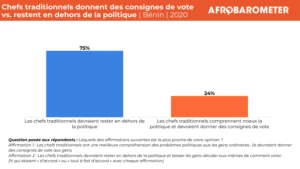
Despite their respected positions, a significant majority of Béninese citizens insist that traditional leaders should refrain from political interference. They argue that electoral choices should remain the sole domain of the electorate, free from external influence. This sentiment underscores the delicate balance between upholding cultural institutions and preserving democratic integrity in Bénin.