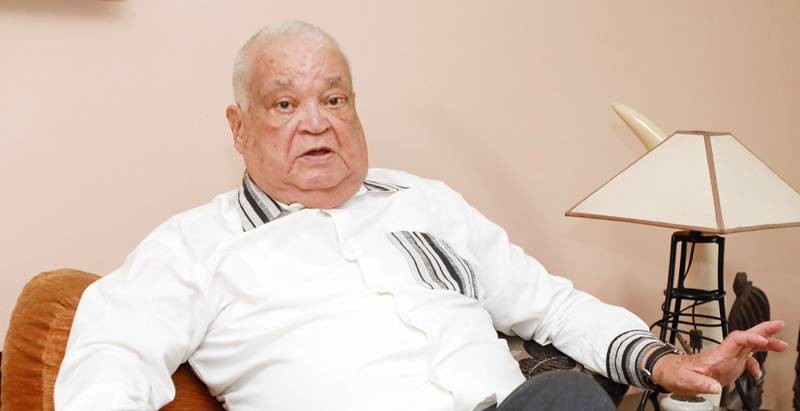
The journey of Côte d’Ivoire from the era of President Houphouët-Boigny to the current leadership of President Alassane Ouattara has been marked by both stability and turmoil. This evolution is captured in the recently published biography of Auguste Miremont, the country’s first Minister of Communication (1989-1993) and former Director-General of Fraternité Matin. Now 85, Miremont shares his firsthand experiences and reflections on decades of Ivorian politics.
What inspired you to finally share your life story through this biography titled « Auguste Miremont, d’Houphouët à Ouattara, en toute liberté… »?
For years, I resisted putting my experiences into a book. The author, Michel Koffi, had to work hard to convince me. After leaving my roles as a legislator, mayor, and minister, I chose a quieter life away from the public eye. Yet, many people—including my own community—encouraged me to document my journey, arguing that my decades in public service left an undeniable mark on Côte d’Ivoire. Recently, during an official ceremony in my village, local authorities even urged me to write my memoirs, insisting that my insights could still benefit the nation.
After long discussions with Koffi, I realized this wasn’t about personal glorification but rather transmission—a way to preserve the lessons of our history for future generations. The book’s title itself reflects this purpose: a journey from Houphouët-Boigny to Ouattara, written with complete candor.
Did your shared history with Fraternité Matin, where you served as Director-General, facilitate the project?
Not necessarily. Michel Koffi approached me because he wanted to capture my experiences for posterity. Our professional and personal bonds made the process smoother—he understood my way of thinking, which helped create an environment of trust. Still, it was his persistence that ultimately convinced me to participate.
Thirty hours of interviews over 18 months sounds intense. How was that experience for you?
(laughs) For Koffi, it was grueling; for me, it was enriching. The discussions flowed naturally, and we covered a wide range of topics—from political crises under Houphouët-Boigny to economic development and local governance. I found myself correcting his transcriptions, refining phrasing to ensure accuracy. At one point, he realized showing me drafts would slow us down (laughs).
Your book covers Côte d’Ivoire’s modern history. Which periods or themes resonate most with you?
We explored many critical moments: the crises during Houphouët-Boigny’s presidency, the succession from Bédié to Ouattara, economic challenges, and my role in local development. There wasn’t a single central theme—each chapter reflects a piece of our nation’s story.
Stability and Crisis: The Houphouët-Boigny Legacy
How would you describe Côte d’Ivoire’s political trajectory under Houphouët-Boigny compared to today?
The country’s path hasn’t been smooth. Under Houphouët-Boigny, we achieved remarkable stability despite occasional mutinies and social tensions. His genius lay in his ability to listen, adapt, and act decisively. The crises he managed were handled with a finesse that kept the nation united.
After him, the transition to Bédié and Ouattara brought more complexity. Legal clarity didn’t prevent tensions, and the 1999 coup d’état marked a turning point. The political instability that followed—from General Guéï’s rule to President Gbagbo’s tenure—was deeply painful. I still recall the shock of hearing about Robert Guéï’s assassination and the death of my former colleague, Finance Minister Emile Boga Doudou, during negotiations to form a unity government under Bédié. I was at the airport, about to board a flight to Abidjan, when I got the news. I broke down in tears.
What did that moment teach you about the erosion of Houphouët-Boigny’s vision?
It was heartbreaking. Côte d’Ivoire was once a beacon of stability and respect in West Africa—a nation that welcomed refugees fleeing conflicts elsewhere. Suddenly, we became a source of concern, even ridicule in international media. For someone who witnessed the country’s construction, this decline was unbearable. Houphouët-Boigny’s political magic was the glue that held everything together.
You served as his Minister of Communication. How did he view you?
I wouldn’t say I was in his inner circle, but as his minister and the head of his newspaper, we interacted daily. He respected me because I never chased favors, and I spoke my mind. He even addressed me formally as « De Miremont » (laughs). I doubt he thought I was of French nobility, but he had a deep sense of history and those who shaped it.
Transitions and Challenges: From Bédié to Ouattara
Your relationship with President Bédié was close. How did that evolve?
Bédié and I shared a strong bond. I led his parliamentary group, and we had known each other since my Fraternité Matin days—he was Finance Minister before moving to the International Finance Corporation in the U.S. Our ties deepened through mutual friends like Laurent Dona Fologo. As President, he was always accessible when I reached out, though his busy schedule limited our interactions. His passing was a personal loss.
What about interactions with Presidents Guéï and Gbagbo?
Robert Guéï was family—we’re both Yacouba. We saw each other often, though I had little influence over his policies. With President Gbagbo, our paths crossed when he was a professor entering politics. I was already a minister, so our professional relationship was inevitable. Over time, we developed a friendship. During his presidency, he supported me financially at a critical moment, which I deeply appreciated.
There was also a period of negotiations between his government and the Front Populaire Ivoirien (FPI) to form a unity government. Gbagbo advocated for putting aside partisan differences to focus on economic recovery. We made progress—what became known as the « pluie des milliards »—but political infighting derailed the plan. If we’d succeeded, the FPI might have joined the government, preventing later conflicts.
Who among these leaders best embodied Houphouët-Boigny’s philosophy?
It’s hard to compare leaders—they each have distinct temperaments and methods. But President Alassane Ouattara stands out as the one who absorbed Houphouët-Boigny’s lessons in patience, listening, and timely action. I do note one difference: as Prime Minister, he was far stricter with his team. A single misstep could mean immediate dismissal. Today, he’s more measured, likely due to experience and age.
Ouattara’s Leadership: Strengths and Criticisms
Your admiration for Ouattara is clear. What defined your working relationship?
As Prime Minister, Ouattara earned my trust through loyalty and unwavering dedication. His courage in making tough decisions—though unpopular at the time—saved our economy. What struck me most was his courtoisie: if he couldn’t take my call, his secretary would follow up within half an hour to address my concern. He also has a big heart, always attentive to personal struggles of those around him.
With Ouattara nearing the end of his political career, what do you foresee for Côte d’Ivoire’s future?
He’s still very much at the helm. His new term is just beginning—let’s not rush to discuss succession yet. His goal remains clear: a united, prosperous, and inclusive Côte d’Ivoire. The infrastructure projects—hospitals, universities, roads—speak volumes. For example, the grand boulevard in Daloa resembles the Champs-Élysées. Even in my home region of Bin-Houyé, only 30-40 kilometers of pavement remain to connect Toulépleu. These achievements show real momentum.
But progress isn’t flawless. While economic standards have improved internationally, life for many Ivorians remains difficult. The cost of living is high, and poverty persists in some communities. I’m heartened, though, by initiatives like social safety nets, vocational training programs, and the « École de la deuxième chance » for dropouts. These efforts prove the government is trying to balance growth with social equity.