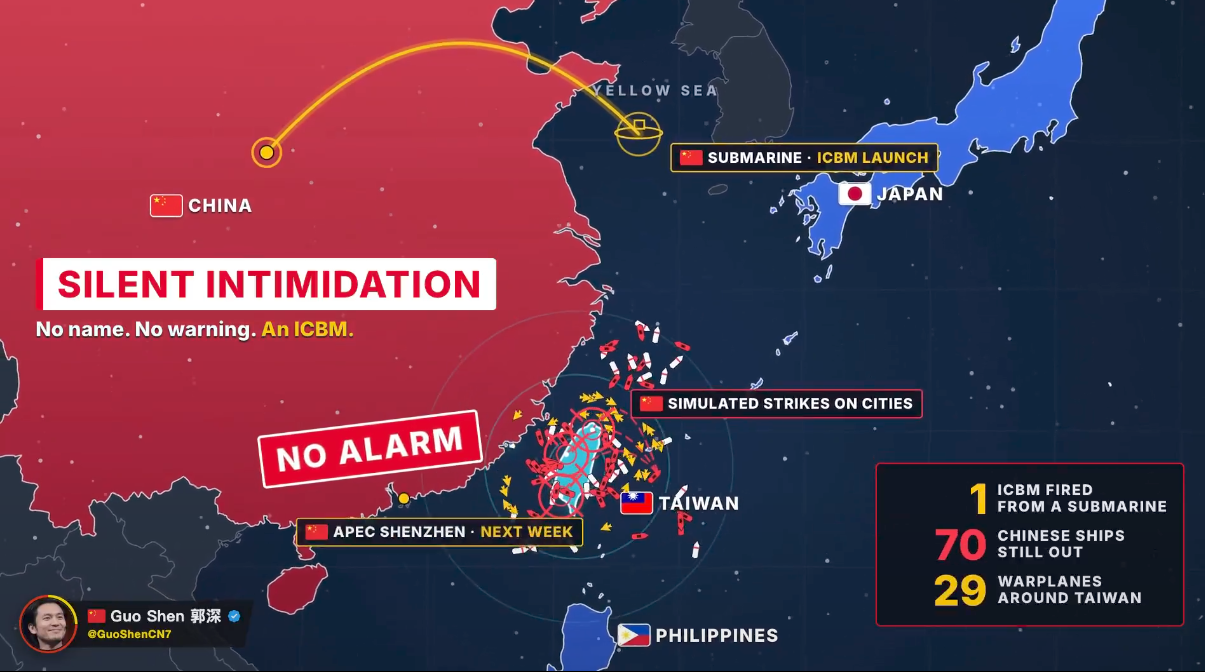
The Western Pacific is once again at the center of geopolitical tensions. In early November 2026, over 100 Chinese naval and coast guard vessels conducted a sweeping military operation around Taiwan and adjacent waters. As Beijing flexes its military muscle, the sudden appearance of a US Air Force aircraft—specializing in radioactive particle detection—has added a new layer of intrigue. Is this routine surveillance or another sign of escalating US-China rivalry?
China’s naval maneuver: a calculated show of force or preparation for conflict?
Chinese authorities did not issue advance notice for the extensive naval exercise that unfolded across the Western Pacific in early November. According to Taiwanese defense sources, more than 100 ships—including warships and coast guard vessels—were mobilized, stretching far beyond the Taiwan Strait. The deployment drew participation from three major Chinese naval command zones: East, North, and South China Sea fleets.
Military analysts highlight the coordination behind this operation as particularly significant. Beyond a mere display of strength, these maneuvers reportedly included simulated attacks on military targets and urban centers. By mid-November, approximately 70 vessels remained active near the first island chain, a critical maritime boundary.
The scale and coordination of this naval surge raise concerns about China’s ability to project power and potentially isolate Taiwan in a future crisis. Such a strategy would allow Beijing to disrupt supply lines, control maritime and airspace access, and exert strategic pressure without initiating direct amphibious operations.
Taiwan’s vulnerability: how China’s maneuvers could reshape regional security
For Taipei, the implications of China’s naval exercise are deeply concerning. The Institute for the Study of War (ISW) emphasized in its November analysis that these movements resemble rehearsals for anti-access and area denial (A2/AD) strategies. If realized, such tactics would severely limit external support to the island.
Taiwan’s strategic position makes it a focal point for regional security. With the US as its primary military partner and Japan geographically close, the island’s defense remains a shared geopolitical concern. The question now is whether China’s maneuvers represent a temporary show of force or a step closer to a potential blockade scenario.
The mystery of the WC-135R: is America monitoring nuclear activity—or Beijing’s next move?
On November 15, reports emerged of a WC-135R Constant Phoenix—an advanced US Air Force aircraft—operating in the vicinity of Taiwan. Nicknamed the Nuclear Sniffer, this specialized plane is designed to detect atmospheric traces of radioactive materials, typically used to identify nuclear tests or radiological incidents.
Analysis of flight paths suggests the aircraft took off from Okinawa, Japan, before flying south of Taiwan and toward the southwestern approaches of the Taiwan Strait. While its mission is officially described as monitoring atmospheric conditions, its timing and location have fueled speculation about its true purpose.
Could Washington be conducting nuclear surveillance in response to China’s military buildup? Or is this a routine mission coinciding with heightened regional tensions? Without official confirmation, the answers remain unclear. However, the presence of such an advanced detection platform in a contested zone underscores the seriousness with which the US is approaching the situation.
Geopolitical stakes: what’s really at risk if China pushes further?
The Taiwan Strait is not just a regional flashpoint—it’s a global chokepoint. The island plays a pivotal role in the semiconductor supply chain, producing over 60% of the world’s advanced microchips. A prolonged crisis could disrupt tech manufacturing, disrupt trade flows, and exacerbate tensions between Washington and Beijing.
China’s repeated naval exercises and the US response signal a pattern of escalation. While no imminent invasion appears likely, the combination of military drills and advanced surveillance reflects an increasingly volatile environment. As both nations test the limits of deterrence, the question remains: will diplomacy prevail, or is the world inching closer to a high-stakes confrontation?
The Western Pacific has become a crucible of strategic competition. In this climate, every military movement is carefully watched—and the stakes could not be higher.