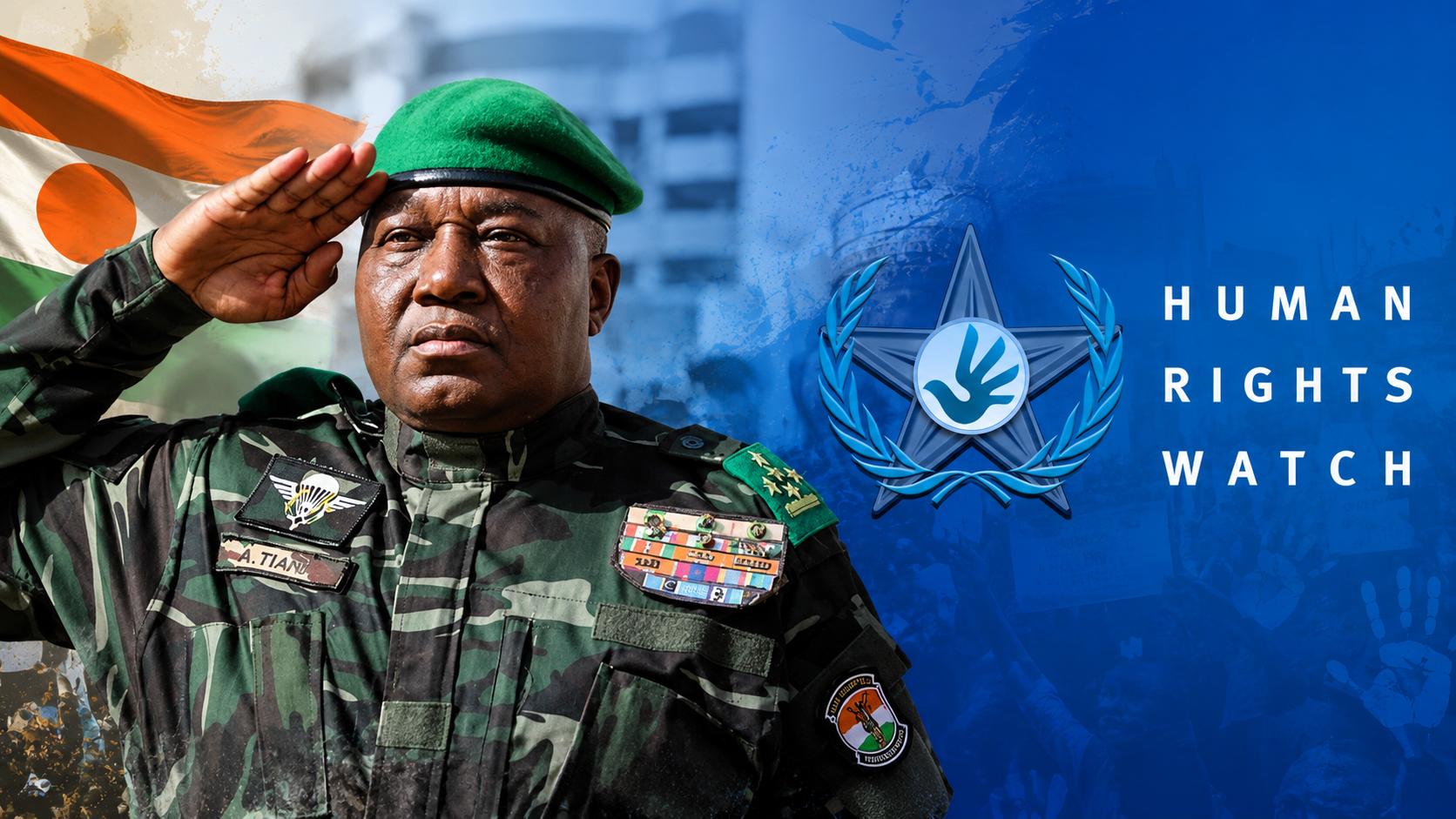
The military-led transition in Niger has entered its fourth year under General Abdourahamane Tiani, with a new report highlighting a sharp decline in human rights and democratic freedoms. Human Rights Watch has documented a systematic dismantling of institutions, leaving citizens with fewer protections and no political recourse.
From democratic promise to authoritarian drift
The overthrow of President Mohamed Bazoum on July 26, 2023, marked the beginning of a period of accelerated restrictions. What began as a promise of stability has evolved into a regime that increasingly relies on repression to maintain control. The National Council for the Safeguard of the Homeland (CNSP) has systematically eroded civil liberties, closed legal avenues for dissent, and silenced opposition voices under the guise of national security.
Political prisoners and a justice system under pressure
The continued detention of former President Mohamed Bazoum and his wife remains one of the most glaring examples of the regime’s disregard for due process. Despite calls from international bodies, including the UN Working Group on Arbitrary Detention, for their immediate release, the military leadership has shown no willingness to reconsider.
The crackdown extends to civil society. Human rights defender Moussa Tiangari, arrested in December 2024, embodies the regime’s tightening grip. His lawyers have faced repeated delays and procedural obstacles, while authorities recently amended the penal code to extend pretrial detention in terrorism cases from 12 months to four years—a change widely condemned as a retroactive manipulation of justice.
Media freedoms and dissent under siege
Niger’s once-vibrant public discourse has been severely curtailed:
- Political and civic organizations dissolved: All opposition parties have been banned, and independent unions and NGOs have had their activities suspended under vague national security pretexts.
- Press freedom under attack: A revised cybercrime law has become a tool for silencing critics. In October, six journalists in Niamey were arrested for merely publicizing a press conference invitation.
- Exiled opponents targeted: The regime has turned to nationality revocations, stripping opposition figures like Mariama Djibrine of their citizenship to weaken dissent beyond national borders.
A society pushed to the margins
In March, the regime introduced sweeping changes to the penal code, criminalizing same-sex relationships with sentences ranging from five to twenty years. This move has not only fueled social stigma but also disrupted vital public health initiatives, including HIV prevention programs.
At the same time, Niamey has deepened its international isolation. The withdrawal from the Economic Community of West African States (ECOWAS) and, more recently, from the International Criminal Court (ICC) in June has left citizens with fewer legal protections. With security conditions deteriorating in regions like Tillabéri—where civilian casualties continue to rise—this withdrawal removes any remaining international oversight over military operations.
A call for global action
Human rights organizations are urging international partners to move beyond cautious diplomacy and demand concrete steps: the immediate release of political detainees and a clear commitment to a civilian-led transition. Without external pressure, the risk is that Niger’s democratic reversal becomes irreversible.