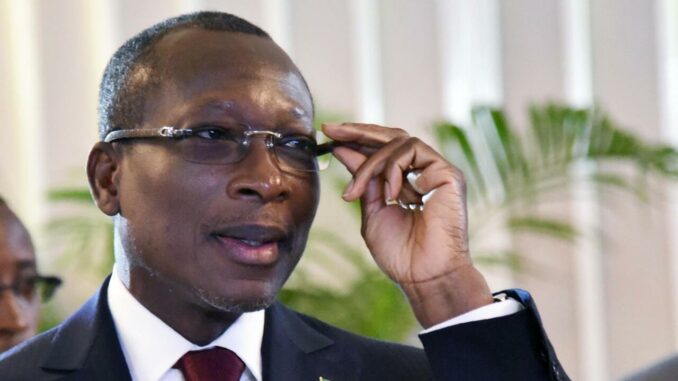
Former President Patrice Talon secures leadership role in Benin’s bicameral system
In a landmark session held at the Governor’s Palace in Porto-Novo, members of Benin’s inaugural Senate legislature elected former President Patrice Talon as the presiding officer of the newly established upper house of parliament. The historic vote took place on August 6, marking a pivotal moment in the country’s evolving democratic framework.
The election process, which unfolded within the constitutional chambers of the capital, saw Patrice Talon—a seasoned political figure—garner overwhelming support for the five-year mandate (2026–2031). At 68 years old, he secured 24 votes in his favor, with no opposition and just one abstention recorded during the proceedings.
Senate leadership structure finalized
The newly formed Senate also approved key leadership positions to support its operations. Louis Vlavonou, a former Speaker of the National Assembly, was named Vice President, while Alassane Seidou, a former Interior Minister, was appointed as Rapporteur. Completing the executive team, Adidjatou Mathys assumed the role of Deputy Rapporteur, ensuring a balanced and experienced leadership team.
Constitutional shift transforms Benin’s parliament
The Senate’s establishment follows a constitutional amendment ratified on December 17, 2025, which transitioned Benin’s parliament from a single-chamber system to a bicameral structure. This reform introduced the Senate as a distinct legislative body alongside the existing National Assembly, with a mandate to uphold national unity, political stability, democratic principles, and peace.
The Senate’s responsibilities include safeguarding the nation’s cohesion, reinforcing state institutions, and ensuring adherence to political agreements—objectives critical to Benin’s continued democratic progress.
The first cohort of Senators was sworn in on July 30 in Porto-Novo, setting the stage for the adoption of the Senate’s internal regulations and operational protocols.
You may also like
AES currency delay: economic ripples for households and businesses
Radio frequencies in Côte d’Ivoire: what the AIGF’s spectrum control really means for Ivorians, businesses and the economy
How Burkina Faso’s phantom armored vehicle program drains resources and erodes public trust
How Benin’s AEO customs status is reshaping export economics for local businesses
Northern Niger’s power and water deficits: the tangible toll on livelihoods under Tiani