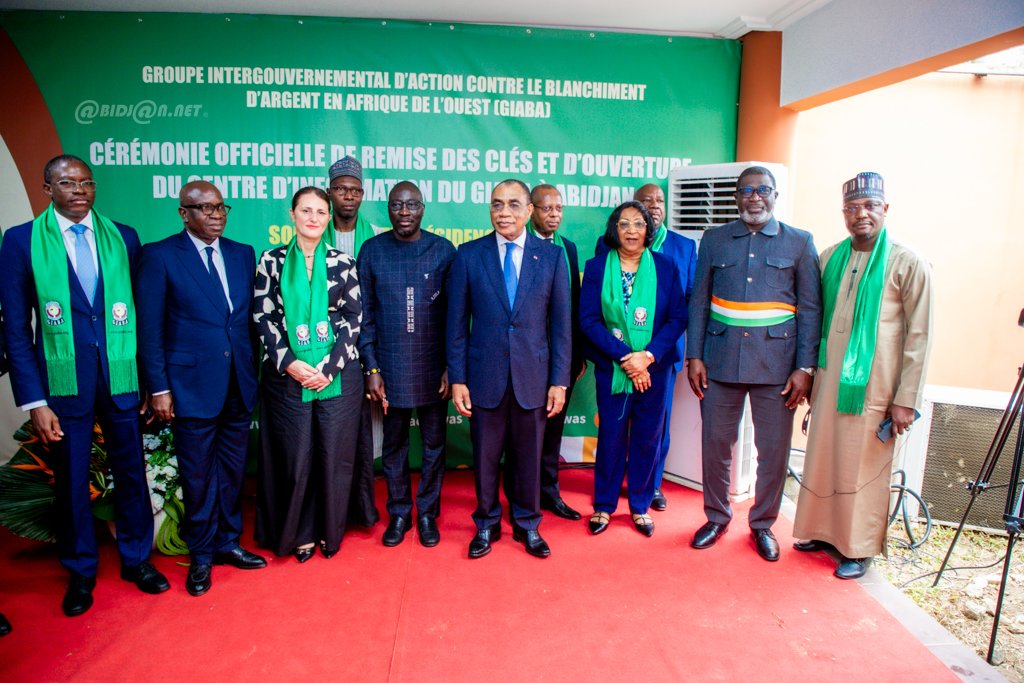
The Ivory Coast’s Minister of Economy, Finance and Budget, Adama Coulibaly, officiated the grand opening of the newly relocated GIABA Information Centre in Cocody this past Wednesday. The event marked the handover of keys for a state-of-the-art facility, provided by the Ivorian government in accordance with the Headquarters Agreement, signaling a major leap forward in regional efforts to combat financial crime.
Established by a CEDEAO Council of Ministers decision in November 2010 during the 65th ordinary session in Abuja, the Abidjan centre was designed to serve francophone and Lusophone member states, complementing a similar facility in Lagos for anglophone nations. Officially launched in September 2015 following the Headquarters Agreement signed in Yamoussoukro in March 2014, the centre has since become a cornerstone of West African financial integrity initiatives.
Strengthening regional cooperation against evolving financial threats
Speaking at the inauguration, Minister Coulibaly emphasized the growing sophistication of money laundering and terrorist financing schemes, highlighting the urgent need for coordinated regional responses. “No single nation can effectively tackle these challenges alone,” he noted, stressing that pooling resources, intelligence and expertise is now more critical than ever.
The new centre is poised to serve as a regional hub for awareness campaigns, capacity-building, research, documentation and communication, supporting CEDEAO member states and the broader West African community in their fight against illicit financial flows.
GIABA chief outlines vision for next-generation financial crime prevention
Edwin W. Harris Jr., outgoing Director General of GIABA, reflected on the centre’s achievements since its 2015 inception. Under his leadership, the facility has hosted open days for youth, public conferences, regional public speaking competitions and tailored training seminars for journalists, religious leaders and civil society organisations.
It has also played a pivotal role in supporting mutual evaluation processes for member states, helping strengthen national frameworks against financial crime.
“With our new premises, we are entering a new chapter,” Harris stated. He described the upgraded facility as a strategic investment for francophone and Lusophone CEDEAO members, designed to become a regional knowledge hub for anti-money laundering and counter-terrorism financing (AML/CFT) efforts.
Empowering future leaders and building regional expertise
The revamped centre will prioritize youth engagement, offering specialized training modules, research opportunities and professional development initiatives. Its Computer-Based Training (CBT) centre will deliver tailored programmes for judges, investigators, financial institutions, academics and students, with certifications available to validate expertise in AML/CFT compliance.
Harris called on public authorities, financial institutions, universities, media outlets, civil society groups and technical partners to actively participate in the centre’s programmes, reinforcing a culture of integrity and good governance across West Africa.
The timing of the inauguration holds special significance, coinciding with the end of Harris’s tenure on August 31, 2026. The new facility stands as a lasting legacy, equipping regional stakeholders with the tools needed to disrupt illicit financial networks and safeguard economic stability.