
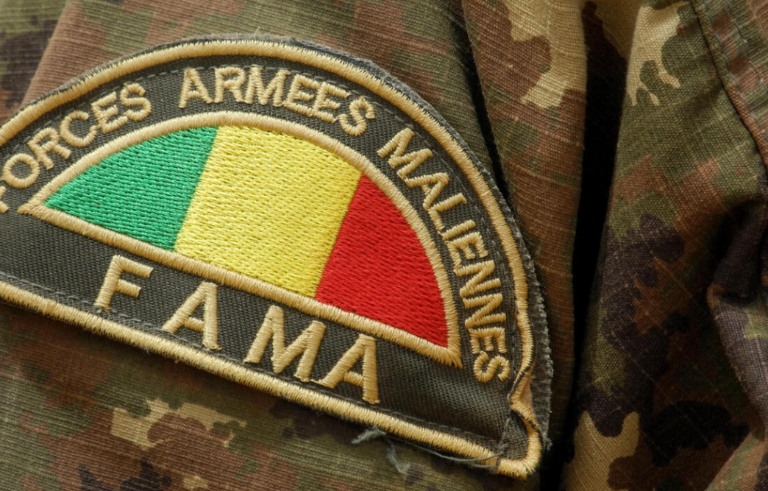
Nearly 80 Malian soldiers are believed to have been killed on 10 September when assailants stormed the military camp at Dioura, in the Mopti region. The Group for the Support of Islam and Muslims (JNIM) claimed responsibility for the assault within hours, stating it had seized control of the key FAMa position before withdrawing. Several troops remain unaccounted for, and others are thought to have been taken captive. For local communities, this latest military setback has deepened both fear and a growing sense of abandonment.
A death toll that exposes the army’s fragility
The Dioura assault ranks among the deadliest suffered by Malian armed forces in recent memory. Available information suggests that close to 80 soldiers lost their lives in the attack.
Hours after the violence, JNIM, an Al-Qaeda affiliate, claimed it had overrun the camp before pulling back.
The sequence is deeply troubling. It demonstrates that a military position considered strategic can still be hit with devastating force, despite years of operations against armed groups.
For residents of Dioura and nearby villages, however, the concern goes beyond the military death toll. Each attack fuels the same anxiety: that the violence is creeping ever closer to their homes and livelihoods.
In Dioura, civilians bear the brunt of insecurity
In this part of central Mali, people have lived for years amid clashes, displacement and restrictions imposed by insecurity. A military camp should, in principle, serve as a protective presence.
When such a camp falls to an armed group, the message sent to locals is deeply alarming.
The disappearance of soldiers, possible captures and uncertainty over the fate of some troops intensify the anxious atmosphere. Families await news. Communities dread further reprisals or fresh confrontations.
Under these conditions, daily life becomes harder. Movement may be curtailed, trade disrupted and access to essential services weakened. Over time, military insecurity turns into a social crisis.
A fresh blow for the junta
The Dioura attack also lands in a politically sensitive context for Mali’s authorities. The ruling junta has made territorial reconquest and the restoration of national sovereignty central pillars of its policy.
Officials have claimed a strengthening of Malian forces and greater autonomy in fighting jihadist groups.
But the events at Dioura brutally expose the limits of that narrative.
How can a major military position be held for hours by a jihadist group when authorities have promised for years to regain control of the territory?
The question is all the more awkward because Malian authorities have gradually reduced cooperation with certain foreign partners while embracing a more autonomous security strategy.
That policy can be defended in the name of sovereignty. Yet it must be judged by its results. And for the people of Mopti, the result remains deeply worrying: insecurity persists and attacks on Malian forces can still inflict massive losses.
The feeling of abandonment spreads
In Dioura, as in other rural areas of central Mali, residents are caught between multiple threats. They must navigate armed groups, military operations and the economic fallout of instability.
The sense of abandonment can become as dangerous as fear itself. When a population no longer believes the state can protect it, trust in institutions erodes.
Rebuilding that trust requires more than political statements. It demands lasting security for communities, protection of travel routes, the ability for farmers to work and guaranteed access to public services.
A tragedy that extends far beyond the battlefield
The Dioura tragedy must not be reduced to a simple clash between FAMa and JNIM. Behind the military toll are grieving families, missing soldiers, relatives waiting for news and civilians facing a fresh wave of anguish.
For Mali’s junta, this attack is above all a serious warning. After years of security promises, people now expect concrete results.
In Dioura, the real issue is less about who temporarily controls a camp than whether the Malian state can genuinely protect those living around these military positions. As long as that question remains unanswered, each new attack risks feeding further insecurity and disillusionment.
You may also like
Niger: why general Salaou Barmou was sacrificed on the altar of russian dependence
Niger: the widening gap between Niamey’s security rhetoric and the reality on the ground
Mali: plus de 50 soldats et cinq paramilitaires russes tués dans une attaque djihadiste d’une rare violence
Niger: the silence at the top of the state fuels questions after the August mutiny
Le carnet de Malian relance l’enquête sur la migration clandestine au Sénégal