When social media images overshadow educational progress
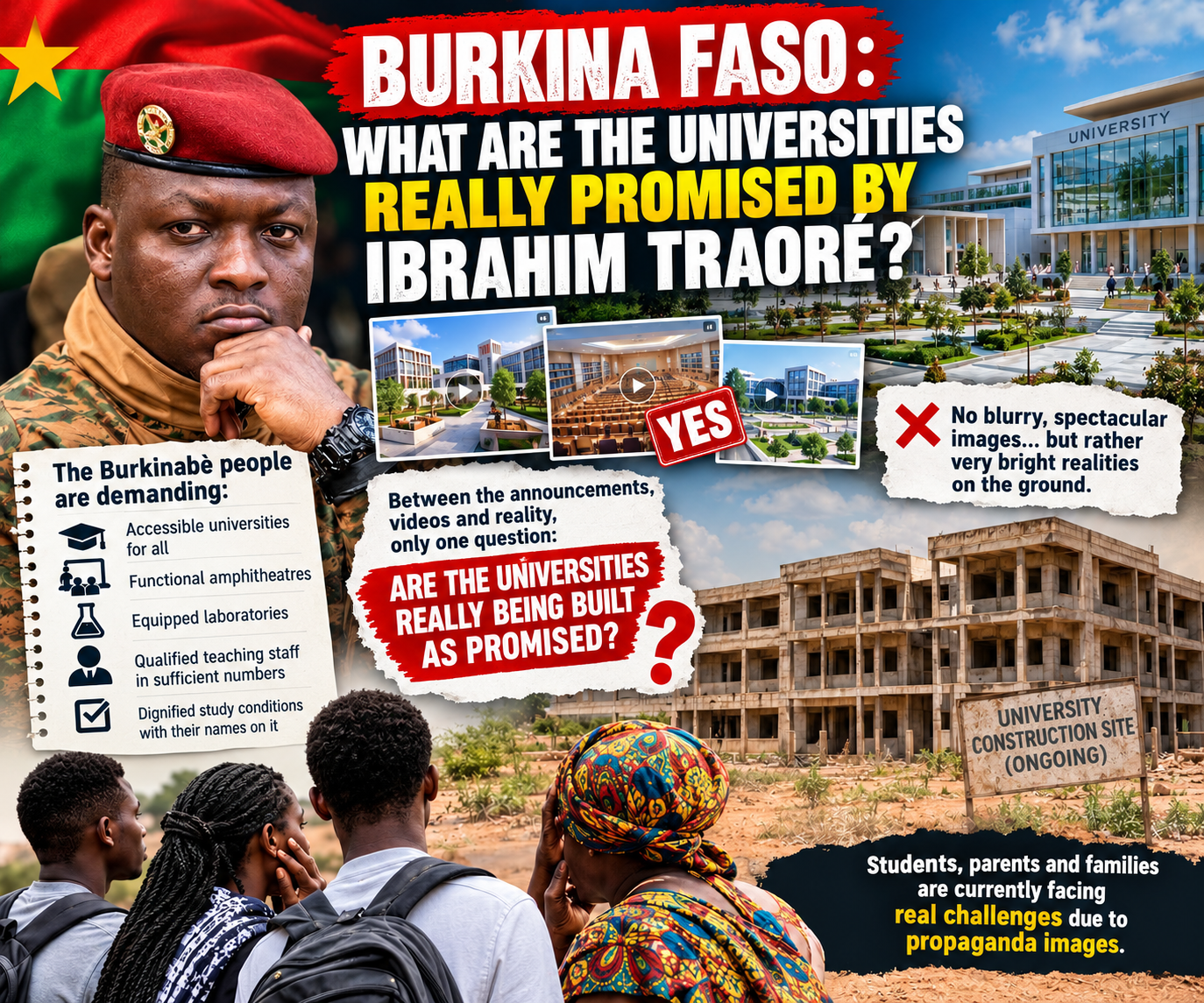
Behind the striking visuals circulating on social platforms lies a pressing question: how many of Burkina Faso’s promised state-of-the-art universities have actually been built, and what do students see on the ground today? While the government highlights impressive infrastructure through carefully curated content, parents and learners demand more than digital spectacle they seek functional campuses, equipped labs, qualified faculty, and learning environments that meet national standards.
Digital deception in political messaging
The line between verified achievement and manufactured imagery has blurred in Burkina Faso’s political communications. Multiple journalistic investigations have exposed misleading videos falsely attributed to national projects, including cases where footage from distant construction sites in Algeria was presented as local progress. Although these cases targeted real estate rather than educational facilities, the pattern raises a critical concern: in an era where artificial intelligence can generate indistinguishable fake content, how can citizens separate genuine development from algorithmic fabrication aimed at shaping public perception?
What separates truth from AI-generated fiction?
Determining the origin of a video requires tracing its original source.
On-the-ground verification is essential to confirm whether a stated university campus exists as depicted.
Public access to independent audits or official documentation could strengthen transparency.
From announcements to actual learning spaces
Political declarations often move faster than construction timelines. A campus announced with ceremony may still be years from welcoming students, and even completed buildings may lack essential resources. The danger lies not in ambition, but in conflating intention with outcome. When a headline touts a new “smart university,” families may assume classrooms are ready and textbooks on shelves but without verified data, such claims remain unverified.
In one documented instance, the government announced the inauguration of a 1,200-seat amphitheater, four medium lecture halls, and six laboratories at Nazi-Boni University in Bobo-Dioulasso. While this represents tangible progress, it represents only part of a broader agenda. To assess the full picture, one must examine:
How many announced universities have been completed?
Are student enrollment numbers sufficient to reduce overcrowding?
Are teaching staff recruited and trained?
Are digital learning tools available beyond promotional videos?
AI in political storytelling: a growing risk
The proliferation of AI-generated visuals has transformed public narratives. A 30-second clip can now depict a fully furnished auditorium or a bustling campus, even when no such facilities exist. Such manipulations, whether intentional or not, distort public understanding of national development. Without rigorous fact-checking, citizens may applaud progress that exists only in pixels.
Independent media and civil society play a vital role in verifying claims. Reputable organizations have already debunked multiple instances of misleading content attributed to national leaders, underscoring the need for reliable oversight. But the responsibility extends beyond watchdogs: the government must publish verifiable data, open facilities to public inspection, and invite impartial journalists to audit progress.
From pixels to pedagogy: measuring true educational development
Beyond the question of existence is one of function. A building, no matter how modern, becomes an educational asset only when it serves its intended purpose. That requires:
Functional internet connectivity and reliable electricity
Well-stocked libraries and updated curricula
Transparent faculty recruitment processes
Student support systems and career services
Without these elements, even the most advanced campus risks becoming an empty shell an architectural marvel with no academic heartbeat.
What students deserve, and what they can verify
For families investing savings in higher education, the stakes are high. They need clarity: not just images, but inspection reports; not just press releases, but enrollment figures; not just promises, but open-door policies allowing campus visits by parents and journalists.
The credibility of any educational revolution must rest on transparency. Until students can walk into classrooms equipped and active, the debate over Burkina Faso’s universities remains unresolved. The ultimate question is not how impressive the videos look but how well the institutions serve the people they were meant to empower.
By Élise Ntamag — Journalist