A transparency measure that raises as many questions as it answers
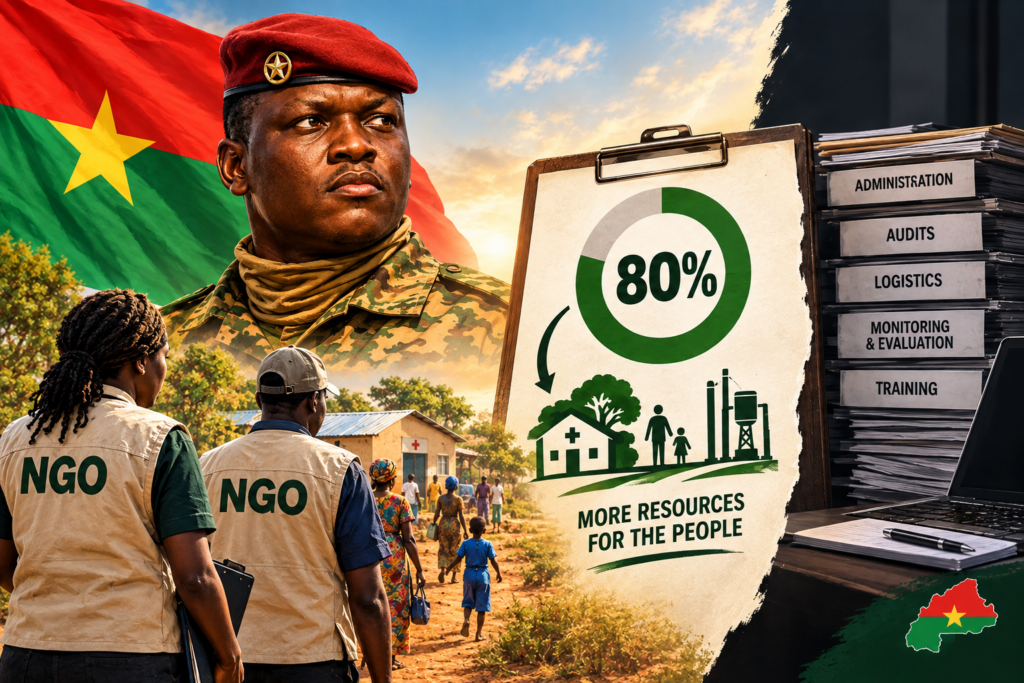
The Burkinabè government has presented its new NGO regulation as a tool for transparency and efficiency. Adopted on 24 September 2026 under the presidency of Captain Ibrahim Traoré, the measure requires NGOs to devote at least 80 % of their resources to direct investment in the field.
The principle appears straightforward: cut administrative costs so that more money reaches the populations. Yet this logic deserves closer scrutiny, and the reactions it has provoked suggest the debate is far from settled.
Why a percentage does not equal effectiveness
An NGO does not operate on equipment and infrastructure alone. It must also fund accounting, audits, logistics, project monitoring and the training of its teams.
These expenditures can be indispensable.
An auditor does not build a health centre, but he may prevent fraud. A logistician does not treat a patient, but he ensures that supplies reach their destination.
Cutting these functions to meet an imposed ratio could therefore weaken oversight mechanisms a concern that has fuelled much of the public debate since the regulation was adopted.
What exactly counts as “direct investment”?
This is one of the main questions the measure leaves open.
Constructing a health centre is easy to identify. But what about the salaries of the staff who work there? Maintenance? Training? Transport of equipment? Monitoring of beneficiaries?
Without a precise definition, applying the threshold may become complex.
The government must therefore clearly explain what falls within the 80 % and what is excluded a clarification that many organisations say they are still waiting for.
One rule for missions that differ widely
Not all NGOs follow the same model.
An organisation that builds schools will naturally have more material expenditure. Another, specialising in training, legal assistance or social protection, will invest primarily in human skills.
Applying the same ratio to all risks penalising certain activities without demonstrating that they are less useful.
The risk of unintended consequences
An organisation unable to reach 80 % could be pushed to alter its budget artificially.
It might reduce oversight positions or favour expenditures that are easily classified as “direct”.
Yet spending more in the field does not automatically produce more results.
Effectiveness must be measured by impact: the number of beneficiaries, the quality of services, the cost of interventions, the results achieved and the sustainability of projects.
Oversight can be strengthened through other means
If the objective is genuinely to protect funding, the government has other instruments at its disposal: independent audits, publication of accounts, traceability of funds, project inspections and sanctions in cases of misappropriation.
These mechanisms make it possible to verify the actual use of resources.
The 80 % threshold mainly measures their distribution.
A decision that will have to prove itself
The government of Ibrahim Traoré can legitimately demand greater transparency from NGOs. But a percentage guarantees neither sound management nor effectiveness.
The real question will therefore be simple: will this rule concretely improve the assistance provided to populations, or will it compel certain organisations to change how they operate solely to comply with an administrative ratio?
The outcome will have to be assessed on the facts.
For in an NGO, an expenditure that is not visible in the field may sometimes be precisely what ensures that the money arrives there.
By Daniel Mbami — Politics and Security
You may also like
Benin-Algeria defense pact: the fallout, the debate and what comes next
Gabon’s un vice-presidency: reactions, debates and the road ahead
Djenné attack aftermath: Mali’s fuel blockade sparks debate over army’s next move
Benin reacts to Candide Azannaï detention ruling: what the decision changes for the coup inquiry and the country’s future
Benin’s supreme court ruling on General Houndégnon: reactions, debate and what happens next