
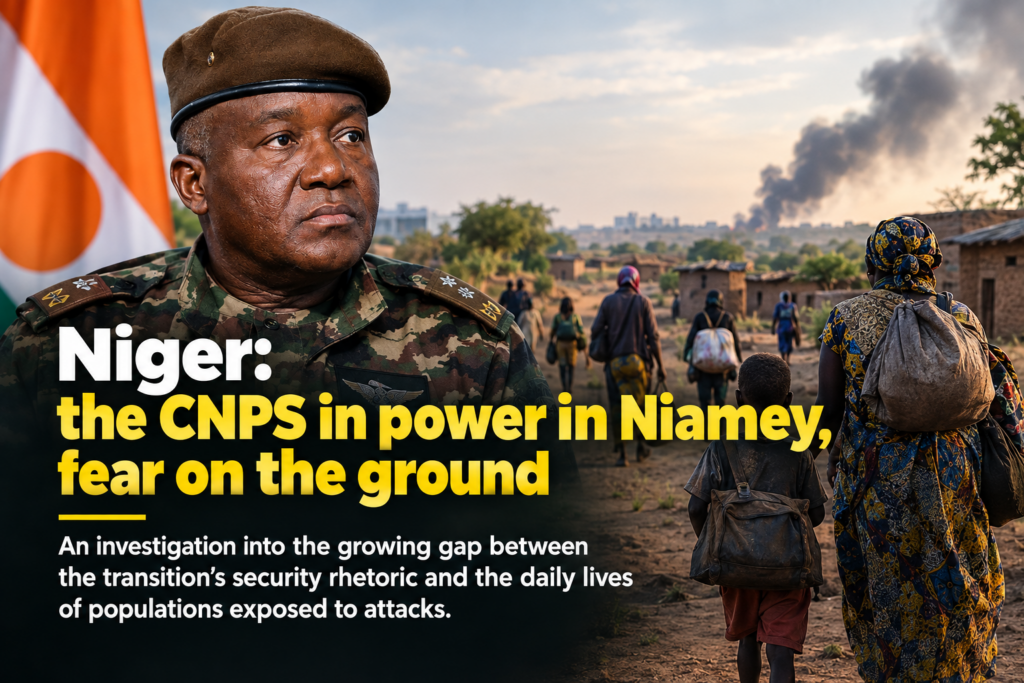
An examination of the growing distance between the transition’s security discourse and the daily lives of communities exposed to armed attacks.
Promises of control, a reality of fear
They pledged to reclaim control. To restore security. To return Niger’s sovereignty and dignity. Three years after the July 2023 coup, the National Council for the Safeguard of the Homeland (CNSP) continues to frame its seizure of power as a historic break.
Yet far from Niamey, a different reality is taking shape.
In areas regularly struck by armed groups, populations continue to live with fear, uncertainty and, at times, a sense of abandonment. Villages are hit, families displaced, livelihoods paralysed. And one question keeps returning: where are the leaders when attacks occur?
This may be one of the most troubling contradictions of the military transition.
Security promised from the capital, not delivered in the danger zones
Since taking power, the CNSP has made security a central pillar of its legitimacy. The overthrow of President Mohamed Bazoum was justified in part by the deterioration of the security situation.
The promise was clear: to do better.
Yet in the most exposed regions, particularly in the west of the country, attacks continue to shape daily life. Against this backdrop, a persistent observation fuels questions: the officials who embody the transition rarely appear in the areas directly affected, at the moment when residents are confronting the aftermath of attacks.
Authorities communicate from the capital. They announce operations, hail military victories or promise responses. But for populations living near the most dangerous zones, the question is far more concrete: who comes to assess the damage? Who meets the affected families? Who explains what happened and what will be done to prevent it from happening again?
A government that has made security its primary justification cannot indefinitely speak of war from the offices of the capital.
Niamey under surveillance, the periphery under pressure
This is one of the most visible paradoxes of the system put in place since the coup.
At the top, the regime’s security has become an absolute priority. Signs of mistrust within the military apparatus, changes in the hierarchy and the multiplication of control measures reflect a power preoccupied with its own stability.
Meanwhile, far from the political centre, populations remain confronted with another insecurity: one that kills, displaces, closes schools, destroys local economies and upends daily life.
Two realities appear to coexist.
On one side, a power focused on its survival and the securing of its apparatus. On the other, citizens still waiting for the promise of protection made after the coup to translate concretely into their daily lives.
Sovereignty, however, should not stop at the gates of Niamey.
The human cost of the war
Behind every military communiqué lies a reality that official figures rarely capture in full.
There are families leaving their villages.
Farmers hesitant to return to their fields.
Traders whose activities are paralysed.
Children whose schooling is disrupted.
And entire communities living in anticipation of the next attack.
It is precisely in these territories that the success or failure of the transition should be measured.
Not only in official ceremonies.
Not solely in speeches about sovereignty.
But in the state’s capacity to protect those who have neither escort, nor palace, nor special security detail.
The problem is not only military. It is also political.
For when a population feels that its leaders are visible for ceremonies, speeches and announcements, but absent when danger strikes, trust inevitably begins to erode.
A transition that communicates more than it confronts the ground?
The CNSP has built much of its image on a break with the old system. New partners, a new diplomatic discourse, denunciation of foreign influences: communication around sovereignty has become one of the regime’s pillars.
But communication does not replace presence.
A state can announce victories. It can denounce its adversaries. It can mobilise the vocabulary of patriotism and resistance.
But one question remains: do populations truly feel more protected?
This is where official discourse meets its limits.
For sovereignty is not measured solely by the number of foreign partners expelled or welcomed. It is also measured by a state’s ability to control its territory and protect its citizens, particularly those living in the most vulnerable areas.
When attacks continue and populations remain exposed, slogans eventually collide with a reality far harder to disguise.
The silence of the ground, the echo of speeches
The question now facing Niger goes beyond General Abdourahamane Tiani alone.
It concerns an entire system of governance.
Can a seizure of power continue to be justified by the former regime’s security failures without accepting, three years later, to be judged on the same ground?
Can proximity to the people be claimed while leaving populations in the most exposed areas waiting for a more visible state presence?
And above all, how long can a transition ask the population to wait while the promise that underpinned its rise to power remains largely unfulfilled?
True patriotism is not measured by the power of a speech.
It is also measured by a leader’s ability to look his people’s suffering in the face.
To go where the state is expected.
To own failures as well as victories.
And to understand that a power does not protect a nation from the capital’s offices alone.
The real test
In Niger, the authorities continue to speak of sovereignty, security and rupture.
But in areas where attacks persist, another reality imposes its own questions.
Can a regime present itself as the saviour of a people without meeting those who live daily with the consequences of insecurity?
This may be the true assessment of the transition.
Not in slogans.
Not in ceremonies.
Not in televised statements.
But on those roads, in those villages and among those families who, when attacks occur, are still waiting to know whether the state will truly come to them.
For governing a country at war is not only about protecting power. It is first and foremost about not leaving the people alone to face the war.
You may also like
Bénin : comment la fermeture préventive des écoles du Nord déjoue les plans terroristes
Niger: why general Salaou Barmou was sacrificed on the altar of russian dependence
Mali: Dioura attack leaves army reeling and civilians fearing the worst
Mali: plus de 50 soldats et cinq paramilitaires russes tués dans une attaque djihadiste d’une rare violence
Niger: the silence at the top of the state fuels questions after the August mutiny