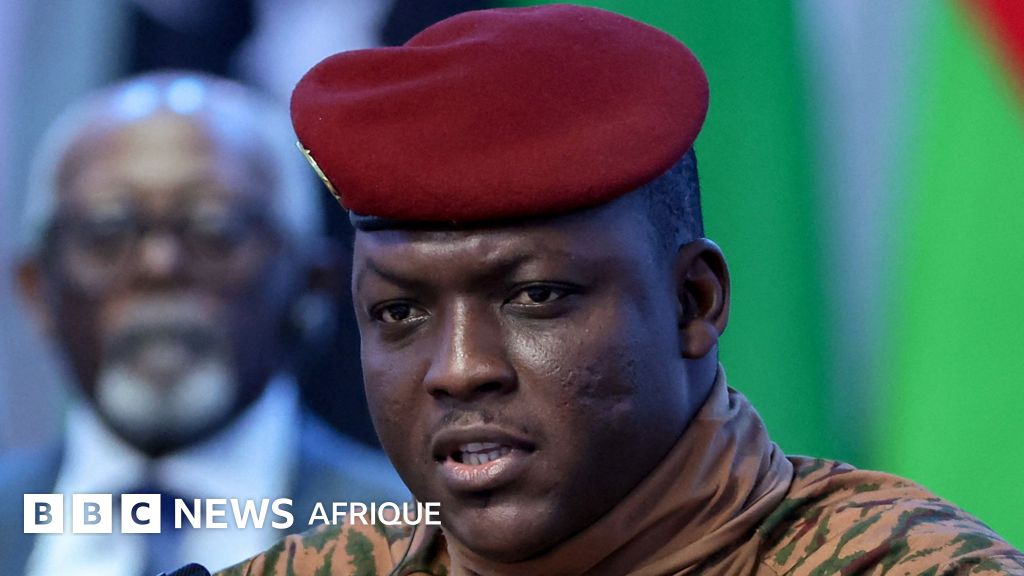
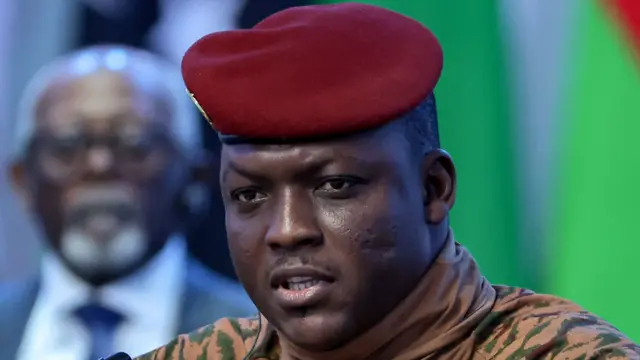
The military leader of Burkina Faso has declared that democracy is “killing” the nation and must be abandoned, during a prime-time television interview on state broadcaster RTB.
Captain Ibrahim Traoré, who seized power in a 2022 coup, argued that most Africans reject democratic systems and that Burkina Faso requires a distinctly different approach. He provided no further details about his proposed alternative governance model.
Traoré had previously pledged to restore civilian rule by July 2024, but in May 2024—just two months before the deadline—the transitional government extended his mandate by five years. The announcement came after authorities banned all political parties in January 2025 as part of a broader “state reconstruction” initiative.
“People should stop talking about democracy,” Traoré stated during the interview. “Democracy isn’t for us.”
He invoked the example of Libya, a neighboring North African nation that has struggled with instability since the 2011 NATO-backed overthrow of Muammar Gaddafi. Traoré suggested that Burkina Faso could face a similar fate if it persists with democratic processes.
“Look at Libya—it’s a cautionary tale,” said the 38-year-old leader, who positions himself as a revolutionary fighting Western imperialism. Under Gaddafi’s four-decade autocratic rule, Libya provided free healthcare, education, and housing, yet his ousting plunged the country into prolonged conflict with rival administrations and armed factions.
The Burkinabe leader dismissed political parties as divisive and incompatible with his revolutionary vision, describing them as vehicles for corruption and empty rhetoric. “In Africa—and especially in Burkina Faso—a real politician is someone who embodies every vice: a liar, a flatterer, a smooth talker,” he asserted.
Traoré emphasized his commitment to building a new system rooted in sovereignty, patriotism, and grassroots mobilization, with traditional leaders and local structures playing central roles. He called for economic and military self-reliance, arguing that Burkina Faso cannot progress with conventional work schedules. “Six- or eight-hour workdays won’t help us catch up to wealthier nations,” he declared.
The junta has faced criticism for suppressing dissent, targeting opposition figures, media outlets, and civil society groups. Reports indicate that critics have been sent to frontline positions in the fight against Islamist militants, raising concerns about forced conscription as punishment.
Despite these controversies, Traoré has cultivated significant support across Africa for his anti-Western stance and pan-African rhetoric. Like neighboring military-led governments in Mali and Niger, Burkina Faso has distanced itself from Western partners—particularly France—in its counterterrorism efforts. Instead, it has turned to Russia for military assistance, though insurgent violence continues unabated.
Human rights organizations have documented a surge in civilian casualties since Traoré’s rise to power. According to a recent report, over 1,800 civilians have been killed in Burkina Faso since 2023, with two-thirds of the deaths attributed to state forces and allied militias. Islamist militants are responsible for the remaining third.