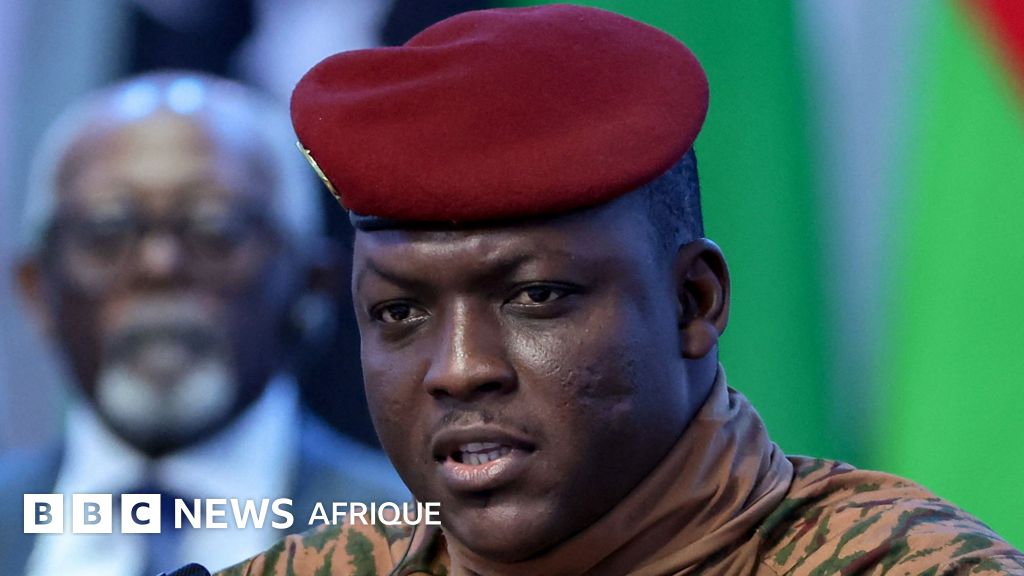
The head of Burkina Faso’s military government has declared that democracy is not suited for the nation, urging citizens to abandon the concept entirely. Captain Ibrahim Traoré, who seized power three years ago, made the remarks during a nationally televised interview, stating that the system « kills » and must be forgotten.
From promise to rejection: Traoré’s shifting stance on democracy
In 2023, Traoré pledged to restore democratic rule in Burkina Faso by July 2024. However, with two months remaining before the deadline, the military government announced a five-year extension of its mandate, effectively sidelining democratic transition. This reversal aligns with recent measures, including the January ban on all political parties under the guise of « rebuilding the state. »
During the interview, Traoré asserted that « people must forget about democracy. It is not for us. » He argued that Western-imposed democratic systems have historically led to bloodshed globally, citing Libya as a cautionary example. The North African nation, once ruled by autocrat Muammar Gaddafi, collapsed into chaos after his overthrow in a Western-backed rebellion, leaving it divided and without stable elections.
Critique of political elites and call for revolutionary change
Traoré, 38, positioned himself as a revolutionary leader resisting Western imperialism. He criticized Burkina Faso’s political class, describing traditional politicians as « liars, flatterers, and loudmouths » who embody corruption. While he did not outline a clear alternative system, he emphasized Burkina Faso’s unique approach: « We are not trying to copy anyone. We are here to completely change how things are done. »
The junta leader’s vision centers on sovereignty, patriotism, and revolutionary mobilization, with traditional leaders and grassroots structures playing key roles. He also stressed the need for economic and military self-reliance, arguing that Burkinabé workers must adopt longer hours to accelerate national development.
A crackdown on dissent and ongoing insurgency
Traoré’s government has faced accusations of suppressing opposition, media, and civil society. Critics allege that dissenters have been sent to frontline combat against Islamist militants as punishment. Despite this, Traoré has cultivated significant support across Africa for his anti-Western rhetoric and panafricanist stance.
Like neighboring military-led states Mali and Niger, Burkina Faso has distanced itself from Western allies, particularly France, in its fight against Islamist insurgencies plaguing the Sahel region. Instead, the country has turned to Russia for military support, though violence continues unabated. Human Rights Watch reported over 1,800 civilian deaths in Burkina Faso since Traoré’s 2023 coup, attributing two-thirds of the killings to state forces and allied militias.
Key takeaways:
- Traoré rejects democracy: The military leader insists Burkina Faso must abandon democratic ideals, calling the system a failure.
- Shift from promise to permanence: Initial pledges to restore democracy by 2024 were replaced by a five-year mandate extension.
- Political party ban: All parties were dissolved in January under the pretext of national reconstruction.
- Anti-Western rhetoric: Traoré frames Burkina Faso’s struggles as a result of Western interference, contrasting his approach with Libya’s post-Gaddafi collapse.
- Human rights concerns: Reports link the majority of civilian deaths since 2023 to state forces, with militants responsible for the remainder.