As South Africa struggles to contain xenophobic violence in Durban, the African Union’s top human rights body has issued a stark warning: if Pretoria does not act swiftly, the country could face an unprecedented humanitarian crisis. The brutal mob killing of an unidentified foreign national in the city’s downtown area has exposed deep-seated tensions over immigration and forced authorities to confront a critical question—can the state restore order before mob justice becomes the new normal?
Why the African Union is sounding the alarm on South Africa’s xeno-violence
The African Commission on Human and Peoples’ Rights (ACHPR) has condemned the October 22 mob killing in Durban as a potential crime against humanity, marking one of the strongest international responses to South Africa’s escalating xenophobic attacks. While legal experts debate whether the circumstances meet the strict criteria for such a classification, the commission’s warning underscores a growing concern: the state’s failure to protect vulnerable populations could have devastating regional consequences.
The victim, a man in his 30s or 40s, was beaten to death by a group of around 50 assailants near a busy road. Police reports indicate he was targeted amid a climate of rising hostility toward immigrants, though his nationality remains undisclosed. What is clear is that this murder was not an isolated incident but the latest in a series of violent acts fueled by inflammatory rhetoric against foreign nationals.
How Durban became a flashpoint for anti-immigrant violence
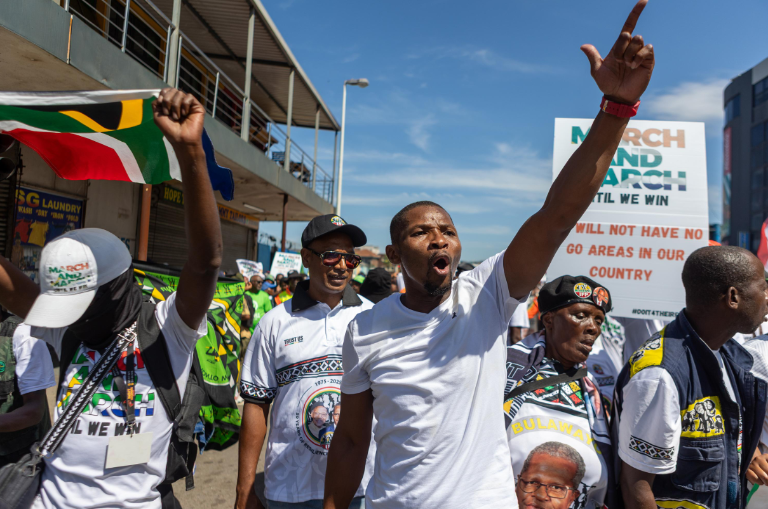
Durban, South Africa’s third-largest city, has long been a hub of tension between locals and migrants. In recent months, xenophobic protests have devolved into riots, looting, and destruction of businesses, particularly targeting African migrants. Critics argue that economic frustration and unemployment have been exploited by militant groups advocating for the expulsion of undocumented immigrants, whom they blame for straining public services and contributing to job shortages.
Yet, these grievances cannot justify the vigilante justice that has claimed lives. Human rights advocates emphasize that the right to life is non-negotiable, regardless of a person’s immigration status. The question now is whether the South African government will uphold its constitutional duty to protect all residents or allow mob violence to dictate who deserves safety.
The role of rhetoric in fueling hate crimes
Public discourse in South Africa has increasingly framed immigrants as scapegoats for the country’s economic woes. While peaceful demonstrations are a legitimate form of protest, the line between criticism of immigration policy and incitement to violence has blurred. The African Union’s intervention signals that rhetoric alone can no longer be dismissed as mere political posturing—it has tangible, deadly consequences.
South Africa’s dual crisis: balancing immigration control and human rights
Pretoria faces a delicate balancing act. On one hand, there is pressure to address public concerns about border security and resource allocation. On the other, the government must uphold its legal and moral obligations to prevent discrimination and violence. The African Commission’s call for a swift, impartial investigation into the Durban killing reflects this tension—justice must be served, but systemic issues must also be addressed.
The South African Human Rights Commission has echoed these concerns, condemning the attack as a violation of constitutional rights. The organization argues that while immigration enforcement is a state prerogative, no group or individual has the authority to act as judge, jury, and executioner. The message is clear: the rule of law must prevail over mob mentality.
What’s at stake for continental solidarity
The crisis in Durban challenges the very foundations of Pan-African unity. Historically, many African nations supported South Africa’s struggle against apartheid, welcoming refugees and activists. Today, the tables have turned, with South African citizens targeting migrants from neighboring countries. This shift raises urgent questions about the future of regional cooperation and the protection of African lives beyond borders.
For the African Union, the Durban killing is more than a human rights violation—it is a test of the continent’s commitment to shared values of dignity and justice. The commission’s warning is not just a condemnation of a single act of violence but a challenge to all African leaders to confront xenophobia within their own borders.
Can justice prevent the next tragedy?
The investigation into the Durban mob killing will be a defining moment for South Africa. A credible inquiry, followed by prosecutions, could deter future vigilante attacks and restore faith in the justice system. Conversely, inaction risks normalizing mob violence and emboldening those who believe they can take the law into their own hands.
The African Commission’s strong language suggests that half-measures will not suffice. Pretoria must act decisively—not only to punish the perpetrators but to dismantle the rhetoric and policies that enable such violence. For the sake of regional stability and human dignity, the time for action is now.
The way forward: accountability and systemic change
To prevent further bloodshed, South Africa must:
- Enforce existing laws against hate speech and incitement to violence, holding individuals and groups accountable for inflammatory rhetoric.
- Strengthen police response to protect vulnerable communities and prevent mob attacks from escalating.
- Promote inclusive dialogue to address the root causes of anti-immigrant sentiment without resorting to violence or scapegoating.
- Uphold constitutional protections for all residents, ensuring that no one is denied safety based on nationality or immigration status.
The death of one man in Durban cannot be undone, but it can serve as a turning point. The choices Pretoria makes in the coming weeks will determine whether South Africa remains a beacon of democratic values or slides into a cycle of impunity and fear.