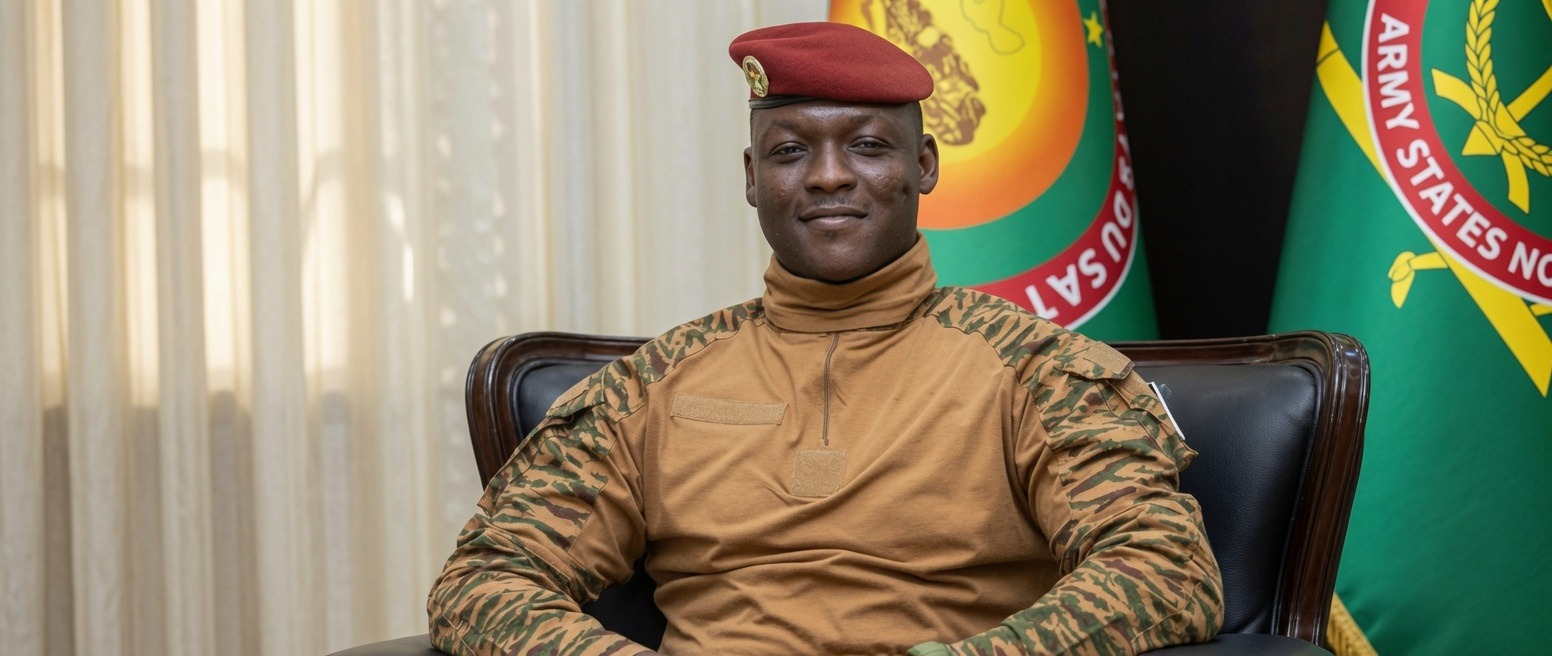
The recent address by Captain Ibrahim Traoré in Ouahigouya has laid bare a deep structural fracture within Burkina Faso’s ruling military apparatus. His unfiltered language—marked by crude expressions like “merde” and threats of merciless suppression—reveals a crisis of trust that extends beyond mere rhetoric. In both governance and warfare, the over-reliance on intimidation and sterile posturing does not signal strength; rather, it exposes systemic fragility. A regime that publicly vows to crush its own officers admits, in no uncertain terms, that its cohesion no longer stems from shared doctrine or strategic alignment but from sheer fear of purge.
This approach creates a precarious paradox for the transition’s stability. By dismantling the notion of a clear hierarchy—”there is no number one or number two”—Traoré aims to preempt rival factions from emerging. Yet, in doing so, he concentrates all risks onto his own shoulders. His insistence on battlefield experience as the sole source of legitimacy traps the regime in a well-trodden pitfall of military dictatorships: a legitimacy that is inherently personal, non-transferable, and entirely dependent on immediate battlefield successes.
Beyond the verbal aggressiveness, this hardening of discourse obscures a critical strategic misstep. By prioritizing political loyalty checks over structural reforms in military capabilities, the transition risks suffocating its own command chain. Officers, now fixated on self-preservation and internal surveillance rather than tactical innovation, may retreat into cautious conformity. An army paralyzed by the dread of false accusations inevitably loses its edge on the frontlines, widening the chasm between Ouagadougou’s rhetoric of resolve and the grim realities of the battlefield.
Ultimately, this governance through fear achieves the opposite of its intended effect. Rather than dissolving internal dissent, the pervasive climate of suspicion and surveillance pushes dissident elements into deeper secrecy. The annals of Sahelian military regimes underscore a harsh truth: when open debate and internal critique are crushed under the threat of “merciless suppression,” opposition does not vanish—it merely waits for the opportune moment to resurface with greater force.