
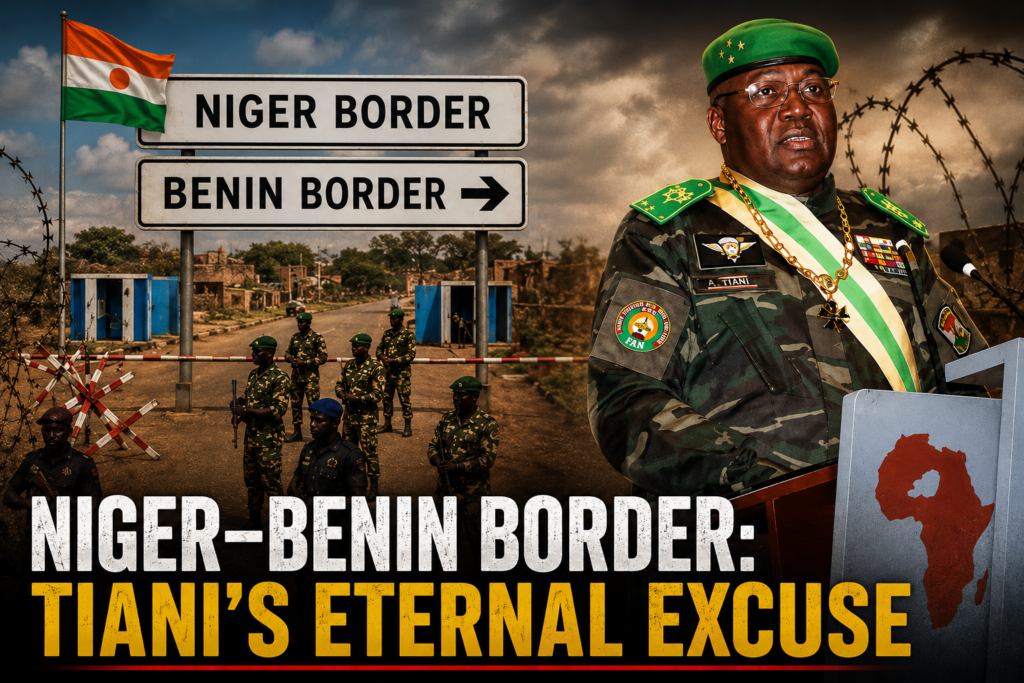
Persistent stalemate despite diplomatic overtures
Nearly two months after Benin’s Romuald Wadagni visited Niamey and experts from both nations convened to address the border dispute, hopes for a swift resolution between Niger and Benin have dimmed. Technical discussions had fostered cautious optimism regarding a gradual resumption of cross-border activities.
However, on July 26, during the first anniversary of his leadership, General Abdourahamane Tiani dismissed any immediate prospect of reopening the border. In a televised address on the national broadcaster ORTN, he stated: ‘Certain prerequisites must be addressed before considering the irreversible decision to reopen the frontier.’
Vague demands and indefinite postponement
The crux of the issue lies in the lack of specificity surrounding these so-called ‘prerequisites’. No clear definition has been provided regarding:
- the exact requirements for their fulfillment;
- the criteria that would indicate their resolution;
- or a timeline for their implementation.
This deliberate ambiguity grants the military-led government a strategic advantage: it enables the deferral of reopening indefinitely without necessitating concrete justification for the delay. Each new condition can be substituted for another, perpetuating the border closure as an open-ended issue.
Security rhetoric losing credibility
Since the July 2023 coup, the Nigerien authorities have repeatedly cited security as the primary justification for the closure. They contend that Benin’s territory harbors armed groups or foreign actors posing a threat to Niger’s stability.
Yet, these claims have never been substantiated with verifiable public evidence. Meanwhile, terrorist attacks continue to devastate several Nigerien regions—including Tillabéri, Tahoua, and Diffa—suggesting that the border closure has not significantly enhanced domestic security.
This inconsistency raises a critical question: if the closure were truly intended to bolster national security, why do violent incidents persist at an alarming rate?
Technical progress overshadowed by political calculations
Just weeks prior, Beninese and Nigerien experts had reconvened to explore technical frameworks for a phased reopening of the border. These discussions aimed to reconcile security concerns with the restoration of trade flows.
By dismissing these efforts, General Tiani underscores a clear message: the final decision rests solely on political grounds. In essence, technical negotiations now appear to serve primarily as a delaying tactic rather than a pathway to resolution.
Economic fallout disproportionately affecting Niger
While Benin faces reduced transit traffic to the Port of Cotonou and declining customs revenues, the impact on landlocked Niger is far more severe. Historically dependent on regional corridors for imports and exports, Niger now incurs exorbitant logistical costs by rerouting goods through alternative countries.
Consumers and businesses bear the brunt of this burden:
- soaring food prices;
- escalating construction material costs;
- higher prices for imported pharmaceuticals;
- supply shortages for local traders;
- diminished competitiveness for Nigerien enterprises.
Small-scale merchants along the border are among the hardest hit, with many experiencing severe income losses and once-thriving towns experiencing economic stagnation.
Regional cooperation weakened by prolonged closure
Beyond economic repercussions, the border closure undermines broader regional collaboration. Academic exchanges, cross-border local governance initiatives, joint development projects, and efforts to combat illicit trafficking have all become increasingly unfeasible.
Ironically, the closure has not eradicated clandestine networks; instead, it has often exacerbated their proliferation by pushing trade into informal channels that evade regulatory oversight.
Sovereignty as a political narrative
By framing the closure as an ‘irreversible’ decision, General Tiani aligns the issue with symbolic sovereignty. The move is presented as a defiant stance against external pressures. Yet, this raises a fundamental question: does sovereignty lie in economic isolation or in effectively safeguarding the welfare of citizens?
To many observers, the prolonged closure increasingly appears to serve a political communication strategy rather than a measurable security objective. It reinforces a narrative of perpetual resistance, bolstering the junta’s domestic legitimacy among a segment of the population.
The human cost of a political standoff
The official discourse obscures the human toll of this impasse. Transport operators left without livelihoods, merchants facing ruin, students barred from crossing, families separated, and business owners grappling with uncertainty—these are the tangible consequences of a prolonged closure. Each passing week deepens these hardships and further delays the prospect of normalized relations.
A stalemate designed to endure
Three years into the crisis, the Niger-Benin border has evolved from a security concern into a political instrument. By invoking undefined prerequisites, the Nigerien leadership retains full discretion to prolong the status quo indefinitely.
In the meantime, citizens on both sides continue to endure economic, social, and humanitarian consequences for a decision whose tangible benefits remain unsubstantiated. Ultimately, a return to normalcy may only materialize when political imperatives cease to overshadow the daily realities of the populace and the imperative to restore cooperation rooted in dialogue, trust, and pragmatism.
You may also like
Paris FC vs Lyon: kick-off time and TV channel for the Ligue 1 clash
Niger: does Tiani’s purge expose hidden fractures at the top?
Everest Finance dévoile Sama Naffa, une épargne à petits pas au Sénégal
Niger’s junta chief replaces army chief after failed mutiny
Gabon refines trade strategy to position local businesses in the African continental market