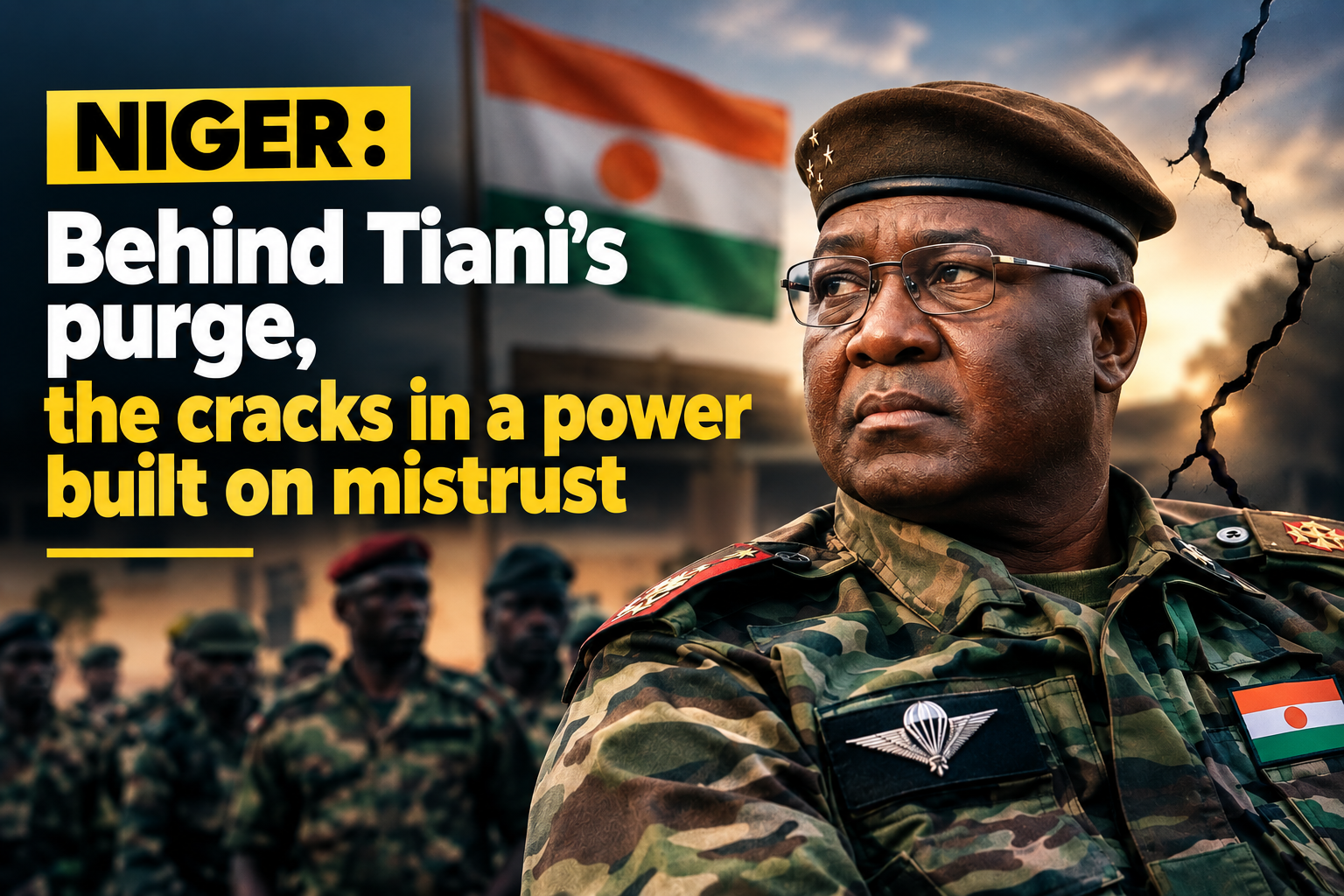
Since the announcement of an alleged coup attempt that was said to have been foiled, Niger’s leadership has appeared to operate in a state of permanent alert. Behind the cascading changes in the military hierarchy, one question looms: is the junta consolidating its authority or attempting to contain a crisis that now threatens its own summit?
In Niger, the recent decisions by the authorities do not resemble a routine reshuffle. The replacement of several senior military officials and corps commanders comes amid an atmosphere already marked by mistrust, security tensions and suspicions of conspiracy within the state apparatus itself.
The official narrative is one of securitisation. According to this logic, the aim is to identify vulnerabilities, remove elements deemed suspect and guarantee the loyalty of the chain of command.
Yet another reading deserves consideration.
When a military regime massively renews the personnel responsible for its security, it is also a sign that trust at the top is no longer a given.
Fear changes sides
Since the overthrow of Mohamed Bazoum in July 2023, the survival of Tiani’s power has largely rested on control of the military and security apparatus. Yet it is precisely this structure that now appears to be under heightened surveillance.
The question then becomes awkward: who is the leadership really seeking to neutralise?
Opponents? Military officials suspected of disloyalty? Potential rivals? Or simply men whose influence has grown too significant to be tolerated by the centre of power?
It would be premature to assert that an open fracture exists at the summit. But the multiplication of changes in the military hierarchy provides enough material to question the solidity of internal balances.
For a purge can temporarily strengthen a regime. It can also produce the opposite effect: creating new grievances, shifting rivalries and fostering a climate in which everyone ends up suspecting their neighbour.
Tiani’s silence, a new zone of uncertainty
To this situation is added the prolonged absence of General Abdourahamane Tiani from the public scene.
In such a sensitive period, this discretion is striking. Not because it would prove any incapacity on the part of the junta leader, but because the silence of a military ruler, at the very moment when his security apparatus is being profoundly reshuffled, naturally leaves room for questions.
Several scenarios can be envisaged.
The first is that of a deliberate strategy. The leadership might choose to maintain a degree of opacity around its chief in order to let the junta’s structures manage the crisis and carry out necessary changes without publicly exposing its own divisions.
The second scenario is more concerning: that of real tension at the summit. A rivalry between military officials, a temporary sidelining, disagreements over the conduct of the regime or other internal difficulties could partly explain this period of withdrawal. At this stage, however, nothing allows these hypotheses to be turned into certainties.
It is precisely this absence of verifiable information that fuels rumours.
The paradox of a power eager to display strength
The junta is clearly seeking to send a message: the leadership controls the situation and will tolerate no internal threat.
But each dismissal, each replacement and each official silence also produces another image: that of a system constantly seeking to verify who is truly loyal to it.
Herein lies the paradox.
The more the regime reinforces its control mechanisms, the more it publicly exposes its need to control. The more it insists on the internal threat, the more public opinion is tempted to question the real origin of this instability.
The question is therefore not only whether a coup attempt was actually foiled. It is about understanding what this crisis has revealed about the internal functioning of Niger’s leadership.
A battle for control of the summit
In the coming weeks, the signs to watch will be numerous: new transfers within the army, appointments to strategic posts, statements by key officials, Tiani’s public reappearance and possible reactions from the various components of the security apparatus.
It is these elements, more than the rumours circulating on social media, that will determine whether the regime is merely going through a phase of reasserting control or facing a genuine crisis of confidence.
For now, one thing appears clear: Niger’s junta wants to lock down its security apparatus, but this desire for lockdown also reveals the extent of the mistrust prevailing at the top.
And in a power born of a coup, one question always remains sensitive: when leaders begin to fear their own men more than their adversaries, where does the regime’s fragility truly begin?