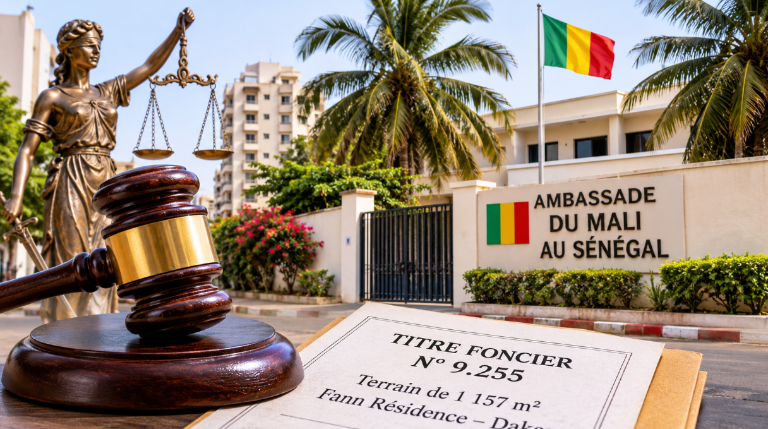
Diplomatic immunity versus property rights: the explosive land dispute in Dakar
A high-stakes legal battle between Mali’s embassy in Senegal and a local developer has escalated after a Dakar court ordered the diplomatic mission to vacate a 1,157 square meter plot in the upscale Fann Résidence neighborhood. The ruling, handed down in early November 2026, has thrust an unusual dispute into the spotlight—one that pits sovereign immunity against property law while testing the limits of diplomatic protections on foreign soil.
The controversy centers on ownership of a prime Dakar parcel, where Mali’s embassy has maintained a presence for years despite claims by Immoland SARL, a Senegalese property firm, that it holds the legitimate title. According to court documents reviewed by local media, the company asserts full ownership via land deed n° 9.255, arguing that the embassy’s occupation of the site is legally unfounded.
Why the court sided with the developer in the property battle
The ruling reflects a fundamental legal principle: diplomats do not automatically inherit property rights simply by occupying premises. Citing the absence of valid documentation proving Mali’s embassy held legitimate title to the land, the Senegalese judiciary confirmed Immoland SARL as the rightful owner. The decision explicitly states that the embassy’s continued presence on the parcel is “without right or title,” setting the stage for eviction.
Yet legal victory for the developer does not equate to immediate physical removal. While the court has ordered the embassy to relinquish control of the property—including all structures and individuals under its authority—the mechanics of enforcement remain unclear. Questions persist about how such an eviction might be carried out without breaching international diplomatic norms, particularly those enshrined in the Vienna Convention on Diplomatic Relations (1961).
Key precedents in diplomatic land disputes
Diplomatic missions typically occupy leased or donated properties rather than claiming ownership. When disputes arise, they often hinge on:
- Whether the host nation granted the land as sovereign territory
- The presence of a valid title deed in the sending state’s name
- Whether the property was acquired through legitimate commercial means
In this case, the court appears to have treated the embassy’s occupation as a private property claim—subject to the same adjudication as any other land dispute. That approach challenges long-held assumptions about inviolability, suggesting that even diplomatic missions must respect host country property laws when claims conflict.
What’s at stake for Mali, Senegal, and bilateral ties
The ruling carries significant consequences beyond real estate. For Mali, losing control of a diplomatic site in Dakar could force a costly relocation or restructuring of consular operations. Senegal, meanwhile, faces pressure to balance judicial authority with diplomatic sensitivities. A mishandled eviction could strain relations; a reversal of the ruling could undermine investor confidence in the country’s property sector.
Balancing these stakes requires nuance. The Vienna Convention protects embassy premises once occupied for diplomatic functions, but it does not shield illegal occupation. The court’s decision implies the land was neither gifted nor leased by Senegal to Mali—a distinction that may shield Dakar from accusations of overreach.
Unanswered questions loom over the embassy’s next move
With no official response from Mali’s government, several critical issues remain unresolved:
- Will the embassy file a legal appeal? Challenges to the ruling could prolong the dispute for months or years.
- What enforcement mechanisms are available? Police cannot forcibly enter embassy grounds without violating diplomatic immunity, leaving enforcement in legal—and political—limbo.
- Has either government engaged in mediation? Diplomatic channels may offer a discreet path to resolution before public confrontation escalates.
Until these questions are addressed, the land remains a legal battleground, watched closely by international law observers and real estate investors alike. For now, the embassy’s continued presence suggests behind-the-scenes negotiations may be underway—but the clock is ticking on a resolution.
Beyond Dakar: what this dispute signals for Africa’s growing land conflicts
This case exemplifies a broader trend across African capitals, where rapid urbanization and surging property values have intensified land disputes—even involving foreign governments. As cities like Dakar, Nairobi, and Johannesburg densify, similar clashes may arise between sovereignty claims and commercial development. The ruling here sends a clear message: host nations’ property laws apply to all, embassies included—but enforcing those laws diplomatically remains a delicate art.