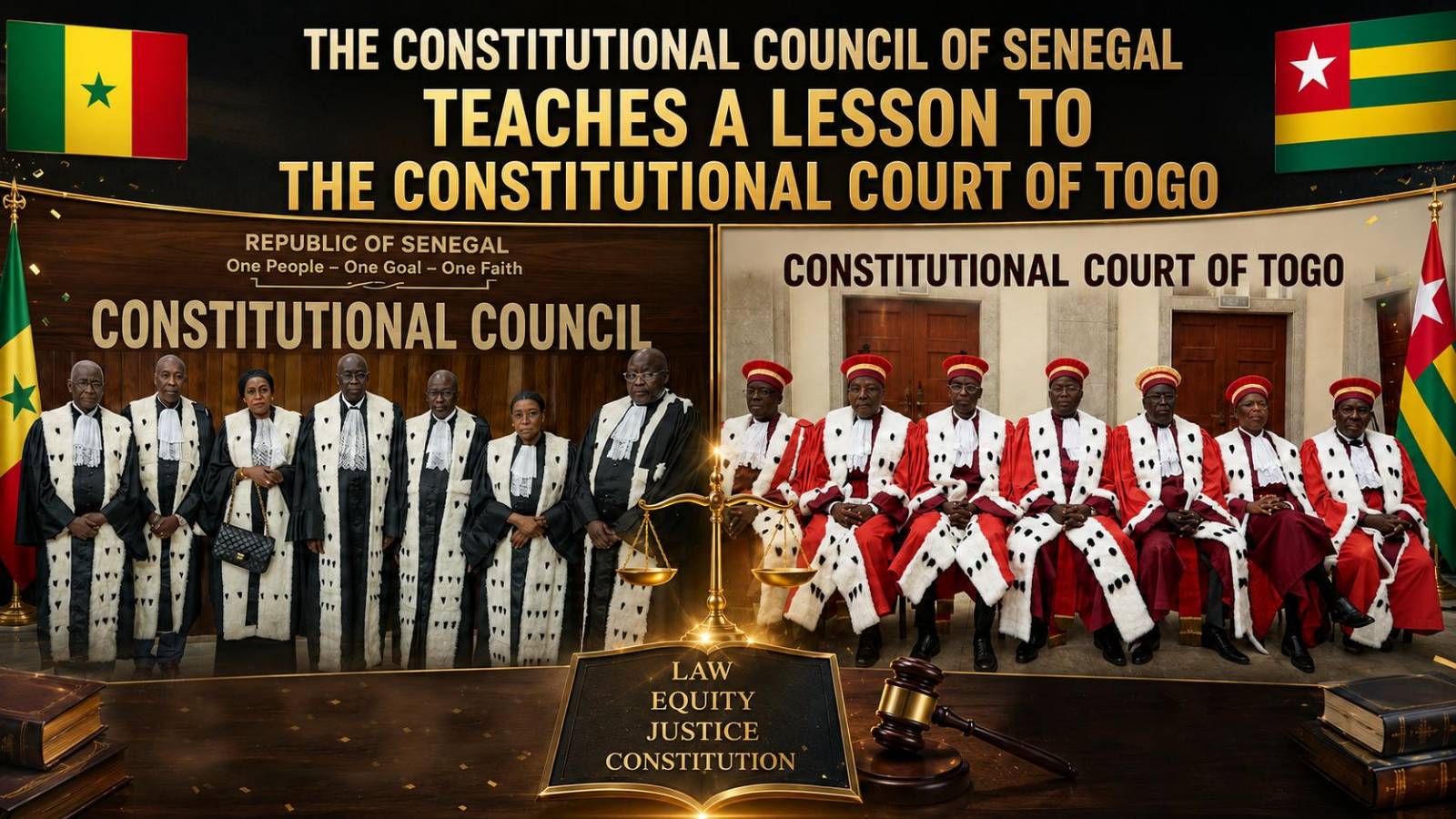
In the evolving landscape of West African governance, Senegal and Togo present sharply contrasting models of constitutional interpretation. Recent legal rulings in both countries have underscored fundamental differences in how state institutions perceive their role in upholding—or circumventing—the rule of law.
Judicial independence as a defining divide
The contrast could not be clearer. In Dakar, the Constitutional Council demonstrated unwavering commitment to the supremacy of constitutional principles, blocking a controversial constitutional reform backed by the government of Ousmane Sonko and a parliamentary majority. The decision served as a stark reminder: electoral victories do not grant unlimited authority. Within a functioning state governed by law, political legitimacy is subordinate to constitutional boundaries.
In Lomé, the Constitutional Court took a markedly different approach. It approved sweeping changes to the country’s foundational charter despite widespread criticism from opposition groups, civil society, and legal experts. Critics argue the reform lacked genuine national consultation, fundamentally altering the nation’s institutional architecture without fostering inclusive dialogue. A constitution is meant to embody the social contract; when it appears to be a political tool rather than a consensus-based foundation, its legitimacy erodes.
The stakes: stability, trust, and democratic resilience
This divergence highlights a critical truth: the strength of a democracy is not measured by the elegance of its constitutional text, but by the willingness of its guardians—particularly its highest courts—to enforce those rules with independence, fairness, and courage. When constitutional bodies falter in their oversight role, the consequences ripple across society. Without robust judicial checks, political conflicts risk escalating into institutional crises, undermining public confidence and inviting external scrutiny.
The Senegalese experience offers a compelling case in point. By refusing to rubber-stamp political expedience, the Constitutional Council not only preserved constitutional integrity but also reinforced institutional stability. Such judicial assertiveness sends a powerful signal: the rules apply equally, regardless of who holds power. This predictability fosters political stability, bolsters investor confidence, and enhances the country’s international standing.
In contrast, a constitutional court perceived as aligning with executive preferences risks losing moral authority. Citizens may conclude that domestic remedies are futile, pushing disputes toward regional bodies like the ECOWAS Court of Justice. This trend, already evident in Togo, signals a breakdown in trust in national institutions.
Constitutions as living contracts, not political tools
A constitution must endure beyond individual governments. In mature democracies, major reforms are preceded by broad consultations, rigorous debate, and efforts to build consensus. This caution stems from a simple truth: the constitution shapes not just the present, but future power transitions.
When constitutional changes are driven by short-term political goals, they set dangerous precedents. Each incoming majority may feel empowered to rewrite the rules to its advantage, perpetuating cycles of instability and concentrating power in the hands of a few. The result is a constitution that no longer serves as a neutral arbiter, but becomes itself a source of conflict.
Learning from experience over imitation
Togo has sought external benchmarks, including constitutional models from India, to inform its transition toward a parliamentary system. While comparative study can offer valuable insights, it cannot replace a deep engagement with Africa’s own democratic challenges. The continent’s most resilient democracies—like Senegal—thrive not because they imported foreign systems, but because they prioritized the consistent application of constitutional principles.
What sets Senegal apart is not its constitution’s wording, but the willingness of its Constitutional Council to exercise real oversight—even when doing so defies the political establishment. This commitment to principle over convenience is what sustains public trust and international credibility. Investors, development partners, and global institutions evaluate countries not by the frequency of constitutional amendments, but by the reliability and fairness of their legal frameworks.
Ultimately, the contrast between Dakar and Lomé reveals a deeper philosophical divide. In Senegal, the constitution functions as a constraint on power. In Togo, critics argue, it risks becoming an instrument of political convenience. A resilient democracy is not measured by the number of constitutional reforms it undertakes, but by its institutions’ capacity to protect citizens from all forms of excess—executive, legislative, or judicial.