
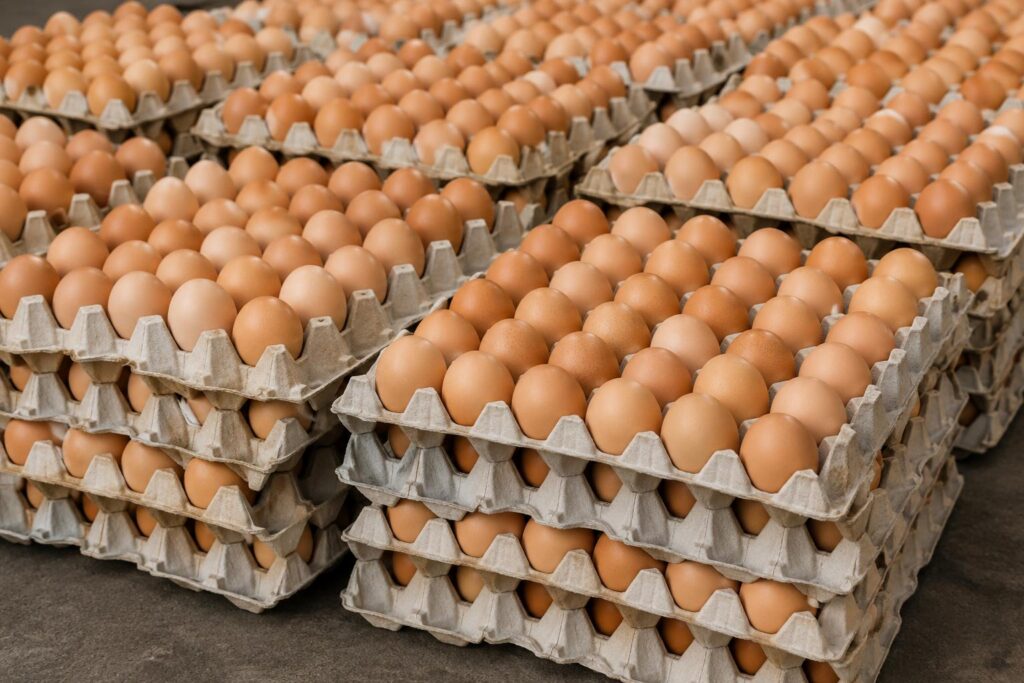
In a move that has sent shockwaves through Niger’s poultry sector, the government has imposed a strict price ceiling on eggs, capping the retail price of a single hen egg at 100 F CFA. The policy, announced by the Ministry of Commerce and the Ministry of Livestock, sets the wholesale price at 2,600 F CFA per crate and 2,750 F CFA for retailers. While framed as a way to ease the financial burden on households, this intervention threatens to suffocate the very industry it claims to protect.
The illusion of price control versus rising production costs
The government’s decision to freeze egg prices ignores the brutal reality facing poultry farmers. The cost of feed—the lifeblood of poultry farming—has skyrocketed in recent months, driven by inflation, rising fuel prices, and supply chain disruptions. Critical feed ingredients like maize, soybean cake, cottonseed meal, and mineral supplements have become prohibitively expensive, squeezing profit margins to the breaking point.
By setting an arbitrary retail price without addressing the soaring cost of feed, the authorities have effectively pushed producers into an impossible situation. Farmers now face a stark choice: sell at a loss, halt production, or abandon the sector entirely. The policy’s flawed logic assumes that controlling the price of a finished product can be done in isolation from the costs of its production.
A direct assault on economic freedom
Niger’s economy thrives on private initiative, where entrepreneurs take calculated risks to create jobs and drive growth. The egg price cap, however, undermines this foundation by stripping producers of their right to set prices based on their actual costs. When the state dictates pricing without considering the financial realities of businesses, it doesn’t regulate—it stifles.
Why would any investor risk millions of F CFA to build poultry farms, secure bank loans, or hire local workers if the government reserves the right to cap their revenue at an unsustainable level? This policy sends a chilling message: economic freedom in Niger is conditional, subject to the whims of administrative decrees rather than market forces.
Unintended consequences: shortages and black markets
History shows that artificial price controls rarely achieve their intended goals. Instead, they often trigger unintended and harmful side effects. Niger’s poultry sector is no exception. Within weeks, the following risks could materialize:
- Collapse of small-scale producers: Unlike large industrial farms, small poultry farmers lack the financial resilience to absorb losses. Many will be forced to shut down, leading to mass layoffs and economic hardship in rural communities.
- Reduced supply: Facing unsustainable margins, farmers will likely downsize their flocks, leading to a drop in egg production and further tightening the market.
- Rise of black markets: As official supplies dwindle, eggs will disappear from store shelves. Desperate consumers will turn to unregulated markets, where prices could exceed the capped 100 F CFA—effectively punishing the very people the policy aims to help.
Smart regulation: supporting production, not capping prices
The goal of making eggs affordable for all Nigeriens is commendable, but price controls are not the solution. To truly stabilize the market, the government must address the root causes of the crisis. This means:
- Subsidizing feed production: Providing financial support to reduce the cost of essential feed ingredients.
- Tax exemptions on poultry inputs: Removing taxes and duties on feed and related supplies to lower production costs.
- Easier access to credit: Offering low-interest loans or grants to help farmers expand or sustain their operations.
Freezing egg prices without tackling the surging cost of feed is an economic contradiction. It places an unsustainable burden on producers while doing little to help consumers. Worse, it sends a dangerous signal to investors: that economic freedom in Niger is fragile, dependent on bureaucratic decisions rather than market-driven growth.
If Niger truly wants to secure its food sovereignty and protect its poultry sector, the solution is clear. Liberate prices, support production, and let the market function freely. Anything less will only deepen the crisis.
You may also like
Bénin et Émirats arabes unis renforcent leur coopération militaire
Did Togo really spend two million dollars on a symbolic un map?
Did billions vanish from the vaults of the Special Criminal Court in Cameroon?
Why are Bénin’s amazones celebrating a historic handball triumph in Ouagadougou?
Niger’s official narrative masks deep fractures within the ruling junta