
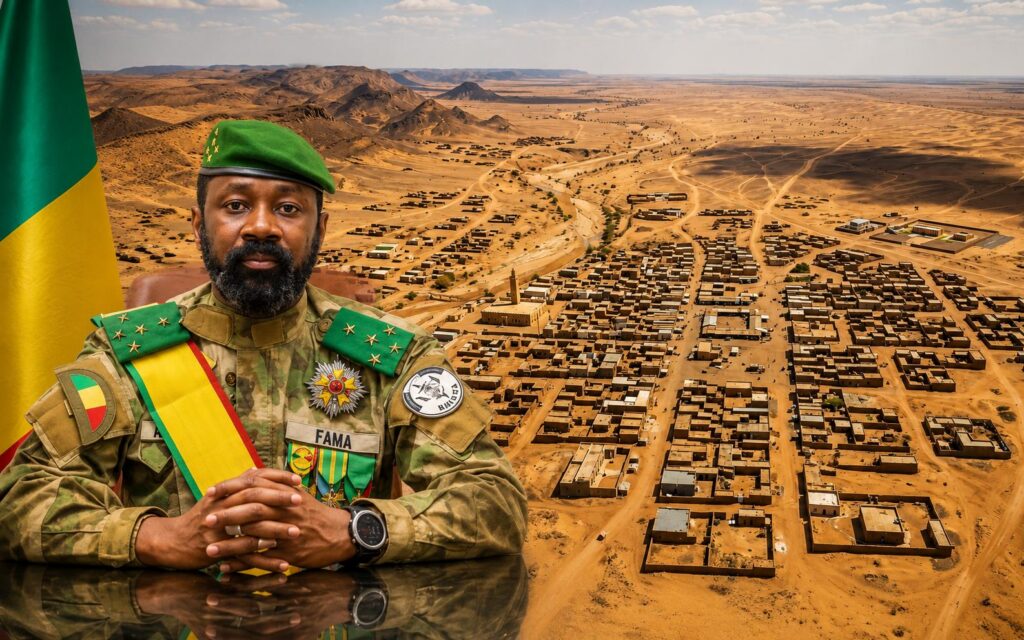
Intense clashes erupted yesterday near Tin Araban, close to Tabankort, pitting a large military convoy from the Malian Armed Forces (FAMa) and their Russian-backed Africa Corps allies against a coalition of armed rebel and terrorist groups. As northern Mali becomes a flashpoint of violence, the striking silence from transition authorities in Bamako raises serious questions about their efforts to conceal the worsening security crisis.
The Gao-Anéfis corridor has become the epicenter of an unprecedented confrontation. Reports indicate that a substantial military convoy—comprising around 60 vehicles including logistics trucks, armored units, and ground troops—departed from Gao earlier this week. Its mission: to reinforce and resupply the critical stronghold of Anéfis, a town in the Kidal region facing relentless pressure from armed groups opposed to Bamako’s authority.
The ambush unfolded in the desolate stretch of land around Tin Araban, roughly 100 kilometers south of Anéfis. The attackers, believed to belong to a temporary alliance of Tuareg independence fighters from the Azawad Liberation Front (FLA) and jihadist factions from the Group for the Support of Islam and Muslims (JNIM), executed a coordinated assault backed by heavy weaponry and drone strikes. Fighting raged for most of the day, leaving behind a trail of destruction and casualties.
Heavy losses suffered amid a shroud of secrecy
While an independent and definitive assessment remains impossible due to restricted access to the area, intercepted communications from insurgent sources point to significant losses. Several FAMa transport vehicles and light armored units operated by Russian instructors from Africa Corps (formerly Wagner) were reportedly destroyed or captured. Partial footage also suggests the loss of reconnaissance drones and dozens of casualties on both sides.
In the aftermath of this critical engagement, one undeniable truth emerges: no official statement has been issued by Malian authorities. Over 24 hours after the outbreak of hostilities near Tabankort, the Directorate of Information and Public Relations of the Armed Forces (DIRPA) and the transitional government in Bamako have maintained a deliberate silence.
This information blackout is not a matter of technical delay or tactical caution. It reflects a clear strategy to obscure the true state of security in the country from the people of Bamako. By refusing to acknowledge the severity of the setbacks or the intensity of the fighting in the North, the authorities in Bamako are clinging to a narrative of FAMa’s exclusive and flawless advancement—even if it means denying reality itself and betraying the trust of the nation.
Anéfis: the linchpin of Mali’s northern strategy
The stakes of this battle extend far beyond a single tactical setback. For Bamako, the ability to hold and protect the supply lines between Gao and Kidal is vital for its long-term presence in northern Mali. Should the convoy’s failure to reach Anéfis hold true, and reinforcements fail to arrive, the garrison stationed there risks being cut off, potentially allowing the northern coalition of armed groups to launch a major counteroffensive. A territorial reality that the political rhetoric of the capital will struggle ever more to conceal behind a veil of military secrecy.