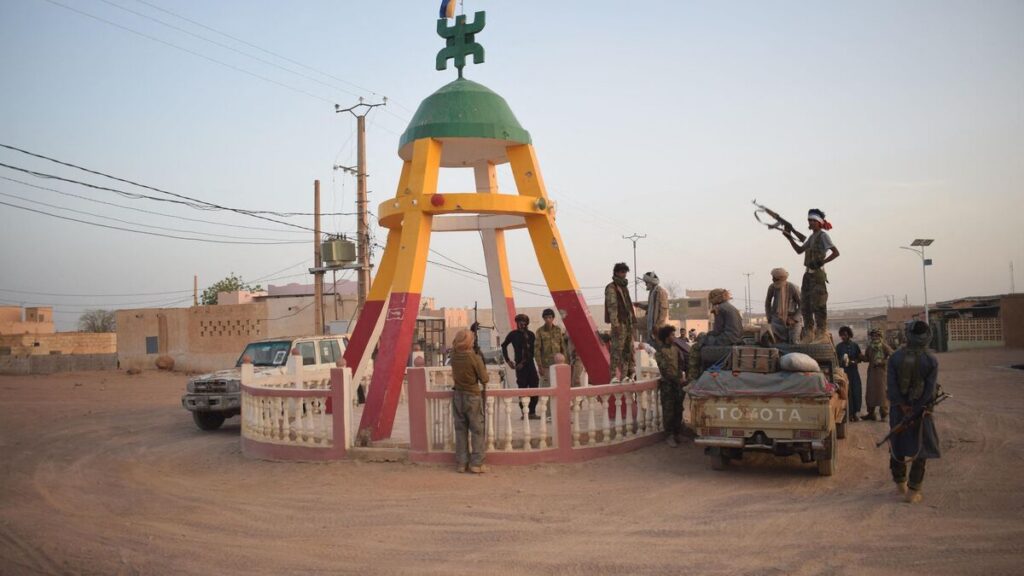
This past weekend marked a significant shift in the Sahel’s volatile landscape. Rebel forces, aligning with Tuareg separatists, launched coordinated attacks against strategic positions held by Mali’s ruling junta. Among the targets was the residence of Defense Minister Sadio Camara, who was killed in the assault. Meanwhile, in eastern Mali, fighters reclaimed the city of Kidal, a key stronghold the junta had controlled for years with the iron grip of the Africa Corps—a shadowy Russian paramilitary group.
After intense clashes and prolonged negotiations, Africa Corps withdrew from Kidal, though its influence across the region remains undiminished. As one of Russia’s most clandestine military branches abroad, Africa Corps now stands as Moscow’s primary instrument for projecting power in West Africa, particularly in nations grappling with instability and shifting alliances.
From Wagner’s ashes: the rise of Africa Corps
The Africa Corps emerged in late 2023, following the dramatic decline of the Wagner Group—a once-feared Russian mercenary force. Its existence was first hinted at by military blogger Deux Majors on Telegram, who cited remarks by Igor Korotchenko, a former Russian colonel and Kremlin-aligned journalist. Korotchenko revealed that Africa Corps operates under the direct supervision of Deputy Defense Minister Yunus-bek Yevkurov. Unlike Wagner, which operated with relative autonomy, Africa Corps is tightly controlled from Moscow, reflecting the Kremlin’s strategy to centralize its foreign military engagements.
Wagner’s decline was accelerated by the deaths of its founders, oligarch Yevgeny Prigojine and ex-intelligence officer Dmitri Utkin, in a suspicious plane crash in August 2023. Prigojine, once a close ally of President Vladimir Putin, had briefly rebelled against Moscow in a failed mutiny earlier that year. With Wagner’s influence waning, Africa Corps was positioned to absorb its assets, personnel, and operations across Africa.
A name steeped in history and controversy
The choice of name for this new force is deliberate, drawing inspiration from the Deutsches Afrikakorps, the Nazi military unit that fought in North Africa during World War II. While Africa Corps denies direct ties to historical fascism, critics argue the moniker underscores an attempt to evoke wartime nostalgia while disguising its modern geopolitical ambitions.
Mission: countering Western influence and securing Russia’s foothold
From its inception, Africa Corps has outlined a clear agenda: to conduct large-scale military operations across Africa, positioning Russia as a counterbalance to Western dominance. Igor Korotchenko, a key figure in its formation, described its mission as supporting governments seeking to break free from neocolonial dependencies, purge Western military presence, and reclaim full sovereignty. In practice, this means providing military training, arms, and advisory support to allied African regimes.
Where Wagner was often accused of brutal tactics—including war crimes and violent repression—Africa Corps presents itself as a more disciplined alternative. Its strategy hinges on forging long-term alliances with local governments, offering security assistance in exchange for political loyalty and access to critical resources. This approach has allowed it to expand rapidly across the Sahel, from Burkina Faso and Niger to Libya, Sudan, and the Central African Republic.
Africa Corps takes root in Mali
Mali remains the epicenter of Africa Corps’ operations in West Africa. Since 2024, the group has deployed hundreds—possibly thousands—of fighters to bolster the junta in Bamako against Tuareg rebels and Islamist insurgents. The move came as France and other Western powers withdrew from the region, leaving a security vacuum Moscow was quick to fill.
For Russia, Mali is more than a military outpost—it’s a strategic gateway. Controlling the country allows Moscow to influence regional migration routes, secure access to mineral wealth, and project power deep into the Sahara. Africa Corps’ presence also serves as a deterrent against further Western interference, reinforcing the junta’s grip on power while advancing Russia’s broader geopolitical interests.
Shadows of controversy and global condemnation
Despite its polished image, Africa Corps has not escaped international scrutiny. In 2024, the United Kingdom accused the group of “widespread human rights abuses across the continent” and “exploiting natural resources for private gain.” The allegations echo earlier criticisms of Wagner, suggesting that while Africa Corps may operate under a different banner, its methods and objectives remain deeply controversial.
As the Sahel grapples with insurgency, political instability, and shifting power dynamics, Africa Corps stands as a symbol of Russia’s growing footprint in Africa. Whether it can sustain its influence—and avoid the pitfalls that led to Wagner’s downfall—remains an open question. What is clear, however, is that Moscow is no longer relying on mercenaries alone. It is building a new kind of shadow army—one designed to endure.
You may also like
-
Cameroon’s ‘Pariahs of the Republic’ Haunt President Paul Biya’s Palace
-
Sahelian juntas face escalating internal and external pressures
-
Infantino félicite l’Argentine après la Coupe du monde
-
Chad’s escalating state repression: opposition leaders condemned
-
Burkina Faso: the digital militia and the erosion of press freedom