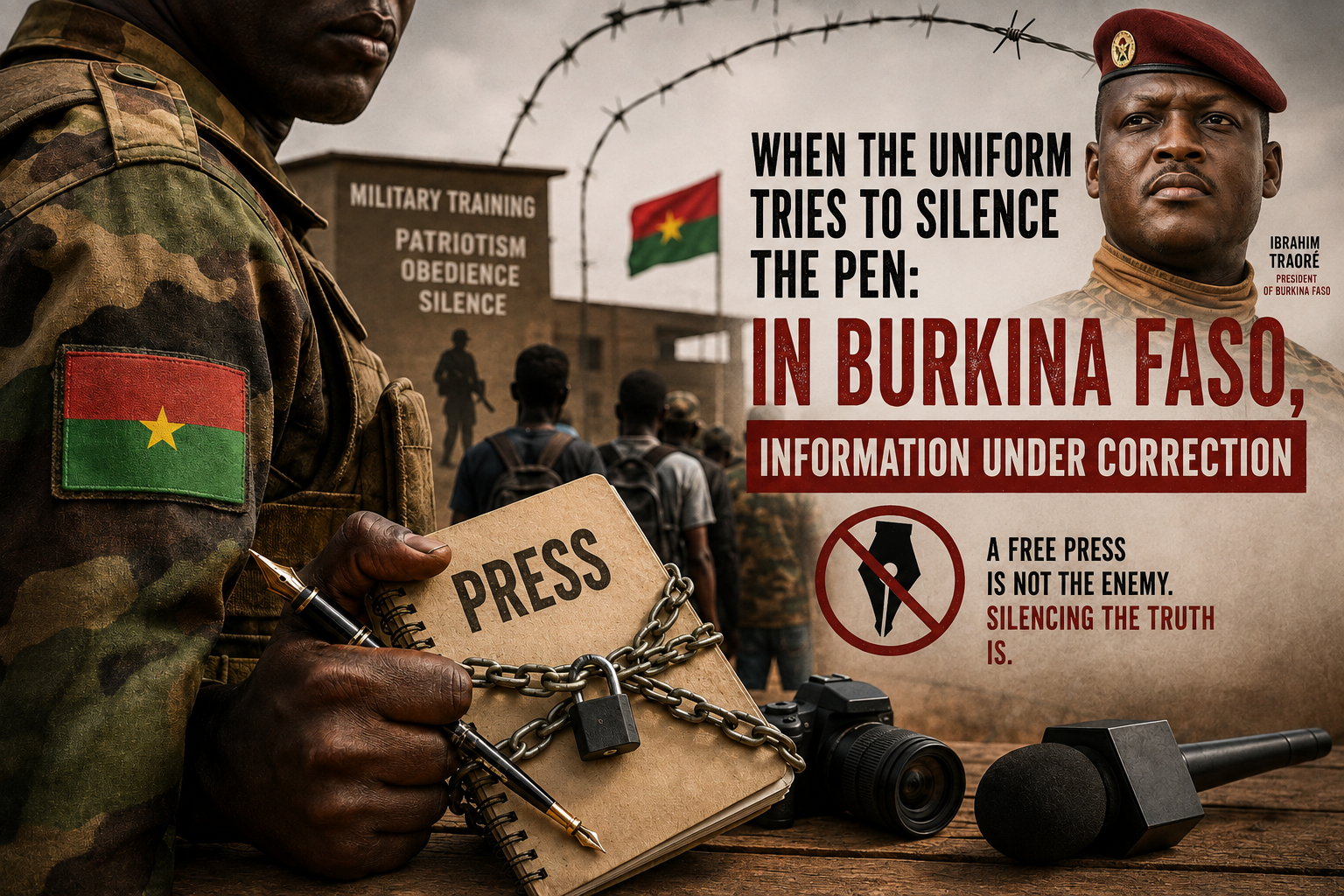
The sight of journalists undergoing military-style training near Ouagadougou should send chills down the spine of anyone who values fundamental freedoms. More than forty Burkinabè reporters have recently completed several days of what was officially billed as a ‘patriotism workshop.’ Beneath the polished veneer of civic education, however, lies a far more sinister agenda: an attempt to re-educate and subjugate independent journalism under the guise of national loyalty.
What remains of press freedom when a reporter is compelled through overt coercion or subtle pressure to attend a military camp to learn what may or may not be spoken about? In Burkina Faso, rigorous investigative reporting and the accurate portrayal of local realities now risk being classified as grave offenses. Exposing security failures, human rights abuses, or civilian hardships is increasingly met with accusations of ‘treason’ or ‘lack of patriotism.’ By dispatching journalists to undisclosed correctional facilities, the current regime does not seek to cultivate informed citizens; it aims to manufacture compliant mouthpieces for state propaganda.
From Patriotic Instruction to Thought Control
This systematic effort to enforce conformity signals a troubling evolution. The crisis Burkina Faso faces is no longer merely one of security governance; it is the emergence of an unchecked authority intent on imposing an absolutist model across all spheres of public life. By monopolizing public discourse and stifling the right to inform, the government positions itself as the sole arbiter of national truth.
Yet journalism that bows to official diktats ceases to be journalism at all. Silencing reporters or forcing them to adopt the intellectual uniform of a single permitted narrative never resolves a national crisis. On the contrary, when the press is gagged, it is the citizens who are deprived of reliable reference points leaving chaos, rumor, and arbitrary rule to fill the void.
Who Controls the Narrative in Times of Crisis?
The fundamental question is not whether the State has the right to communicate sensitive military information, but whether society retains the right to know the realities it confronts. The line between legitimate national security concerns and outright political censorship cannot and must not be erased in the name of expediency.
While a government facing terrorism may legitimately request that media respect operational secrecy or protect identities, these constraints should never be weaponized to convert journalists into extensions of state authority. National security is not synonymous with regime security.
True Patriotism and the Role of the Press
Patriotism, at its core, does not require unquestioning allegiance to those in power. A journalist deeply committed to Burkina Faso’s future has every right and duty to investigate the hardships faced by its people, document civilian displacement, interrogate authorities, and expose systemic failures that weaken the nation. In a democracy, the press is not tasked with safeguarding the government’s image; it is tasked with uncovering facts and presenting them to the public in accordance with professional ethics. The State may challenge a report, present contrary evidence, or pursue legal recourse but it should never predefine what the press is permitted to think.
The Paradox of Controlled Information
The danger of a domesticated media extends far beyond the fate of individual journalists. When official and private outlets refrain from publishing certain truths, the resulting vacuum is never truly empty. It is rapidly filled by unverified claims on social media, clandestine narratives, and rumor. Far from restoring confidence, attempts to control public discourse often erode it further. Trust is not decreed by fiat; it is built through transparency, contradiction, and the ability to verify official statements. A citizenry aware that events can be reported freely is far better equipped to distinguish reliable information from fabrication. Conversely, when truth becomes dangerous to tell, doubt infiltrates every corner of society.
The Inherent Contradiction of ‘Re-educating’ Journalists
At its heart, journalism is defined by the courage to ask uncomfortable questions. A reporter stripped of the ability to scrutinize public decisions, hold leaders accountable, or confront official narratives with lived realities ceases to function as a check on power. In a nation grappling with armed violence, mass displacement, and economic strain, the need for independent journalism becomes even more acute. Crises demand reporters who can verify facts, amplify victims’ voices, contextualize events, and assess decisions made in the public’s name.
Embedding military logic into journalistic practice raises another critical concern: Can those tasked with observing power be expected to operate under the same principles as those wielding it? The military operates on command, discipline, and confidentiality. Journalism thrives on verification, contradiction, editorial independence, and accountability to the public. Merging these roles risks blurring the boundary between military obedience and professional freedom a mix that could prove dangerously destabilizing.
A Slippery Slope of Ideological Scrutiny
Today, it is journalists who are pressured to prove their patriotism. Tomorrow, which other professions might face the same ideological litmus test? Academics, judges, artists, civil society leaders, researchers, or human rights defenders could they all be deemed ‘insufficiently patriotic’ for criticizing government actions?
A resilient democracy is measured not by its ability to silence dissent but by its capacity to withstand contradiction without branding every critique an act of hostility. Historical precedent shows that regimes attempting to monopolize information rarely succeed in controlling reality. They may dominate official channels, impose sanctioned narratives, and intimidate professionals but they cannot eradicate facts. The truth finds paths through testimonies, social media, diaspora networks, and international outlets.
The Path Forward: Trust Through Transparency
The real challenge is not how to enforce a single narrative, but how to cultivate conditions in which reliable information can flourish. In a country at war with armed groups, journalists bear immense responsibility. Equally critical is the responsibility of those in power: to protect citizens without transforming territorial defense into a perpetual justification for curtailing liberties.
Patriotism should never serve as a license for censorship. Nor should it be used to divide citizens into ‘loyal’ and ‘disloyal’ camps based on their willingness to question authority. A journalist who exposes a state weakness does not betray the nation; they may, in fact, help prevent that weakness from spiraling into catastrophe.
This issue now transcends the journalists directly affected by the training program. It speaks to the kind of society Burkina Faso aspires to build: one in which information must first receive state approval, or one in which the State accepts that truth even when uncomfortable has a place in public discourse. If patriotism today means averting one’s gaze from reality to avoid displeasing those in power, then Burkina Faso’s democracy is marching in lockstep toward authoritarianism. But if patriotism means defending the country with integrity, then journalists must retain the right to face reality head-on even when it unsettles those who govern.