
The recurring diplomatic tensions between Morocco and Spain often focus on migration flows, territorial disputes, or security cooperation. Yet beneath these visible conflicts lies a less discussed but critical vulnerability: Rabat’s heavy reliance on Madrid’s energy infrastructure.
For years, Morocco has depended almost entirely on Spanish-controlled networks to meet its energy needs. This dependency has only grown more pronounced in recent years, as geopolitical shifts have redrawn the map of regional gas and electricity flows.
Gas pipelines: a strategic pivot
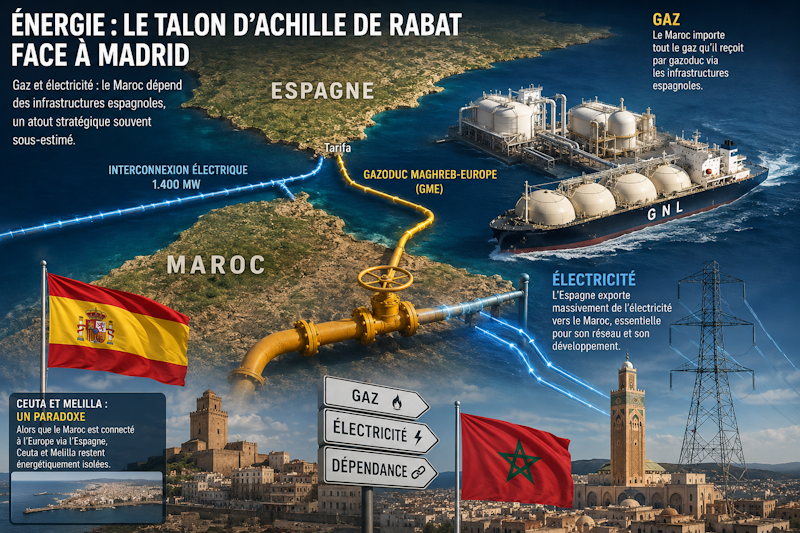
Morocco’s gas supply is now almost exclusively funneled through Spanish pipelines. Until 2021, the kingdom received Algerian gas via the Maghreb-Europe Gas Pipeline (GME), which traversed Moroccan territory. But after Algeria severed diplomatic ties with Rabat and halted GME operations, the direction of gas flows reversed.
Today, Spain exports gas to Morocco through the same infrastructure. In 2025 alone, 10.3 terawatt-hours of gas—worth around 400 million euros—were transported from Spain to Morocco via the GME. This represented nearly a quarter of Spain’s total gas exports that year, underscoring how deeply Rabat now depends on Madrid’s energy network.
The shift highlights a paradox: while Morocco challenges Spain’s sovereignty over territories like Ceuta and Melilla, its energy security remains inextricably linked to Spanish-controlled systems.
Electrical interconnections: powering Morocco’s growth
The energy interdependence extends beyond gas. Two undersea cables link Morocco’s electricity grid to Spain’s, with a combined capacity of 1,400 megawatts. In 2025, Spain exported a record 3,743 gigawatt-hours of electricity to Morocco—a 47.5% increase from the previous year and the highest level since 2017.
The vast majority of these flows—nearly three-quarters—travel from Spain to Morocco. This not only meets rising domestic demand but also supports Morocco’s expanding industrial sector and renewable energy projects. Plans are already underway to add a third undersea cable, further cementing this electrical interdependence.
Rabat’s push for energy autonomy
Morocco is acutely aware of its vulnerability. To reduce dependence on Spain, Rabat is advancing several major projects:
- The Nador West Med LNG terminal, which will allow Morocco to import liquefied natural gas directly by sea and integrate it into the GME network.
- The Nigeria-Morocco Gas Pipeline, a monumental project designed to connect West African gas reserves to European markets via Morocco.
These initiatives promise long-term energy diversification. But they require significant investment and time—years, not months—to become fully operational. Until then, Spain remains Morocco’s primary energy gateway.
Ceuta and Melilla: energy contrasts
The energy relationship between Morocco and Spain is full of contradictions. While Morocco benefits from direct electrical and gas connections to Europe via Spain, two Spanish cities—Ceuta and Melilla—have historically operated as energy islands.
This disparity is finally changing for Ceuta. In 2026, a new undersea cable will connect the city to Spain’s mainland grid, ending decades of isolation. The project, costing approximately 300 million euros, will enhance Ceuta’s energy security.
Melilla, however, remains cut off due to geographic constraints. The contrast is striking: Morocco is plugged into Europe’s energy system through Spain, while part of Spain itself still relies on autonomous power networks.
Energy as a geopolitical lever
These infrastructures are no longer just economic assets—they are becoming geopolitical tools. While neither country may be eager to weaponize them, their disruption would carry severe economic, diplomatic, and legal consequences.
This interdependence reshapes the balance of power between Rabat and Madrid. Morocco holds strong cards in migration control, counterterrorism, and territorial negotiations. But on the energy front, Spain holds a subtle yet powerful advantage.
For now, Morocco is working to reduce its exposure. But until alternative routes become fully operational, Spain remains the indispensable partner in Rabat’s energy future—making this dependency one of the most overlooked factors in their complex relationship.
You may also like
Nourane Foster’s PCRN resignation: what it means for Cameroon’s voters and 2027 race
Senegal’s electoral reform debate: what the fallout from Khalidou dit Mbaye Sokoma’s plan means for the country’s next steps
Senegal: how Sonko’s playful jab at Sadio Mané over 2029 is reshaping the political conversation
Senegal’s shadow funds: How unchecked spending drains public trust and budgets
Bénin: le Sénat tient sa séance inaugurale sous la conduite de Patrice Talon