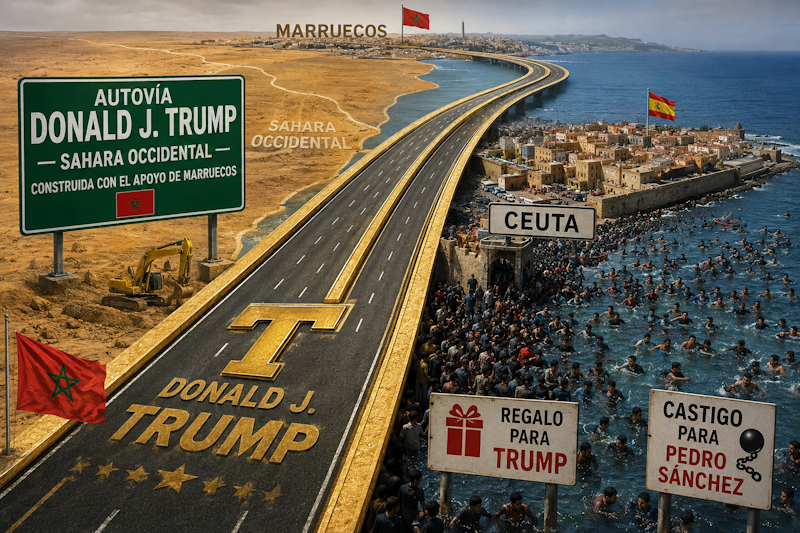
Rabat is deploying a dual strategy to secure decisive backing from Washington on the Western Sahara dispute, combining symbolic gestures with strategic pressure points. The newly renamed Donald J. Trump Highway, spanning 1,055 kilometers from Tiznit to Dakhla, underscores Morocco’s gratitude for U.S. recognition of its sovereignty over Western Sahara in 2020—while a migrant surge at Ceuta serves as a stark reminder of Rabat’s leverage over Europe.
The summer of 2026 has witnessed an unprecedented diplomatic chess match between Morocco, the United States, and Spain. With Donald Trump back in the White House, Moroccan officials are doubling down on efforts to lock in American support for a territory it has claimed since Spain’s 1975 withdrawal.
Symbolic homage meets geopolitical strategy
Morocco’s monarch, Mohammed VI, made headlines by renaming the Tiznit-Dakhla highway after the U.S. president. In a public letter disseminated by the state-run MAP agency, the king framed the gesture as a tribute to Trump’s historic 2020 decision recognizing Moroccan sovereignty over Western Sahara.
Spanning from southern Morocco to the Atlantic coastal city of Dakhla—passing through Laâyoune, a key hub in Western Sahara—the highway is hailed as Africa’s longest road infrastructure. The monarch emphasized its role in “uniting Morocco’s northern and southern regions while linking Europe to the African continent.”
Trump swiftly responded on Truth Social, calling the honor “tremendous” and expressing eagerness to drive the entire route “soon.”
Ceuta’s migrant crisis: a calculated pressure tactic
Yet it is not the highway that cuts through Ceuta—but rather a deliberate shift in migration flows. In late July, nearly 60,000 migrants surged into the Spanish enclave within hours, triggering a humanitarian and diplomatic emergency.
At least 57 lives were lost in the attempt, according to Spanish authorities, with Morocco acknowledging 11 fatalities among its nationals. By allowing border guards to stand down, Rabat signaled its willingness to weaponize migration—a pattern familiar to Madrid.
Ceuta, one of only two land borders between the European Union and Africa, remains a flashpoint in Moroccan-Spanish relations. Rabat has long contested Spain’s claim to the territory, labeling it an “occupied zone.”
A crisis with precedent
This is not the first time Morocco has turned migration into leverage. In May 2021, a similar influx of 8,000 migrants forced Spain to reconsider its stance on Western Sahara. Madrid abandoned its long-held neutrality after hosting Brahim Ghali, leader of the Polisario Front, for medical treatment.
“Morocco expected Spain to endorse its autonomy plan for Western Sahara, but now seeks full recognition of its sovereignty,” notes Carlos Ruiz Miguel, director of the Western Sahara Studies Center at the University of Santiago de Compostela.
The timing is no coincidence: the crisis erupted just days after Spanish Prime Minister Pedro Sánchez visited Algiers, a move perceived in Rabat as a tilt toward Morocco’s regional rival.
Diplomatic chess: three moves in play
Analysts dissect Rabat’s strategy as a multi-pronged offensive:
- Symbolic diplomacy: The Trump Highway serves as a tangible thank-you to Washington, reinforcing U.S. backing for Morocco’s territorial claims.
- Migration as a weapon: By opening the floodgates to Ceuta, Morocco reminds Spain of its vulnerability along Europe’s southern frontier.
- U.S. alignment: With UN-led negotiations stalled, Rabat seeks Washington’s decisive intervention to break the impasse.
Washington’s unwavering stance
The Trump administration has left no doubt about its position. U.S. Secretary of State Marco Rubio restated America’s recognition of Moroccan sovereignty over Western Sahara, while Trump himself endorsed Morocco’s autonomy proposal as the “only viable path to a lasting solution.”
American officials also criticized Spain’s migration policies, warning Madrid that its approach could “jeopardize its own stability.”
Brussels’ growing unease
The Ceuta crisis has sent shockwaves across the European Union. Italy temporarily suspended Schengen agreements with Spain, joined by Finland and Denmark. Belgian MR party leader Georges-Louis Bouchez even called for Spain’s partial suspension from the Schengen Zone.
“Morocco has repeatedly demonstrated its willingness to use migration as a tool of coercion against Spain, leveraging its control over two North African enclaves,” says Paul Melly, analyst at Chatham House.
What comes next?
While the Trump Highway does not pass through Ceuta, its message is unmistakable: Rabat holds the keys to Europe’s southern border. By intertwining symbolic diplomacy with calculated pressure, Morocco is weaving a high-stakes narrative where every thread strengthens its hand in Western Sahara. A lesson European negotiators are now taking to heart.
You may also like
Niger fallout: General Tiani’s coup regret and the fear that now grips the palace
Mali’s media fallout: Maliweb.net and the fight for truthful reporting
Cotonou’s savings push: what the fallout means for West Africa’s financial future
Benin–Spain cultural alliance: what the reaction tells us about what comes next
Niger: Tiani’s widening purge sparks debate over citizenship and loyalty