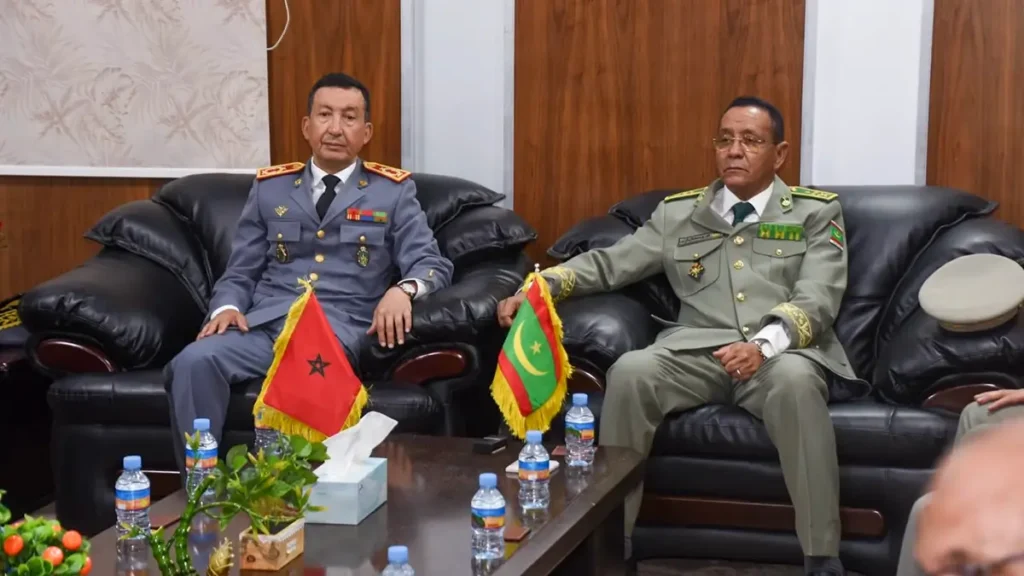
The deepening of defense and security ties between Morocco and Mauritania is a direct response to the deteriorating regional situation, characterized by rising threats in the Sahel and the growth of illicit trafficking networks. This strategic partnership prioritizes the protection of the extensive desert borders shared by the two nations.
During a high-level visit to Nouakchott, Lieutenant General Mohammed Berrid emphasized the evolution of bilateral military relations. The cooperation has moved beyond simple technical coordination toward a structured operational framework designed to tackle shared security challenges effectively.
Advancements in the Morocco-Mauritania Joint Military Commission
The recent meeting served as the sixth session of the Morocco-Mauritania Joint Military Commission, co-chaired by Mohammed Berrid and General Mohamed Vall Ould Rayess. Both delegations highlighted tangible progress that reinforces this strategic alliance, focusing on improving joint operational responses to transborder threats.
On the institutional front, Mauritanian President Mohamed Ould Cheikh El Ghazouani formally received Mohammed Berrid in Nouakchott. During the visit, the Mauritanian Minister of Defense, Hanana Ould Sidi, presented the National Order of Merit to the Moroccan general, a gesture reflecting the high political priority of this security agenda.
Strategic focus on border security and counter-terrorism
Military ties between these neighbors began in 1971, though they were formally structured in 2006 through a memorandum establishing the joint commission. Since then, the worsening security climate in the Sahara and Sahel has necessitated a more robust partnership. The current framework emphasizes several key areas:
- Border surveillance and control of irregular migration.
- Combating terrorism and organized crime.
- Monitoring smuggling routes used for drugs and weapons.
- Neutralizing the infiltration of armed groups.
Specialized sources note that the shared border regions are highly susceptible to criminal networks. Mauritania and Morocco are working to establish a practical stability mechanism to prevent conflict escalation and counter the influence of extremist actors in the Sahelian-Saharan zone.
Joint training and regional stability
A vital component of this cooperation involves military academy exchanges and joint field exercises. These initiatives focus on operational planning, demining techniques, and tactical training. Furthermore, participation in centers linked to the G5 Sahel allows both nations to utilize advanced simulation systems to prepare for multidimensional threats.
The current coordination follows a roadmap established during previous sessions, such as the Rabat meeting in 2024. The Nouakchott session solidified these objectives for 2025, ensuring a systematic approach to regional challenges.
Ultimately, the alliance between Morocco and Mauritania serves as a fundamental pillar for peace in the Maghreb and Sahel. By securing strategic corridors and strengthening border controls, both countries contribute to mitigating the volatility of the Sahara Occidental and surrounding areas, providing an essential mechanism for risk management in Africa.
You may also like
Can Napoli halt the Arsenal machine in their Champions League opener?
Arsenal vs Chelsea: Premier League derby time and TV channel
Juventus vs AC Milan preview: Serie A clash at the Allianz Stadium
Linz ASK – Celtic Glasgow, Ligue des champions, match en direct le 25/08/2026
security crisis in Burkina Faso: assessing the impact of jinim attacks and state response