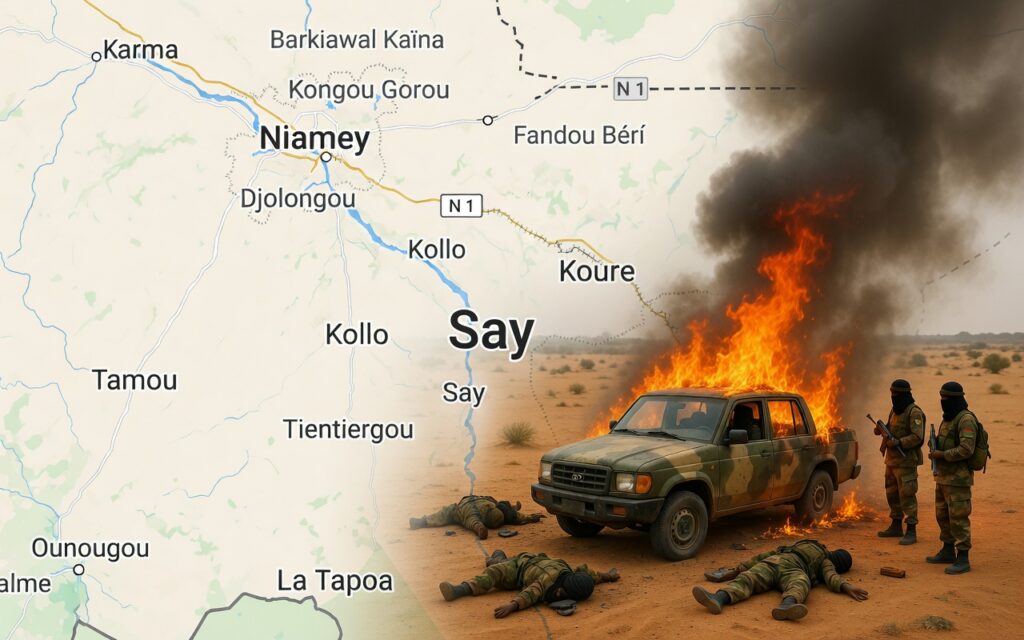
The Group for the Support of Islam and Muslims (JNIM), identified as the primary armed faction linked to Al-Qaeda in the Sahel, has issued a statement claiming responsibility for two coordinated attacks within the past day. These strikes resulted in at least three fatalities and inflicted material damage in the regions of Touré and Say.
escalating threats in the sahel’s volatile western frontier
The western expanse of Niger remains a hotspot of insecurity, with the JNIM intensifying its campaign against national defense forces. Through its established propaganda channels, the militant group detailed its latest operations, targeting strategic routes frequented by military convoys.
roadside bomb strikes near touré
The first incident involved an improvised explosive device (IED) detonated along the Touré road network. While the group did not disclose immediate casualty figures for this specific strike, it confirmed targeting a patrol convoy. The persistent use of homemade explosives has emerged as a critical challenge for Nigerien troops, severely restricting mobility on unpaved roads and remote tracks.
lethal ambush in the say district
Further south, in the Say district, the JNIM reported a deadly ambush that left three soldiers dead. This area, adjacent to the W National Park, has long been a flashpoint for armed incursions, as militants seek to entrench their influence in the forested borderlands shared with Burkina Faso and Benin.
understanding the jihadist strategy of attrition
The recent twin attacks underscore the JNIM’s well-honed tactics of disruption and exhaustion. By deploying a mix of roadside bombs and mobile ambushes, the insurgents aim to:
- Disrupt supply lines and communication routes between major urban hubs.
- Strain security forces through prolonged, low-intensity confrontations.
- Assert a symbolic hold over rural areas near Niger’s capital, Niamey.
government response and public safety measures
As of now, Niger’s Ministry of Defense has not released an official statement to verify or refute the militant group’s claims. However, authorities have accelerated security restructuring efforts since the transition to the National Council for the Safeguard of the Homeland (CNSP), notably bolstering troop presence along the right bank of the Niger River.
Travelers and local residents using these routes are urged to exercise extreme caution, as the persistent terror threat continues to destabilize the region. Regional stability remains at risk amid the evolving security landscape.

You may also like
Burkina Faso: shrinking civil service payroll exacts a heavy toll on households and local economies
Simporé’s TV admission: Burkina Faso reacts as the security narrative crumbles
Gabon’s ghost payroll purge: public reaction, union pushback and what happens next
After Burkina Faso’s imam crackdown: the fallout, the anger, and the road ahead
Benin’s disability card rollout: reactions, scrutiny and what happens next