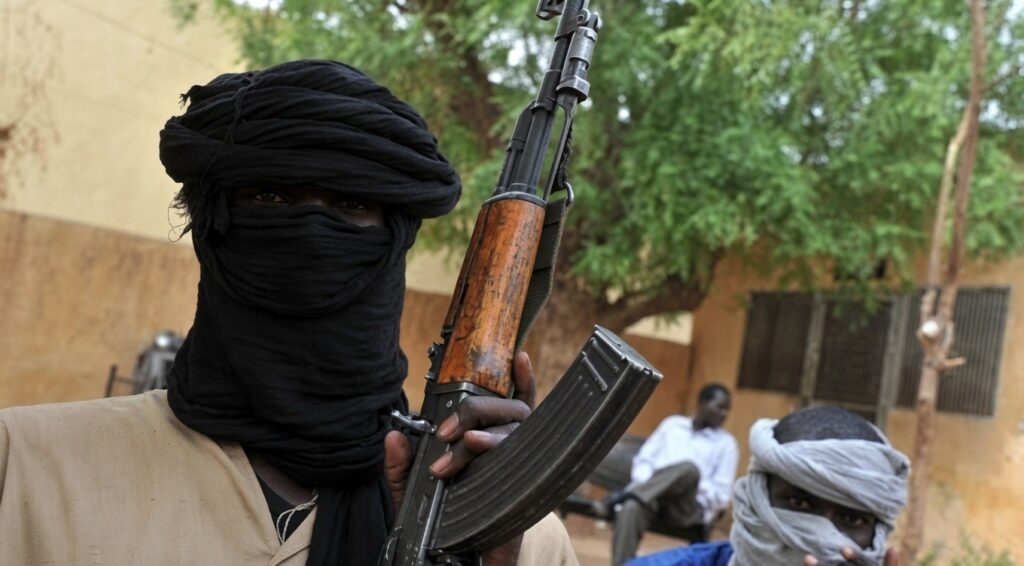
The attack on a Russian Africa Corps convoy north of Niono on 28 September 2026 did more than damage a paramilitary unit. It rattled markets, disrupted transport routes and deepened uncertainty for thousands of civilians already living between armed groups and shrinking state authority.
How the ambush unfolded — and who was hit
A column of Russian paramilitaries from Africa Corps, the structure that replaced Wagner in the Sahel, came under heavy fire late that Monday morning. The ambush occurred between Tiemaba and Wewo, north of Niono in the Ségou region.
Unlike the joint patrols that normally pair Africa Corps units with Malian armed forces (FAMA), this convoy was almost entirely composed of Russian fighters — a detail that made the attack both unusual and consequential.
Casualties and equipment losses
The JNIM, Al-Qaeda’s affiliate in the Sahel, quickly claimed responsibility. In its statement, the group said it had killed or wounded at least seven Russian personnel and seized a significant stock of military gear before withdrawing. Local sources in the area reported at least four Russian fighters killed.
Neither Mali’s general staff nor Africa Corps officials released an official toll for this specific incident. The Malian army did confirm a series of targeted airstrikes the following day near Dioura and other nearby areas, hitting what it described as identified terrorist positions.
Why Niono’s economy feels every ambush
Niono sits at the heart of a farming and trading belt that feeds much of central Mali. The area around Tiemaba and Wewo is not just a military flashpoint — it is a corridor for livestock, grain and goods moving between Ségou, the inner delta and markets further north.
When a convoy is attacked on these roads, the immediate human cost is only part of the story. Transporters reroute or suspend trips, traders lose access to supplies, and prices for basic goods climb. For families already squeezed by years of conflict, each new ambush translates into higher costs and fewer opportunities to earn a living.
The Katiba Macina factor in central Mali
Niono has long been identified as a zone of strong influence for Katiba Macina, a key component of the JNIM coalition. That presence shapes everything from local governance to the freedom of movement for civilians and security forces alike.
The fact that the JNIM could mount a complex ambush on a Russian-only convoy suggests the group retains detailed knowledge of routes and timings. It also raises questions about how exposed foreign paramilitary units are when they operate without local forces alongside them.
What this means for civilians caught in the middle
For residents of Niono and surrounding villages, the consequences are immediate and practical. Fear of reprisals or further clashes can push families to leave their farms. Schools and health centres, already fragile, may shut temporarily. And the informal networks that keep local commerce alive — from small traders to transport drivers — become harder to sustain.
The longer-term impact is equally serious. Repeated disruptions discourage investment, make it harder for aid groups to reach those in need, and push young people toward migration or, in some cases, armed groups. Each attack erodes the trust that communities place in whatever authority claims to protect them.
Questions the ambush leaves behind
This attack stands out because of the convoy’s composition. If Africa Corps is increasingly deploying without Malian army units, the risks to its personnel — and to the civilians living along those routes — may grow.
It also complicates the narrative that foreign paramilitaries have stabilized the region. For people in Niono, stability is measured less by military communiqués than by whether they can travel to market, send children to school and sleep without fear. On all three counts, the ambush delivered a setback.
The road ahead for central Mali
What happens next will depend on how Africa Corps and Malian forces adapt. More air strikes may follow, but they rarely address the underlying dynamics that allow groups like the JNIM to operate. For the communities along the Tiemaba–Wewo axis, the priority is simpler: safer roads, functioning markets and a sense that the violence will not keep escalating.
Until then, every convoy that moves through Niono carries not just soldiers, but the economic hopes of a region that has already endured too much.
You may also like
Mali’s poverty crisis: how hunger and hardship are reshaping daily life for millions
Guinea-Bissau’s December election: what Embaló’s return means for daily life, stability and the economy
The $20 million bounty on Robert Brovdi: what it means for Ukraine’s citizens, businesses and war economy
What the UN’s 10.5 billion FCFA in Gabon really means for households and small businesses in 2025
What Tinubu’s four-week Europe trip costs Nigeria as independence day looms