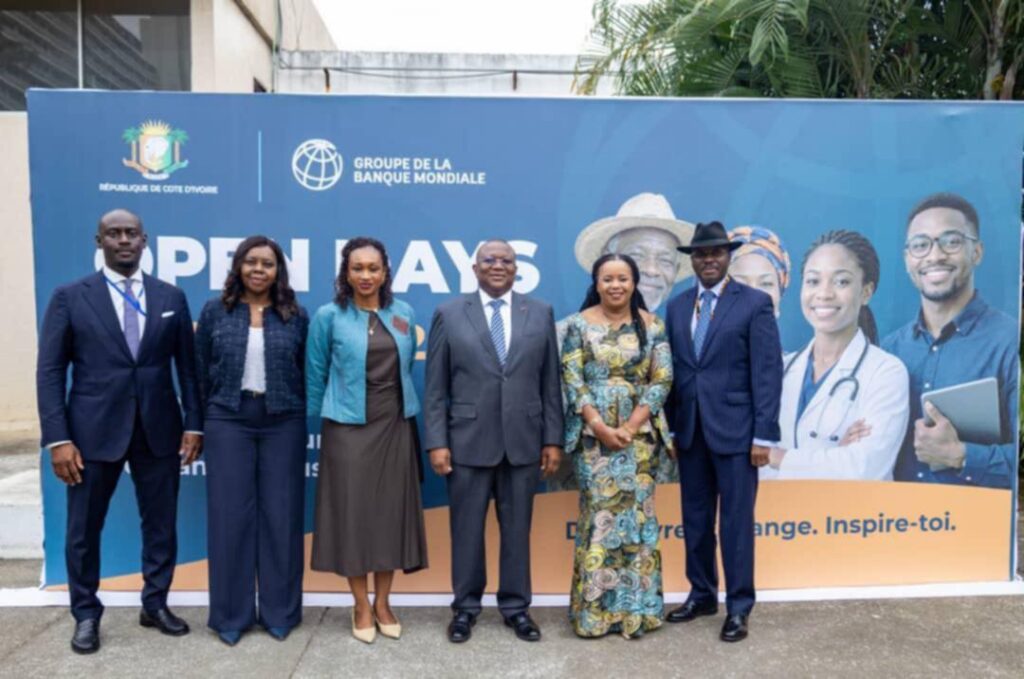
The World Bank Group’s active portfolio in Ivory Coast currently stands at 25 projects with a combined value of $5.3 billion. That figure was spotlighted on Monday, September 21, 2026, in Abidjan during the opening of the institution’s first-ever Open Days, a two-day event that has quickly become a focal point for public debate about the country’s development trajectory and what comes next.
Why the $5.3 billion figure is sparking conversation
Amadou Coulibaly, Minister of Communication and Government Spokesperson, delivered the opening address on behalf of Dr. Souleymane Diarrassouba, Minister of Planning and Development and World Bank Group Governor for Ivory Coast. The scale of the portfolio — 25 active projects spanning multiple sectors — has prompted questions about how effectively the funds are being deployed and what tangible outcomes citizens can expect in the months ahead.
A two-day forum puts employment front and center
The Open Days, held September 21–22 under the theme “Jobs and Opportunities: Building Together for Inclusive Growth,” brought together several government ministers alongside Marie-Chantal Uwanyiligira, the World Bank’s Division Director for Ivory Coast, Benin, Guinea, and Togo. Over the course of the event, students, recent graduates, and project leaders engaged directly with teams running World Bank–financed initiatives in education, employment, entrepreneurship, and infrastructure. Employment emerged as the dominant thread, with the National Development Plan 2026–2030 targeting three million new jobs, prioritizing young people and women.
Where the money is going across sectors
World Bank Group financing in Ivory Coast covers a broad spectrum: infrastructure, agriculture, energy, education, health, and human capital development. Over the past five years, the International Finance Corporation (IFC) has invested nearly $2.7 billion in the country. The Multilateral Investment Guarantee Agency (MIGA) is meanwhile working to bolster investor confidence, a key factor in sustaining the momentum.
Active portfolio vs. future commitments: understanding the distinction
The current portfolio is separate from the larger engagement announced for the coming years. At the Consultative Group meeting for financing the National Development Plan 2026–2030, held in Abidjan on July 8–9, 2026, the World Bank Group pledged more than $17 billion: $10 billion from the World Bank, $5 billion from the IFC, and $2 billion from MIGA. That announcement has fueled public debate about whether the country has the absorptive capacity to turn such sums into real jobs and infrastructure.
Pioneering financial operations that set a regional precedent
The partnership has also produced financial firsts in the region. In December 2024, Ivory Coast completed a debt-for-development swap with the World Bank Group’s support — the first of its kind backed by the institution. Covering nearly €400 million in commercial debt, the operation improves the country’s debt profile and frees up resources for education. In 2025, the country finalized West Africa’s first sustainability-linked sovereign loan, worth €433.3 million, backed by a dual guarantee from the International Bank for Reconstruction and Development (IBRD) and MIGA.
Reactions and the road ahead
The Open Days follow a series of high-level exchanges. On September 10, Dr. Souleymane Diarrassouba hosted Harold Tavares, Executive Director for Africa Group II on the World Bank Group’s Board, in Abidjan. Their discussions covered the Ivorian portfolio and preparations for the next Country Partnership Framework, which will align with the priorities of the National Development Plan 2026–2030. As the country moves toward that new framework, the debate is shifting from the size of the portfolio to the pace of delivery — and whether the promised jobs will materialize for the young Ivorians the plan is designed to serve.
You may also like
Nanga armored vehicles: mounting fallout, public backlash and where Burkina Faso goes from here
After the eyeglasses verdict in Cameroon, a reckoning for the press and its critics
Mali’s official narrative stirs debate as Goïta’s promises collide with daily struggles
Nanga armoured vehicles: Burkina Faso’s ‘made in Burkina’ claim sparks national debate as questions mount
Sévaré attack aftermath: Mali’s security debate and the road ahead