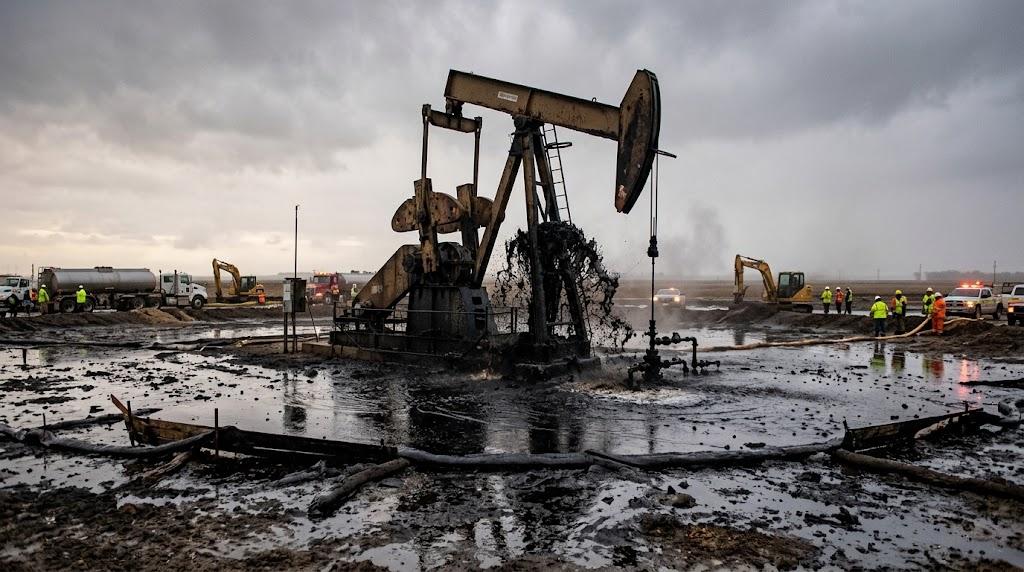
When a technical failure spirals into an environmental catastrophe, the real damage isn’t just in the visible destruction—it’s in the invisible poison spreading unseen across one of Earth’s most fragile landscapes. That’s the stark reality unfolding in the heart of Niger’s Agadem oil block, where since September 25, 2026, a once-routine drilling mishap has erupted into a full-blown ecological crisis at Well Goumeri W8.
Over 1,700 kilometers from the capital Niamey, the Sahara’s golden dunes are now stained with crude oil slicks stretching endlessly into the horizon, while a silent but deadly plume of toxic gas poisons the desert air. Yet the most alarming threat isn’t the oil—it’s what’s already been unleashed into the atmosphere: a catastrophic surge of methane, a greenhouse gas 80 times more potent than carbon dioxide over two decades. Is this the price Niger must pay for its oil ambitions?
Seventeen Days of State Silence and Corporate Silence
The clock began ticking the moment hydrocarbons and toxic vapors burst from the wellhead. But for sixteen full days, not a single word was spoken by either the Nigerian government or the Chinese state-owned energy giant CNPC—operator of the disaster-stricken site. No public statement. No emergency deployment. No acknowledgment of scale. Only growing whispers of a cover-up that would make the most cynical industrial players proud.
It wasn’t until October 12—nearly three weeks after the blowout—that the government finally acknowledged a “severe environmental incident.” Even then, the admission came with no details on origin, volume, or timeline. Meanwhile, thousands of tons of methane continued to escape into the sky each day, a toxic gift to the global climate fund. The delay wasn’t an oversight. It was a calculated silence.
The Methane Time Bomb Explosions in Air—Not in the News
Satellite data from the European Space Agency’s Sentinel-5P mission has peeled back the veil on what authorities wanted—and still want—to hide. The figures are staggering:
- Over 40 tons of methane per hour—a volume so large it transforms a local disaster into a regional climate threat.
- More than 17,000 tons released in just three weeks—enough to offset years of carbon reduction efforts across multiple African nations.
- The gas plume has not diminished since the blowout began. Contrary to official claims of “partial control,” the well continues to vent at full force.
Methane’s invisible fingerprints are now etched into the Sahara’s air. This isn’t just pollution—it’s a climate reckoning in real time, one that will echo through atmospheric data for decades.
From Profit to Peril: When Oil Drilling Trumps Safety
This crisis wasn’t born from thin air. It emerged from a deliberate gamble on extraction speed over environmental integrity. Driven by a national target to ramp up production to 90,000 barrels per day—feeding the pipeline destined for Benin—Niger’s authorities bet on haste. Safety audits became optional, maintenance became negligible, and risk assessments were sidelined.
The bill came due fast: two workers severely injured, multiple nearby wells compromised, and a desert ecosystem now absorbing the fallout. With no in-house expertise to stem the flow, the government was forced to call in emergency rescue teams from Algeria’s Sonatrach—an admission of failure that underscores the hollow rhetoric of “African energy independence.”
The Sahara is not an industrial wasteland. And the absence of immediate fatalities does not absolve those who allowed this silent disaster to unfold.
The Real Cost of “Cheap Oil”: Who Pays the Price?
Behind the curtain of broken promises and delayed responses lies a deeper truth: the global climate crisis doesn’t care about national borders or oil revenue projections. A ton of methane released in the Sahara warms the planet as surely as one emitted in Houston or Shanghai.
Yet while the Nigerien people and ecosystems suffer the consequences, the real winners are the distant shareholders of CNPC and the political elites who turned a blind eye. The real loser? The atmosphere itself—a shared global commons, polluted beyond repair for generations to come.
As the fire at Goumeri W8 continues to burn, the question isn’t just whether Niger can contain the blaze. It’s whether the world can afford to let it.